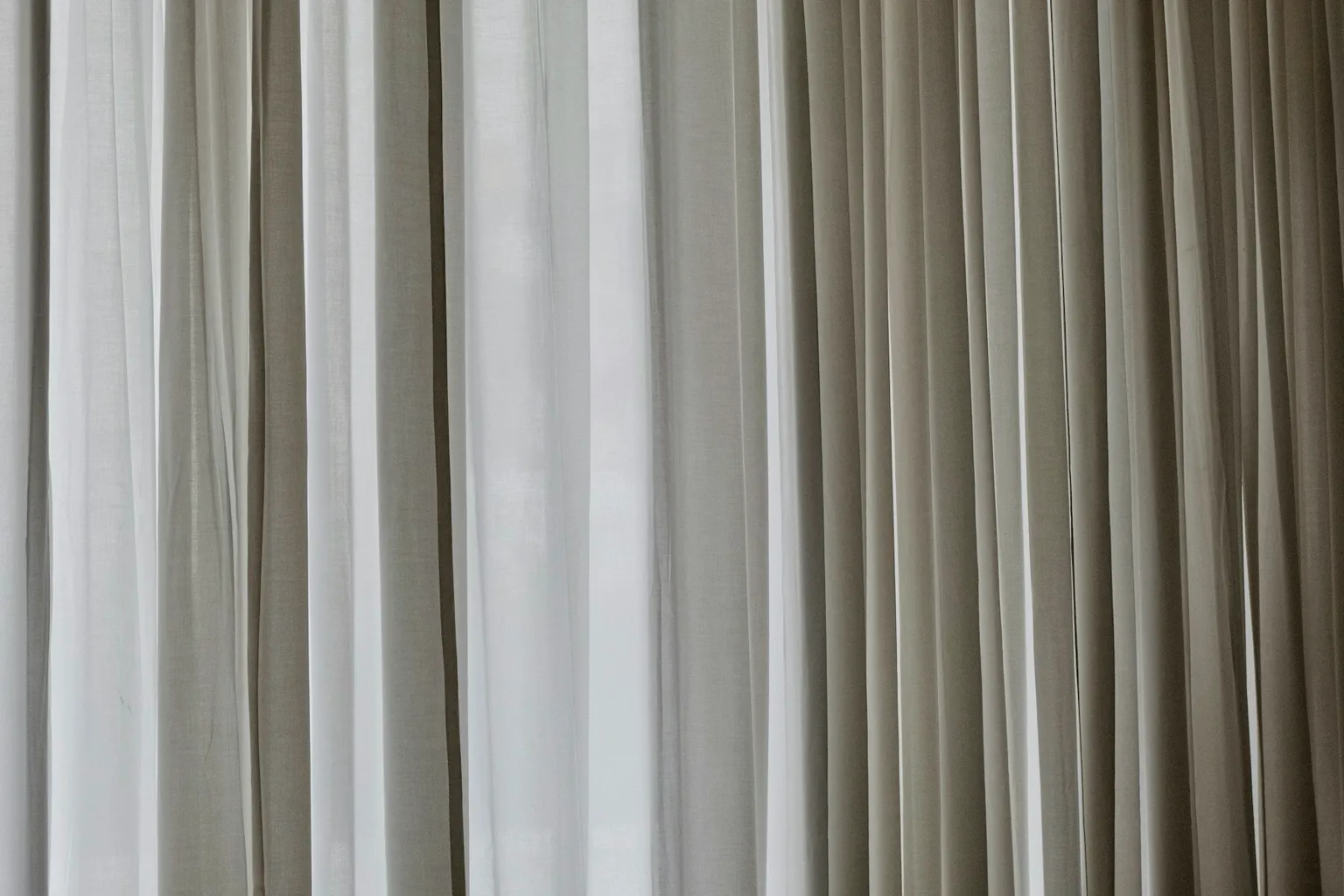
The main types of curtains are sorted four ways: by fabric (sheer, dim-out, blackout, linen, velvet and others), by heading (S-fold, pinch pleat, eyelet, pencil pleat, tab top), by layout (pairs, single panels, double layers, café and tie-back curtains) and by operation (hand-drawn or motorised). Every curtain you buy is one choice from each group. Below are 18 types, with where each suits a Singapore home.
The quotation for your new condo has arrived, and the curtain section reads like another language. “S-fold, dim-out, double track, ceiling mount.” The bedroom line says “pinch pleat, blackout lining” and the living room says “sheer plus night curtain.” Each phrase describes one decision about the curtain. Once you know what each term covers, the quote becomes a list of choices you can check one by one.
Types 1 to 7 are fabrics, which decide how much light comes through, how the curtain hangs and how it is cleaned. Types 8 to 12 are headings. Types 13 to 17 are layouts, and type 18 covers how the curtain is opened.
1. Sheer curtains
Sheers are thin, translucent fabrics. They let daylight in, soften glare and make it harder to see into the room from outside during the day. At night, with your lights on, people outside can see outlines through them, so they are usually paired with a heavier curtain. See day curtains and sheers.
2. Dim-out curtains
Dim-out fabric cuts a lot of light without making the room dark. The glare goes, and you can still move around without switching on lights. It suits living rooms, studies and dining areas. Our blackout vs dim-out guide explains where the line between the two sits.
3. Blackout curtains
Blackout curtains stop most light passing through the cloth. They are made either from a blackout fabric or from a face fabric with a blackout lining sewn behind it. They suit bedrooms, nurseries and media rooms. How dark the room gets also depends on the track and side coverage. See blackout curtains for how we measure and fit them.
4. Linen and linen-look curtains
Linen has a relaxed, natural texture and soft drape. It also creases, can shift in size with humidity and needs careful cleaning. Linen-look polyester gives a similar appearance with easier care. Our linen or polyester guide compares the two for Singapore homes.
5. Polyester and cotton curtains
Polyester is the workhorse fabric in most Singapore flats. It resists creasing, holds its colour reasonably well in strong sun and many versions can go into a washing machine on a gentle cycle. It is also the base for most dim-out and blackout fabrics. See polyester curtains for the weaves we use.
Cotton feels softer and looks more matte, which suits a relaxed bedroom or a kids’ room. It can shrink when washed and fades faster on a west-facing window, so it is usually lined or blended with polyester. Our cotton curtains page explains when a blend makes more sense.
6. Velvet curtains
Velvet is heavy and dense, with a soft pile that gives deep colour and a formal look. The weight helps it hang straight and block light well, and dense cloth like velvet is often suggested for rooms where some sound softening is wanted (see our acoustic curtains guide). The pile collects dust and can mark if crushed, so velvet usually needs professional cleaning rather than home washing.
7. Thermal curtains
Thermal curtains use a dense or coated backing that slows heat coming through the glass. In Singapore the aim is the opposite of a cold climate: keeping afternoon sun heat out of a west-facing bedroom or living room so the air-conditioner has less to fight. They help most on large windows that take direct sun, and they need to be closed during the hot part of the day to do anything. See thermal curtains, and our guide on whether blackout curtains keep heat out.
8. S-fold or ripple fold curtains
The heading is the way the top of the curtain is made and attached. It sets how the folds look and which track or rod you need. Our curtain headings guide covers each in detail.
S-fold curtains hang in even, continuous waves from a dedicated wave track. They look clean and modern and stack neatly when open. They are a common choice in new HDB flats and condos, especially with a ceiling-mounted track or curtain box. See ripple fold curtains.
9. Pinch pleat and double pleat curtains
Pinch pleat curtains have groups of fabric stitched into pleats at regular intervals, giving tailored, formal folds. Double pleat has two folds per group and triple pleat has three. These pleated curtains work on a standard glider track or on a rod with rings, and they sit flatter against the wall than S-fold.
10. Eyelet curtains
Eyelet curtains have metal rings punched through the top, and a rod passes straight through them. They are simple to put up and slide easily, which makes them common in ready-made curtains. They need a rod, cannot sit inside a curtain box and leave a gap above the fabric where light comes through. See our curtain rods vs tracks guide.
11. Pencil pleat curtains
Pencil pleat uses a gathered tape along the top, pulled into tight, narrow folds. It is a simple, older style found on many ready-made curtains. It hangs from plastic or metal tape hooks, explained in our guide to curtain hooks.
12. Tab top and rod pocket curtains
Tab top curtains have fabric loops sewn along the top that slip over a rod. Rod pocket curtains have a sewn channel that the rod passes through. Both give a casual look and both are stiff to draw, so they suit a window you leave in one position most of the day, such as a decorative panel beside a study window. They do not work on a track.
13. Double panel curtains
A double panel, or pair, is two curtains that meet in the middle and open to each side. It is the usual layout for a living room window or a balcony sliding door, because each half stacks on its own side and the glass stays clear in the centre. On a wide condo window, the overlap where the two panels meet is where light leaks, so ask for an overlap arm or extra width at the centre if the room needs to be dark.
14. Single panel curtains
A single panel draws one way and stacks on one side. It suits a window next to a wall, a wardrobe or a corner, where there is room to stack only on one side, and the small off-centre windows common in HDB household shelter bedrooms. A single panel has no centre gap, which helps with darkness, but it takes longer to draw across a wide window.
15. Day and night double-layer curtains
A single curtain does one job. If a room needs daylight and privacy by day, then darkness or full privacy at night, two layers on a double track are the usual answer.
The day curtain is a sheer, hung closer to the window. The night curtain, dim-out or blackout, sits in front. You leave the sheer drawn during the day and close the night curtain in the evening. This needs a double track and enough depth in the curtain box for both layers. Our day and night curtains guide explains the setup, and the curtain pelmet guide covers box depth.
16. Café and sill-length curtains
Café curtains cover only the lower half of a window, usually on a slim rod across the middle of the frame. They block the view in from a common corridor while daylight comes through the top. Sill-length curtains stop at the window ledge instead of the floor. Both suit kitchens and small windows above a counter or a desk, as long as the fabric stays well away from the hob. Our kitchen curtains guide covers fabric and placement.
17. Tie-back curtains
Tie-back curtains are held open by a fabric band, a cord or a metal holdback fixed to the wall at the side of the window. The curtain falls in a soft curve instead of hanging straight. It is a decorative choice for a formal living room or a bedroom with a more classic style. Holdbacks need a solid wall to screw into, which can be a limit beside full-height condo glass. Our guide to curtain accessories covers holdbacks and tie-backs.
18. Hand-drawn or motorised curtains
Most curtains are opened and closed by hand, either by pulling the leading edge or by using a wand clipped to the first glider so you do not handle the fabric. This is simple, has nothing to charge or repair and suits most windows. The track itself makes a difference to how smoothly heavy curtains slide, which our curtain track guide explains.
Motorised curtains run on a powered track, operated by a remote, a wall switch, an app or a schedule. They suit very wide or tall windows, heavy lined curtains, windows that are hard to reach and households that want curtains to close at set times. They need a power point near the track and cost more than a manual track. Our guide to smart curtains covers power, control options and when a motor makes sense.
Ready-made or made-to-measure
Ready-made curtains come in fixed widths and drops. They are quick to buy and suit standard windows where an exact fit is less important. Made-to-measure curtains are sewn to your window’s measurements, with the fabric, lining, heading and fullness chosen for the room. Our ready-made vs made-to-measure guide compares them, and the made-to-measure curtains page explains how ours are measured and fitted.
How to choose between curtain types
Start with the light. Decide how dark each room needs to be at night and how much glare it gets in the afternoon. That picks the fabric, or tells you that you need two layers.
Then look above the window. A curtain box or a false ceiling points to a track, and S-fold or pinch pleat. A solid wall with no box allows a rod, and eyelet or tab top. Full-height glass with no wall above it usually means a ceiling track.
Then think about cleaning. Rooms near the kitchen, rooms with children and flats near main roads collect dust and grease faster, so a fabric you can wash at home saves trips to a cleaner. Last, check the width. Our curtain calculator gives a starting fabric width for the fullness you want.
Types of curtains by room
| Room | Fabric | Heading | Layers | More detail |
|---|---|---|---|---|
| Living room | Sheer plus dim-out | S-fold or pinch pleat | Double track | Day and night curtains |
| Master bedroom | Blackout, fabric or lining | S-fold or pinch pleat on a ceiling track | Single, or sheer plus blackout | Blackout vs dim-out |
| Children’s room | Blackout | Any track heading, with a wand or motor | Single or double | Blackout curtains |
| Study | Dim-out | S-fold, pinch pleat or eyelet | Single | Blackout vs dim-out |
| Rented room | Ready-made sheer or dim-out | Eyelet or pencil pleat on a rod | Single | Ready-made vs made-to-measure |
| Kitchen, bathroom, service yard | Usually a blind instead | n/a | n/a | Curtains or blinds |
These are common pairings, not rules. A room that faces another block closely, or gets strong afternoon sun, may need a heavier fabric than the table suggests. If you are unsure, look at a sample against the window at the time of day the room gets its strongest light.
When blinds suit better than curtains
Kitchens, bathrooms and service yards get splashes, steam and cooking grease. Fabric curtains near a sink or stove get dirty quickly and are slow to dry. A blind made from a wipeable or moisture-tolerant material usually suits these spaces better, and it sits close to the glass, away from the counter.
Blinds also suit small windows above a desk or bed, where a full curtain would get in the way. See our roller blinds and Roman blinds pages, and our guide to curtains or blinds for a side-by-side comparison.
Types of curtains without rods
Most curtain types hang without a rod. Any heading made for a track, such as S-fold, pinch pleat or pencil pleat, hangs from gliders or carriers on a ceiling or wall track, which is the usual setup in Singapore flats with a curtain box or false ceiling. Eyelet, tab top and rod pocket curtains are the types that need a rod.
If you cannot drill, there are other ways to hang a light curtain: a tension rod inside a window recess, adhesive hooks or an adhesive rail, or a clamp that hooks onto the window frame. These suit sheers, café curtains and rentals rather than heavy lined curtains. Our guide to hanging curtains without drilling compares them, and our curtain track guide covers the track types.
Common questions
What are the main types of curtains?
By fabric, the main types are sheer, dim-out, blackout, linen or linen-look, and heavier cloths such as velvet. By heading, they are S-fold, pinch pleat, eyelet and pencil pleat. Many homes combine a sheer and a night curtain on a double track.
Which curtain style suits a modern HDB or condo?
S-fold on a ceiling track or inside a curtain box is a common choice because it gives even folds and a clean line at the ceiling. Pinch pleat suits rooms where you want a more tailored look.
Are pleated curtains still used?
Yes. Pinch pleat and double pleat curtains are still common, especially in bedrooms and in homes with a more classic style. They work on a standard track, so they are a flexible choice if you are not installing a wave track.
Which type of curtain is easiest to maintain in Singapore?
Unlined polyester sheers and polyester blends are usually the simplest, since many can be washed on a gentle cycle. Lined, linen and velvet curtains generally need more care. Always check the care instructions for the actual fabric.
Which type of curtain helps with afternoon heat?
A blackout or thermal curtain, closed while the sun is on the glass, slows the heat reaching the room. A sheer alone cuts glare but lets most of the heat through. On a west-facing window, a sheer plus a lined night curtain on a double track gives you both options.
Should a curtain be a pair or a single panel?
Use a pair when there is space to stack on both sides of the window, such as a living room or balcony door. Use a single panel when the window sits against a wall or wardrobe and can only open to one side.
What are the three types of curtains?
By light control, curtains are usually grouped into three types: sheer, dim-out and blackout. Sheers let daylight through and soften glare, dim-out cuts most light without darkening the room, and blackout stops almost all light through the cloth. Many Singapore homes pair a sheer with a dim-out or blackout curtain on a double track.
What are some popular curtain styles?
In new HDB flats and condos, S-fold curtains on a ceiling track or inside a curtain box are a common choice, often as a sheer plus a night curtain on a double track. Pinch pleat suits a more tailored or classic room, and eyelet curtains on a rod are common with ready-made curtains.
What type of curtain is best?
No single type is best for every room. For a bedroom, a blackout curtain on a ceiling track usually works well. For a living room, a sheer plus a dim-out curtain on a double track covers both day and night. For kitchens and bathrooms, a blind is often the better choice than any curtain.
Which type of curtains look expensive?
Full-height curtains hung from a ceiling track or curtain box usually look the most expensive, because they make the window look taller. Generous fullness, a lined fabric that hangs straight, and an even heading such as S-fold or pinch pleat add to the effect. A short curtain on a visible rod looks more casual.
What are the new curtain trends for 2026?
Clean, full-height curtains are the look most new Singapore flats are going for. S-fold on a ceiling track or in a curtain box is a common choice, usually with a sheer layered behind a dim-out or blackout curtain, and linen-look polyester gives a natural texture with easier care. Our curtain and blind styles guide covers current looks.
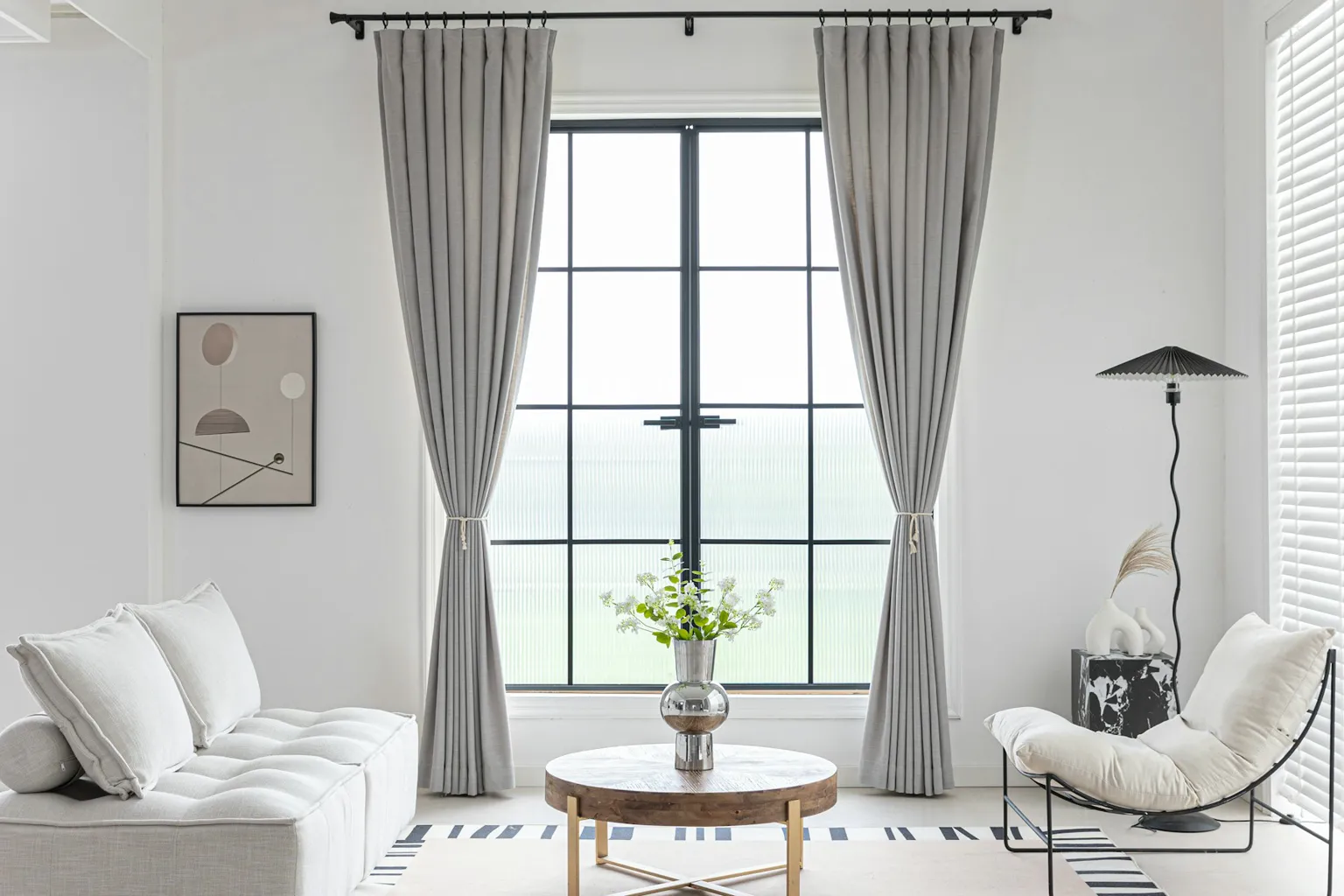 Window Curtains in Singapore: How to Choose for Each Room
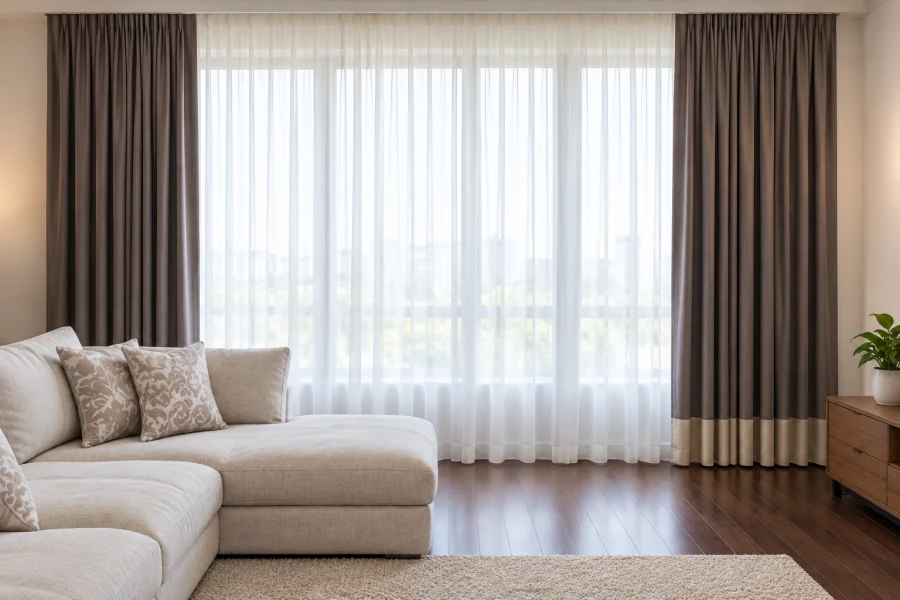 S-Fold vs Pleated Curtains in Singapore: Ripple Fold, Pinch Pleat or Eyelet?
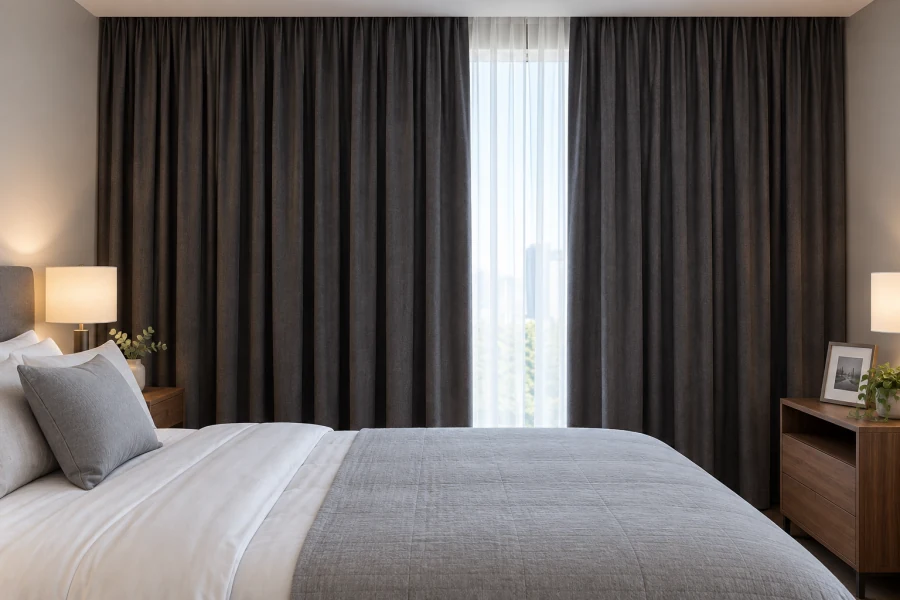 Blackout vs Dim-Out Curtains: Which Do You Need?