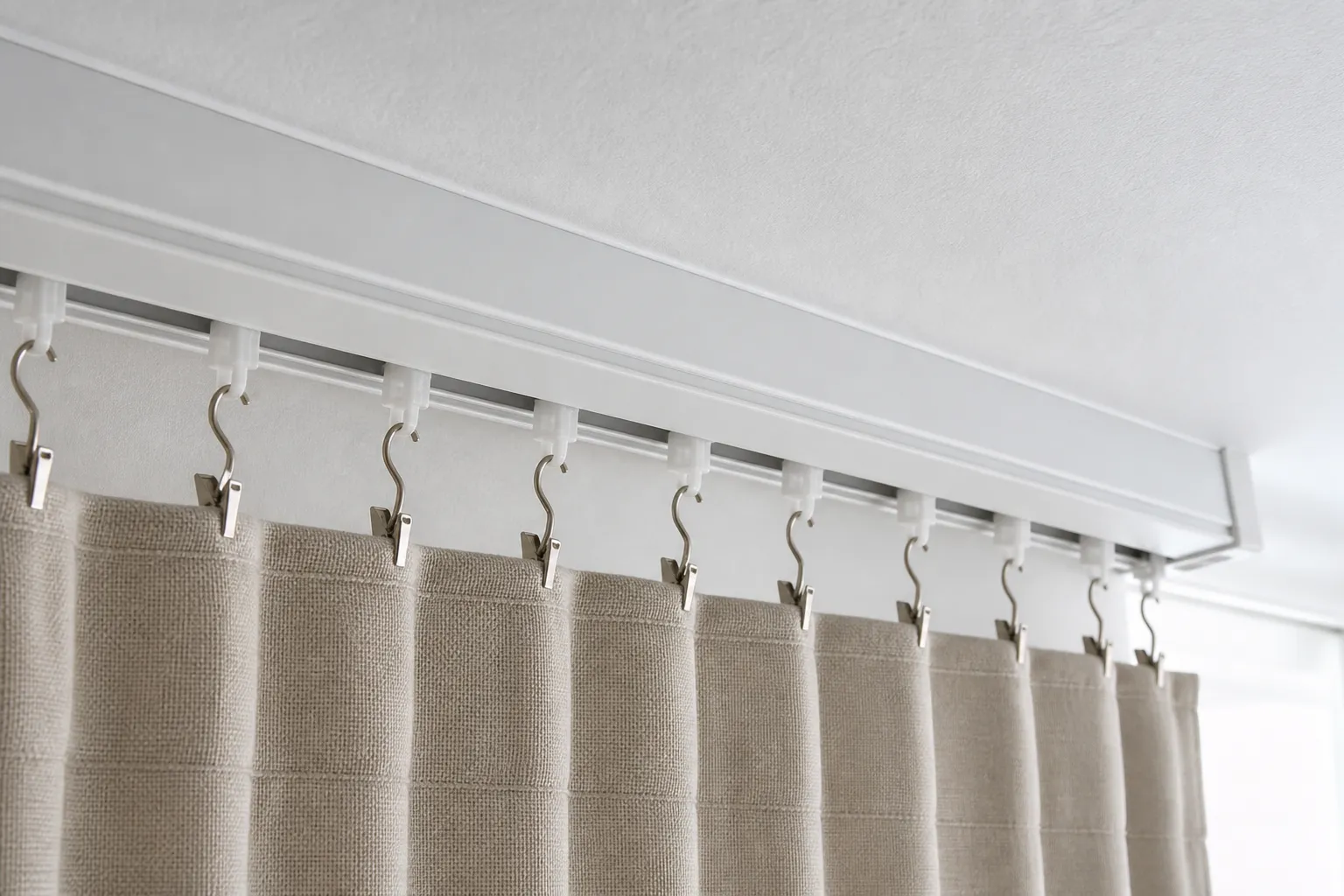
The main types of curtain track in Singapore homes are standard aluminium glider tracks, wave or S-fold tracks, double tracks, bendable tracks for bays and corners, and corded or motorised tracks, fixed to the ceiling, inside a curtain box or on the wall. Match the rail to the heading, the curtain’s weight and the window shape before you buy the cloth.
You picked a fabric you like, then the rail sagged or the heading jammed. In a Singapore HDB or condo, the curtain track decides how the cloth hangs.
Ceiling tracks are the default
Most flats get an aluminium rail fixed to the ceiling or inside a curtain box. The cloth drops full height.
A typical HDB slab sits around 2.6m from the finished floor. I have not measured yours. A false ceiling shortens the drop.
Ceiling mount lets the stack run past the frame so the glass is clear when you open it. HDB concrete takes a proper plug and screw. A standard internal curtain rail does not need an HDB renovation permit.
Household shelter bedrooms are the exception. SCDF and HDB allow drilling into the internal face to a depth of not more than 50mm, with non-metallic inserts and removable screws. Those fixtures have to come down within 48 hours if you are told to clear the shelter.
Wall tracks when the slab will not take the fix
Use wall brackets when the ceiling is a gypsum box with no packer, the handle needs clearance, or a shelter needs a removable wall return.
Watch ferrolite partition walls in newer HDB bedrooms. HDB notes say not to drill within 200mm of the ceiling or beam, and to keep depth around 22mm. Fix to the concrete slab or pack the pelmet.
Hand-draw, corded, or motor
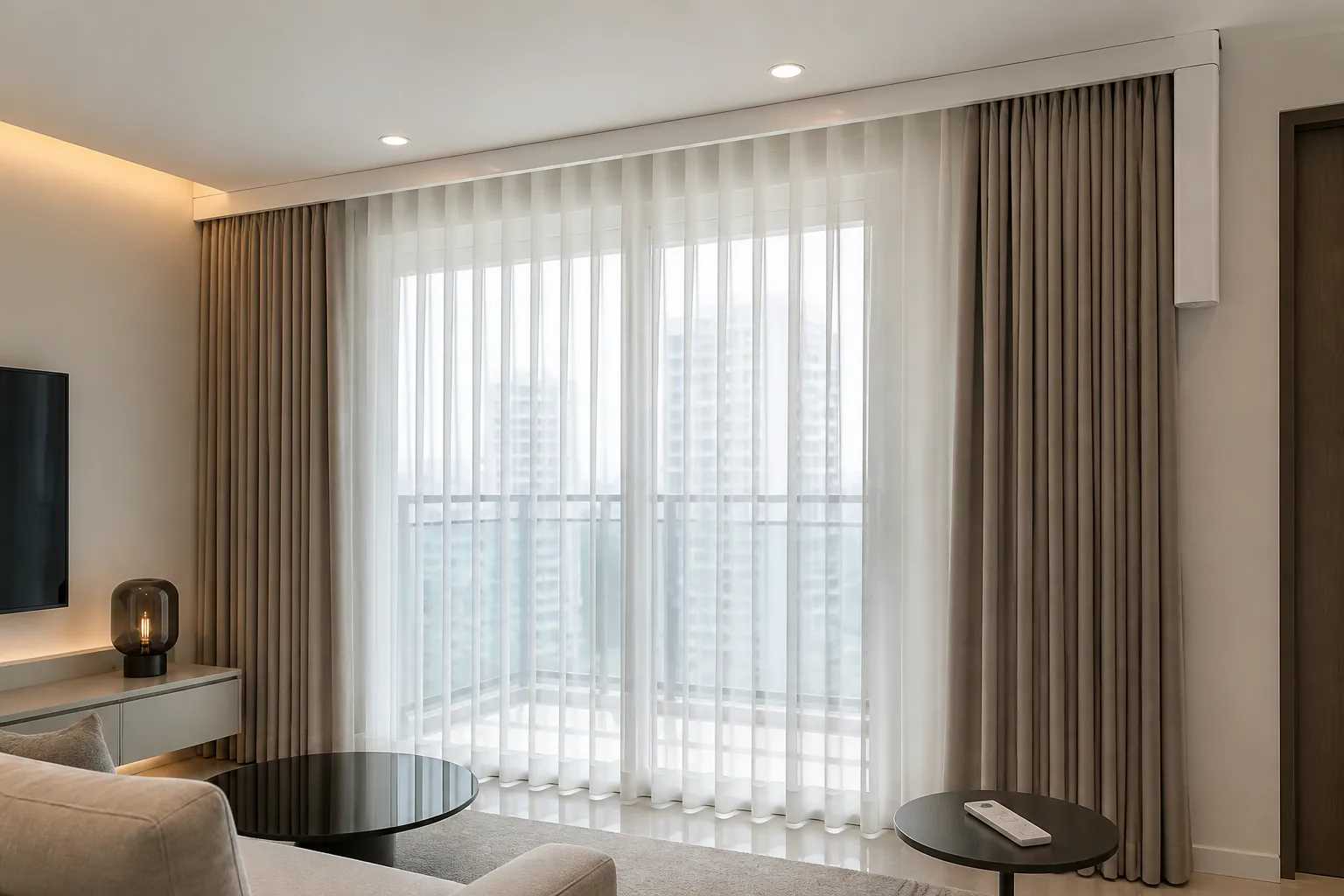
Hand-draw is a glider you pull by the cloth or a baton. It is what most HDB bedrooms need.
Corded tracks use a pull cord so you are not grabbing the leading edge. I specify cord when the run is wide, the cloth is heavy, or the user should not stretch. Ask for a child-safe cleat if the cord hangs.
A motor is a third option. Say so before the track is cut. That product sits on smart curtains.
Match the heading and the weight
A standard C-section aluminium rail with loose gliders takes pinch pleat, pencil pleat, and most hook headings. A wave or S-fold track is a different rail.
The carriers are linked so the ripple stays even. You cannot put a wave heading on a random glider track and expect the S to hold.
Weight is the other half. A sheer or day curtain is light. A blackout with lining is not.
I want more brackets and a thicker section. I do not print a kilogram rating I have not read off the rail in my hand.
Double track hangs a sheer and a night pair. The box has to be deep enough that the two stacks do not fight. Tell the ID before the pelmet is boarded.
Bays and 90-degree corners need a rail that can bend on site. Mark stack direction on the measure.
A rod is a different brief. Use a rod when you want a visible pole. Use a track when you want a clean full-height hang.
A made-to-measure panel still looks cheap on a bent, undersized rail.
Copy this track spec
Curtain track spec. Fill this in before the fitter arrives.
| Step | What to write |
|---|---|
| 1 | Mount: ceiling slab, packed pelmet, or wall. Say if the room is a household shelter or a ferrolite wall. |
| 2 | Heading: pinch, pencil, wave, or eyelet. Wave needs a wave rail. Eyelet needs a rod. |
| 3 | Weight: sheer, lined night pair, or interlined. Ask what section they will use. |
| 4 | Draw: hand-draw, corded with a child-safe cleat, or motor. |
| 5 | Stack: left, right, or split. Leave the walkway clear on a living-room door. |
| 6 | Single or double rail. Write the box depth. Add any bend, join, or return to the wall. |
| 7 | Who supplies the curtains. Track-only is a real job. Say it on the quote. |
Heavy drilling follows HDB noisy-work hours: weekdays 9am to 5pm, not Sundays or public holidays.
Curtain tracks for the living room
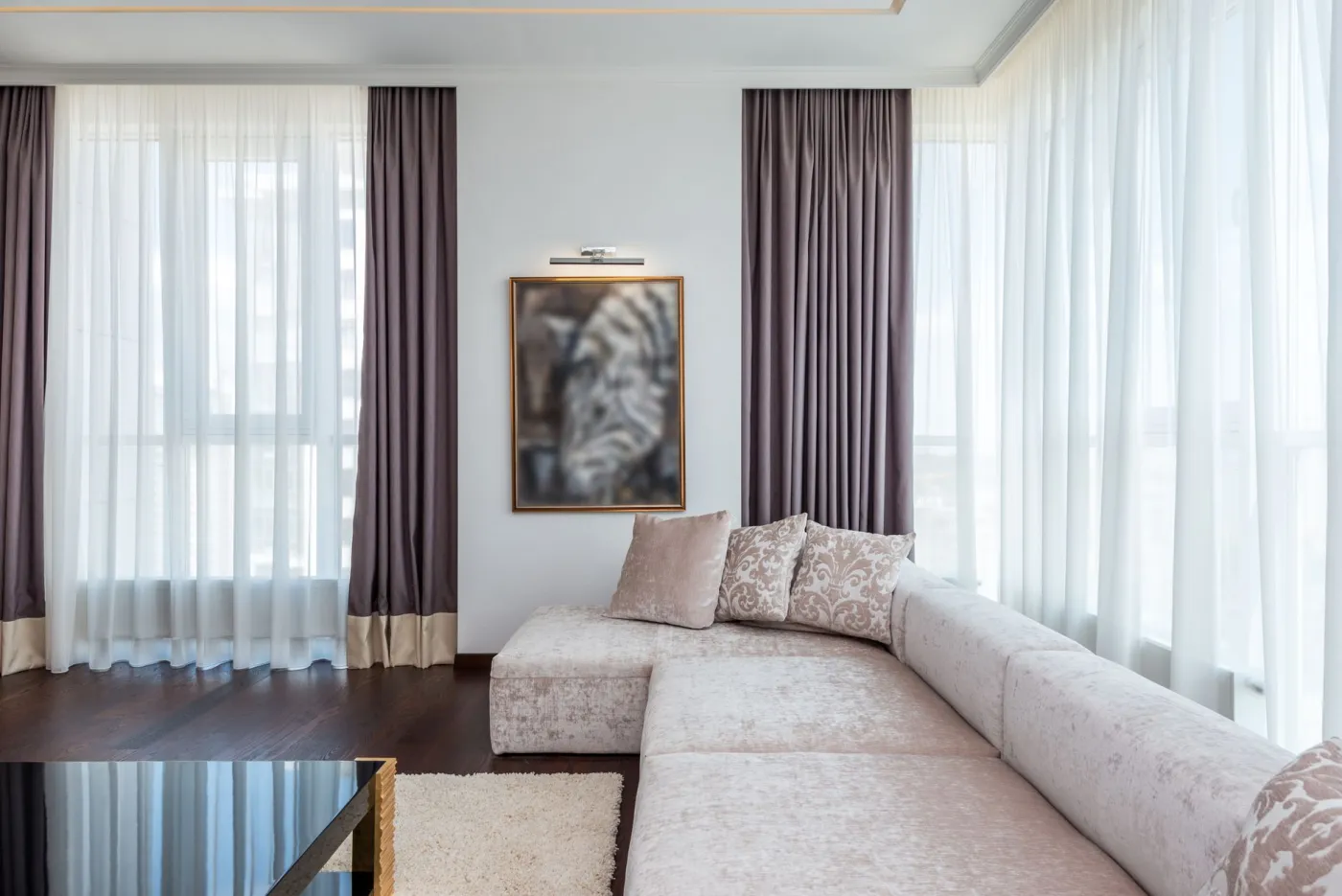
Living room windows in Singapore flats are often wide, or a sliding door to the balcony, so the track has more to carry and the stack needs somewhere to go. A double track is the usual choice: a sheer behind for daytime privacy and a dim-out curtain in front for the evening. That needs a curtain box deep enough for both layers.
Run the track past both sides of the frame, or wall to wall, so the curtains stack off the glass. On a balcony door, set the stack direction so the walkway stays clear. For a very wide run or a heavy lined pair, ask about a corded or motorised track rather than hand-draw. Plan the length with our curtain track length calculator.
Common questions
How many types of curtain track are there?
Most Singapore homes choose from six: a standard aluminium glider track, a wave or S-fold track, a double track for a sheer and a night curtain, a bendable track for bays and corners, a corded track, and a motorised track. Each can be fixed to the ceiling, inside a curtain box or on the wall.
What is a track curtain rod?
It usually means a curtain track: a slim rail with gliders or carriers running inside it, fixed to the ceiling or wall, that the curtain hooks onto. A curtain rod is a visible pole that the curtain hangs from on rings or eyelets. Our curtain rods vs tracks guide compares the two.
What is the recommended spacing for curtain hooks?
It depends on the heading. Pinch pleat curtains take one pin hook behind each pleat and one at each end. Pencil pleat tape takes a hook every few pockets. Wave curtains clip onto linked carriers that set the spacing for you. Each hook needs its own glider, as our curtain hooks guide explains.
What are the types of drapes?
Drapes are usually sorted by heading, such as S-fold, pinch pleat, pencil pleat and eyelet, and by fabric, such as sheer, dim-out and blackout. The heading decides the hardware: S-fold needs a wave track, pleated headings use a standard glider track, and eyelets need a rod. Our types of curtains guide covers 18 types.
 Curtain Rods vs Tracks in Singapore
 S-Fold vs Pleated Curtains in Singapore: Ripple Fold, Pinch Pleat or Eyelet?
 Curtain Pelmets and Curtain Boxes in Singapore Homes