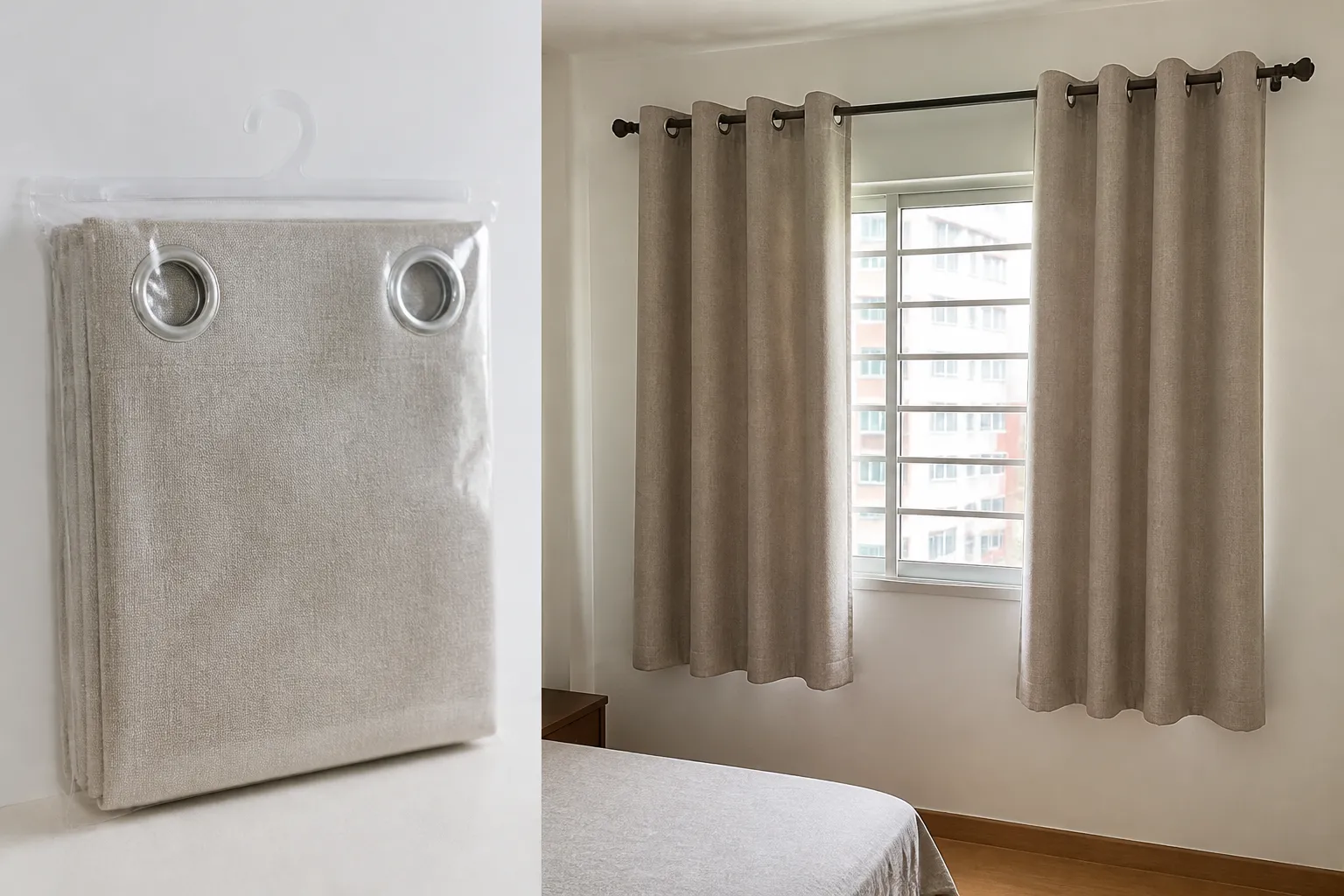
Ready-made curtains suit a window whose width, drop and rail already match a shop size. Made-to-measure suits everything else, which in most Singapore flats means the living room, the master bedroom and any full-height or bay window. A packet can still be a sensible buy for a spare room, a rental or a plain casement under a standard HDB slab.
You are in a shop with a pair of packed panels, wondering if they will fit your flat. Ready-made curtains in Singapore are cut to a shop size. They work if that size already matches your drop, fullness, and heading. Most HDB and condo windows do not.
Ready-made and made-to-measure at a glance
| Question | Ready-made | Made-to-measure |
|---|---|---|
| Width | Set panel widths, sold as a pair or single | Cut from your track length and the fullness you choose |
| Drop | One or two listed drops | Measured from your rail to your floor |
| Heading | Mostly eyelet, pencil pleat or tab top | Sewn for your rail: S-fold, pinch pleat, eyelet and others |
| Lining | Whatever the packet has | Chosen per room: unlined, dim-out, blackout lining |
| Fabric range | The shop’s colours that season | Sampled against your window and light |
| Fitting | You hang them | Measured, sewn and fitted for the opening |
| Best for | Spare rooms, rentals, quick fixes | Living rooms, bedrooms, wide or tall glass |
What ready-made means here
Ready-made is a finished pair, or a single panel, in a listed width and drop. You take it home and live with the hem you got.
A common shop pair in Singapore is 145cm wide by 250cm drop, sold as a pair. IKEA and other retailers use that size a lot. 250cm is close to a typical HDB hang if the rail sits near a 2.6m slab.
I have not measured your room. A false ceiling or an older lower slab will make that 250cm look long, short, or puddled.
Width is where ready-made usually fails first. A pair of 145cm panels is 290cm of cloth.
A living room sliding door that needs gather wants more than that. People buy one pair, hang it flat, and wonder why it looks like a sheet. Our curtain calculator shows how much fabric width a track actually needs once fullness is added.
Heading is the second failure. Eyelet wants a rod. Tape and hooks want a track.
Wave tape wants a wave rail. If you already have an aluminium ceiling track, an eyelet pair is the wrong packet.
Fabric and lining: what a packet leaves out
Shop curtains are usually sold as three kinds. Day curtains are sheers that soften glare. Night curtains are thicker, often with a blackout coating. Semi-sheers sit between the two. That covers a lot of rooms, but the choice stops at what is on the shelf.
The coating on many packet blackout curtains is a rubbery layer bonded to the back of the cloth. It does the job at first. In a west-facing bedroom that takes the afternoon sun through the glass every day, coatings can crack or peel over time, and the panel cannot be relined. A made-to-measure night curtain can use a separate blackout lining sewn behind a face fabric you like, so the face and the lining are two choices.
Humidity matters too. Unlined cotton and linen panels can shrink or relax in length after washing in a humid flat. A packet gives you one drop to start with, so a shrinking panel ends up short. A custom pair can be cut with that fabric’s behaviour in mind. If you want a middle ground between sheer and blackout, dim-out fabric is a common pick for living rooms and studies.
What made-to-measure changes
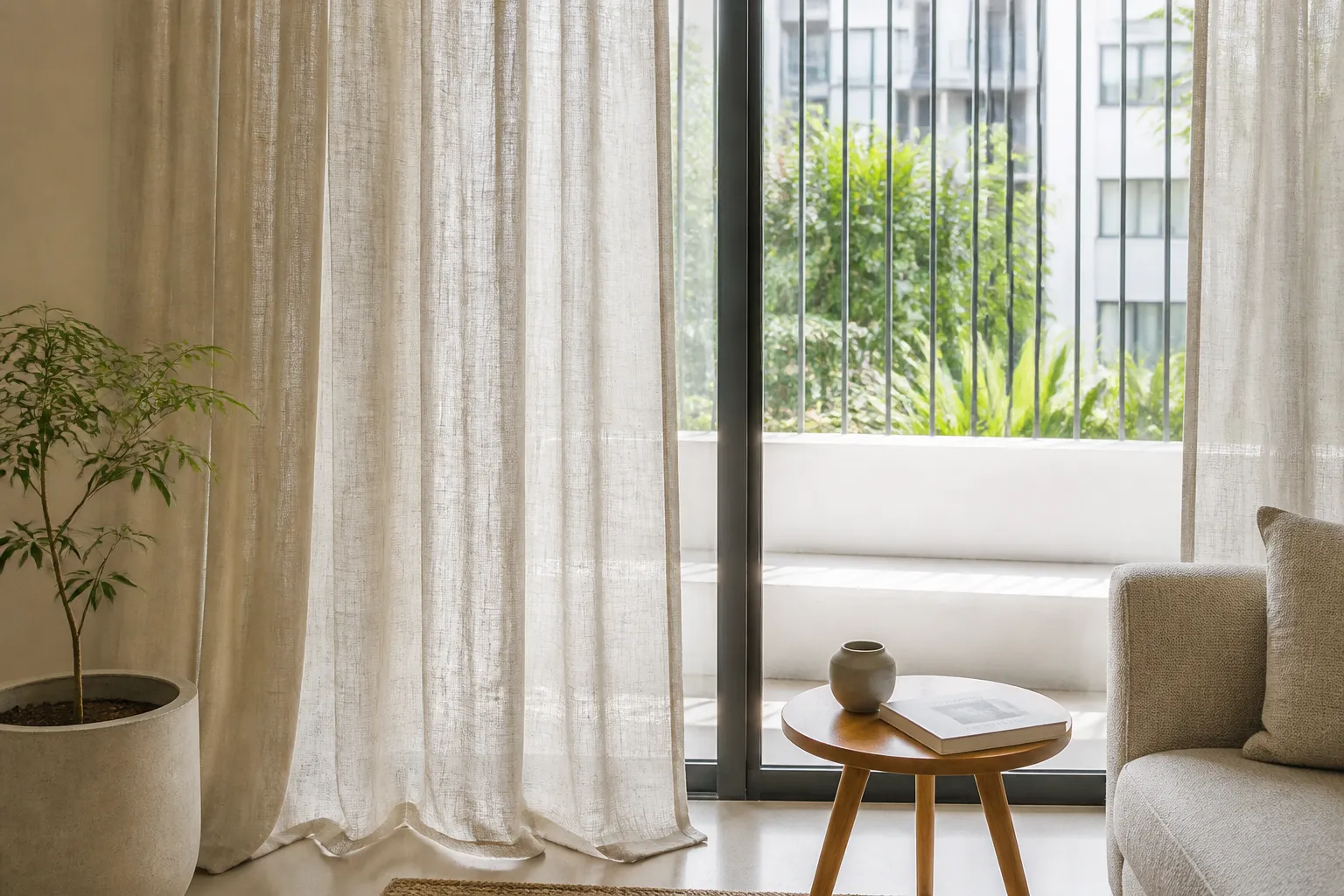
Made-to-measure is a panel cut for the opening we measured. Width, drop, heading, lining, and fullness are decisions, not leftovers.
Width comes from the track length and the gather you want. Drop is planned for that rail on that floor.
Heading is sewn for the rail you have. Lining is part of the same ticket: a blackout back, or a sheer on a second rail.
The made-to-measure curtains page is the product: visit, fabric, sew, fit. This article is the fork. I do not invent a starting price.
How a made-to-measure order runs
The steps are the same for an HDB flat, a BTO fresh from key collection, or a condo unit.
- Measure. We note track length, ceiling height, what sits above each window and which rooms are household shelters.
- Sample. You hold fabrics against the glass at the time of day the room gets its strongest light. A cloth that looks right at night can look thin at 4pm on a west window.
- Decide heading and layers. One curtain or a sheer plus a night curtain, and whether the track is single or double.
- Sew. Panels are made to the measured drop and width.
- Fit. The curtains go up on the rail they were sewn for, and the hem is checked against the floor.
If you want to sanity-check sizes before a visit, our curtain length calculator and our guide on how to measure windows for made-to-measure curtains walk through the numbers.
Windows that rarely fit a packet
These openings usually need a custom pair:
- Full-height living room glass, where the drop is longer than 250cm
- Bay and corner windows, where a straight rectangle leaves gaps
- Household shelter bedrooms with a small, off-centre window
- Double hangs: sheer plus night pair
- Old resale casements with a deep tile stool
A plain bedroom casement under a normal HDB slab, with a rail already up, can be close. Measure before you pay.
When ready-made is enough
You are renting and you want the deposit back. A spare room nobody photographs.
The drop already matches and you have enough width for gather. You need something up this week.
I will not talk you out of a packet that already fits. Measure twice. Do not drill a shelter slab for a two-year lease if a light pair on a rod will do.
When custom is the cleaner brief
You can see the window from the sofa and you care how it sits. You want lining, a heading, or a cloth that is not in the packet range.
The rail is a wave track, a double rail, or a bend. You already know the ready-made hem will puddle or float.
Cheap alteration of a cheap panel is how you spend twice and still see the old fold line.
Can you alter ready-made curtains?
Some changes work. A seamstress can shorten a panel that is too long, as long as the heading stays at the top. Pencil pleat tape can sometimes be re-hooked at a lower slot to lift the hem a little. Adding a separate lining behind an unlined panel is possible on a track with hooks.
Other changes rarely work. You cannot add length to a short panel without a visible band. You cannot turn eyelets into S-fold, because the rings are punched through the fabric. Two packets stitched side by side to make a wide curtain leave a seam that shows when the sun is behind it, and the colour can differ between batches.
Copy this measure list
Measure list. Do this before you buy a packet or book a visit.
| Step | What to write |
|---|---|
| 1 | Track or rod length, not a photo from the sofa. |
| 2 | Drop from the glider (or the top of the rod) to the floor. Say if you want a kiss, a break, or a clear. |
| 3 | Heading already on the rail: hooks, wave, or eyelet. |
| 4 | Shop size if you are comparing: width x drop, pair or single, plus the fibre list. |
| 5 | Window type, and whether the room is a household shelter. |
| 6 | Pelmet depth if a box is coming. Double rail needs more box than a single sheer. |
| 7 | Rooms you will actually dress. One bedroom and a hall is a quote. |
Common questions
Are ready-made curtains good enough for an HDB flat?
For a standard bedroom casement with a rod already up and a drop close to 250cm, often yes. For full-height glass, wide sliding doors, bay windows or a sheer plus night curtain on a double track, a packet usually ends up too narrow, too short or with the wrong heading.
Can I mix ready-made and made-to-measure in one home?
Yes. A common split is custom curtains for the living room and master bedroom, where you look at them every day, and a ready-made pair on a rod in a spare room or study.
Do ready-made blackout curtains make a room fully dark?
The fabric may block most light, but darkness also depends on how the curtain is hung. A panel on a rod leaves gaps above and at the sides. A curtain on a ceiling track or in a curtain box, with enough width to overlap, usually gets the room darker.
 Best Curtain Shops in Singapore (2026)
 How to Measure Windows for Made-to-Measure Curtains in Singapore
 S-Fold vs Pleated Curtains in Singapore: Ripple Fold, Pinch Pleat or Eyelet?