
You have just moved into a rented common room in an HDB flat. The tenancy agreement says no holes in the walls, the window faces the next block, and the morning sun reaches the bed long before your alarm. You need something up this week. There are a few ways to hang curtains without drilling, and each one works within a limit. The two limits that decide most cases are weight and how well an adhesive copes with Singapore humidity.
Check what is already there
Before you buy anything, look above and around the window.
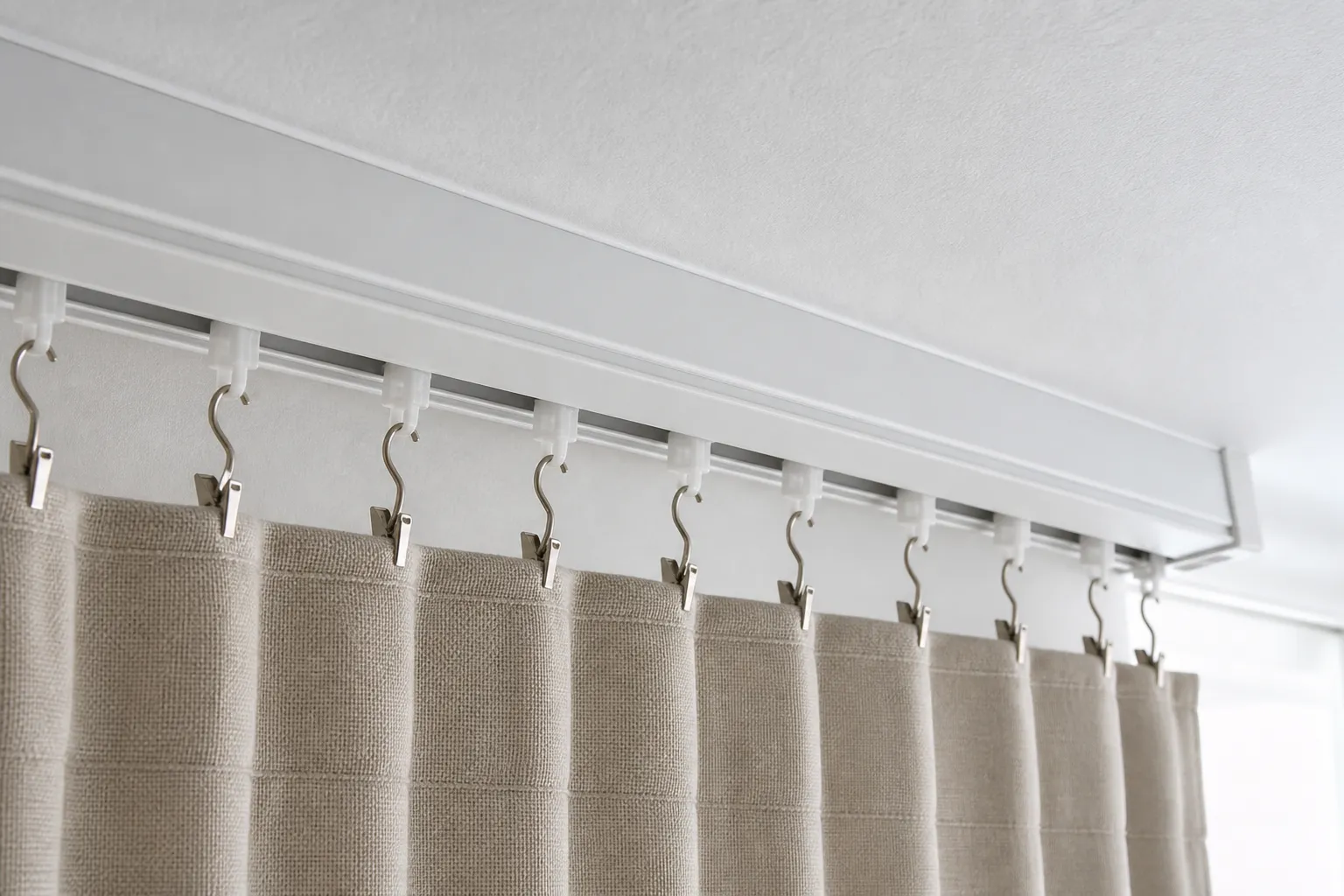
- An old track or rod left by the previous tenant. If it is firmly fixed and the gliders run smoothly, you only need curtains and the matching hooks. Our guide to types of curtain hooks helps you match them.
- A curtain box or pelmet. Even without a track, the end panels of a box can grip a tension rod, and the box hides it.
- A window recess, where the window sits back from the wall with wall on both sides.
- Internal window grilles or a frame with a lip along the top.
If any of these is there, you have more options than a bare wall. Our page on curtain pelmets and curtain boxes explains what a box is built to do.
Tension rods
A tension rod is a telescopic pole with a spring or a twist lock inside. You extend it until it presses hard against the walls at each end, and the grip keeps it in place. Rubber pads on the ends stop it slipping and protect the paint.
It needs two solid sides to push against. That means a recess, the inside of a curtain box, or the gap between a wardrobe and a wall. It cannot work on a flat wall above the window.
Tension rods suit light curtains. A sheer, an unlined day curtain, or a short café curtain across the lower half of a kitchen window are good fits. Every rod has a maximum span and a stated weight limit on the packaging. Stay under both. The longer the rod is extended, the more it sags in the middle and the easier it slips.
Inside a recess, the curtain has to be narrower than the opening, so some light gets past at the edges. Draw the curtain by its leading edge rather than tugging the panel, because a sharp pull is what usually knocks a tension rod loose. Check the grip again after a few days.
Adhesive hooks and adhesive rails
Adhesive hooks, adhesive rod brackets and stick-on curtain rails are sold for exactly this problem. Each product states a weight limit on the pack. Read it, and treat it as a limit for a curtain that hangs still, because drawing the curtain open and closed adds a pull that a still load does not.
Humidity and heat both weaken adhesive. A wall that faces the afternoon sun heats up, and a kitchen or bathroom wall stays damp. Either can let a hook creep or let go weeks after it seemed fine.
Give the adhesive the best start you can.
- Follow the pack’s instructions for cleaning the wall. Most ask for a clean, dry, dust-free wall.
- Avoid freshly painted walls, textured paint and wallpaper.
- Press each hook or bracket firmly for the time stated on the pack.
- Wait the full curing time before hanging anything.
On removal, adhesive can lift paint even when the pack says it will not. If you are renting, ask the landlord before you stick anything to a painted wall, and pull the release tab slowly and straight down when you take it off.
Keep adhesive for light sheers on small windows. It is a poor choice for lined or blackout curtains.
Window-frame clamps and hook-on brackets
Some brackets clamp onto the top of a window frame, a curtain box lip or a door frame, and support a light rod without screws. They only work when the frame’s profile fits the clamp. Check the thickness range the product states and compare it with your frame before you buy.
Mount the clamp on a fixed part of the frame, not on an opening sash, so the window still opens and closes. Make sure the rod and curtain do not stop the window locking or a grille gate opening.
Magnetic curtain rods need a steel frame. Most HDB window frames are aluminium, which magnets do not stick to, so check before you order one.
Comparing the options
| Method | Suits | Weight it can take | What to watch |
|---|---|---|---|
| Tension rod | A recess or the inside of a curtain box | Light, check the stated limit | Sag over a long span, slipping when the curtain is pulled |
| Adhesive hooks or rail | Small windows and light sheers | Light, check the stated limit | Humidity, sun-heated walls, paint lifting on removal |
| Frame clamp | Frames with a profile the clamp fits | Depends on the product | The window and any grille gate must still open |
| Existing track or rod | Flats that already have one | Depends on how it was fixed | Worn gliders and mismatched hooks |
| Drilled track or rod | Blackout, wide windows, full height, double layers | Depends on the hardware and fixings | HDB drilling rules and landlord permission |
When drilling cannot be avoided
A full-height, lined blackout curtain across a wide living-room window is heavy, and it gets drawn at least twice a day. A sheer and a night curtain on a double track add more weight again. None of the no-drill methods above is designed for that load. For a bedroom you want dark, a ceiling or box-mounted track also lets less light over the top than anything wedged inside a recess.
If you are renting, ask the landlord. Many will agree to a track fixed with a few small holes that can be patched when you leave. If you own the flat, a drilled curtain track or a curtain rod on proper brackets is the long-term fix.
HDB flats have two drilling rules to know about.
- In newer HDB bedrooms with ferrolite partition walls, HDB notes say not to drill within 200mm of the ceiling or beam, and to keep drilling depth around 22mm.
- In household shelters, SCDF and HDB allow drilling into the internal face to a depth of not more than 50mm, with non-metallic inserts and removable screws. Fixtures have to come down within 48 hours if you are told to clear the shelter.
Common questions
Can I hang blackout curtains without drilling?
A short, light blackout panel on a tension rod in a recess can work, as long as you stay under the rod’s stated weight limit. A full-height lined blackout curtain on a wide window is usually too heavy for tension rods, adhesive or clamps, and a drilled track will block more light at the top.
Do adhesive hooks work in Singapore humidity?
They can work for light curtains, but heat and damp weaken adhesive over time. Avoid kitchen and bathroom walls and walls that get strong afternoon sun, stay well under the stated limit, and check the hooks every few weeks.
Will a tension rod damage my walls?
Rubber end pads usually protect paint, but a rod set very tight can leave marks or press into soft plaster. Extend it only as far as needed to grip.
Can I reuse the track the previous tenant left?
Yes, if it is firmly fixed and the gliders run freely. Take one glider off and check which hooks it takes before you buy curtains.
 How to Hang Curtains in a Singapore Home: A Step-by-Step Guide
 Curtain Rods vs Tracks in Singapore
 How to Choose a Curtain Track in Singapore