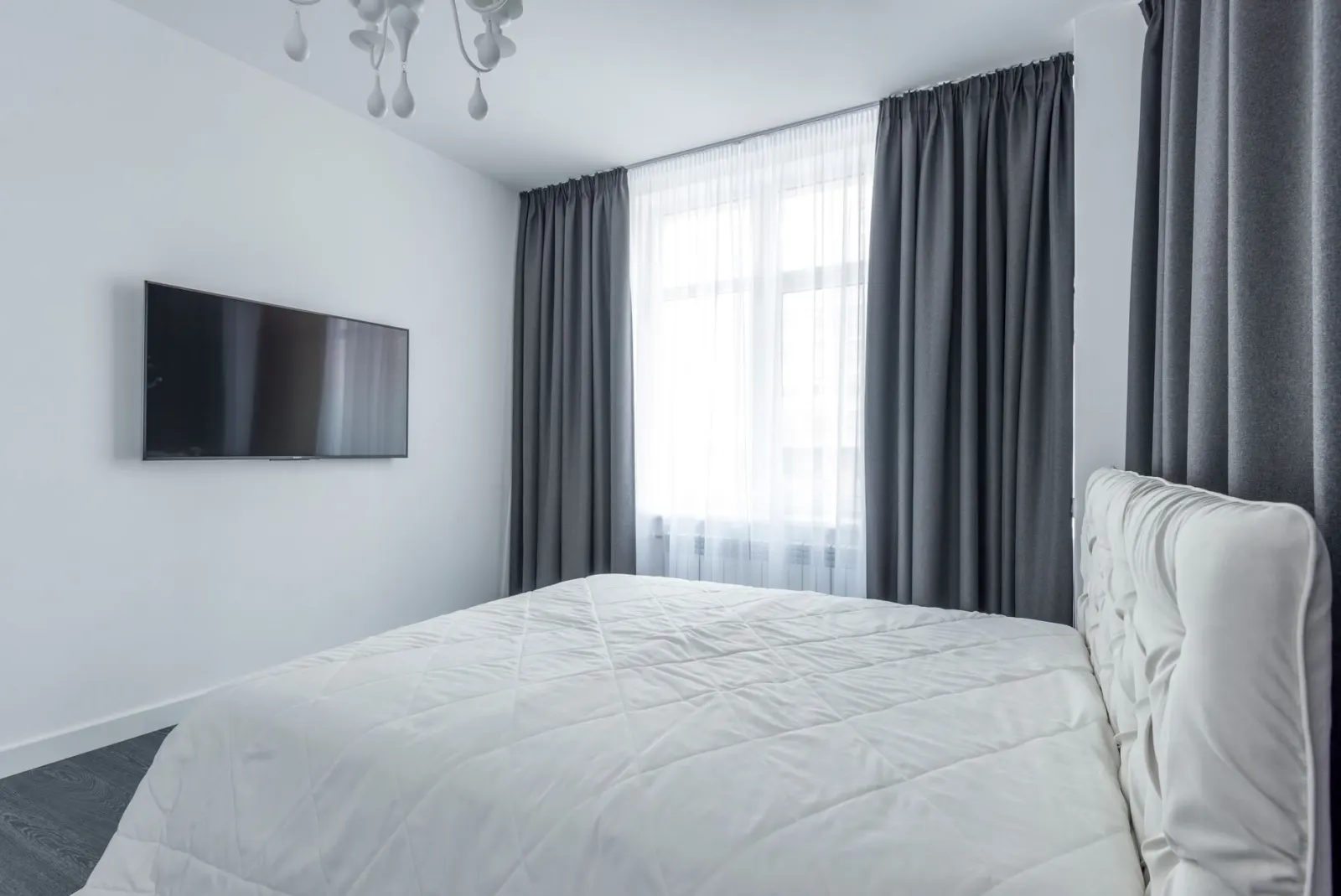
Most curtains in Singapore homes hang on one of five fittings: metal pin hooks for pinch pleats, plastic tape hooks for pencil pleats, S-hooks for sewn rings or loops, rings on a decorative rod, and snap carriers for wave curtains. Match the hook to the curtain’s heading first, then to the track or rod it hangs from.
You moved into a resale flat and the previous owner left the track behind. Your new curtains arrive, and the hooks in the packet do not fit the little eyes on the gliders. Or they fit, but the heading flops forward and shows the rail. Hooks are the smallest part of a curtain job and the easiest one to get wrong. Each type of curtain hook is made for a certain heading and a certain kind of track, so start by checking which pair you already have.
What a curtain hook actually does
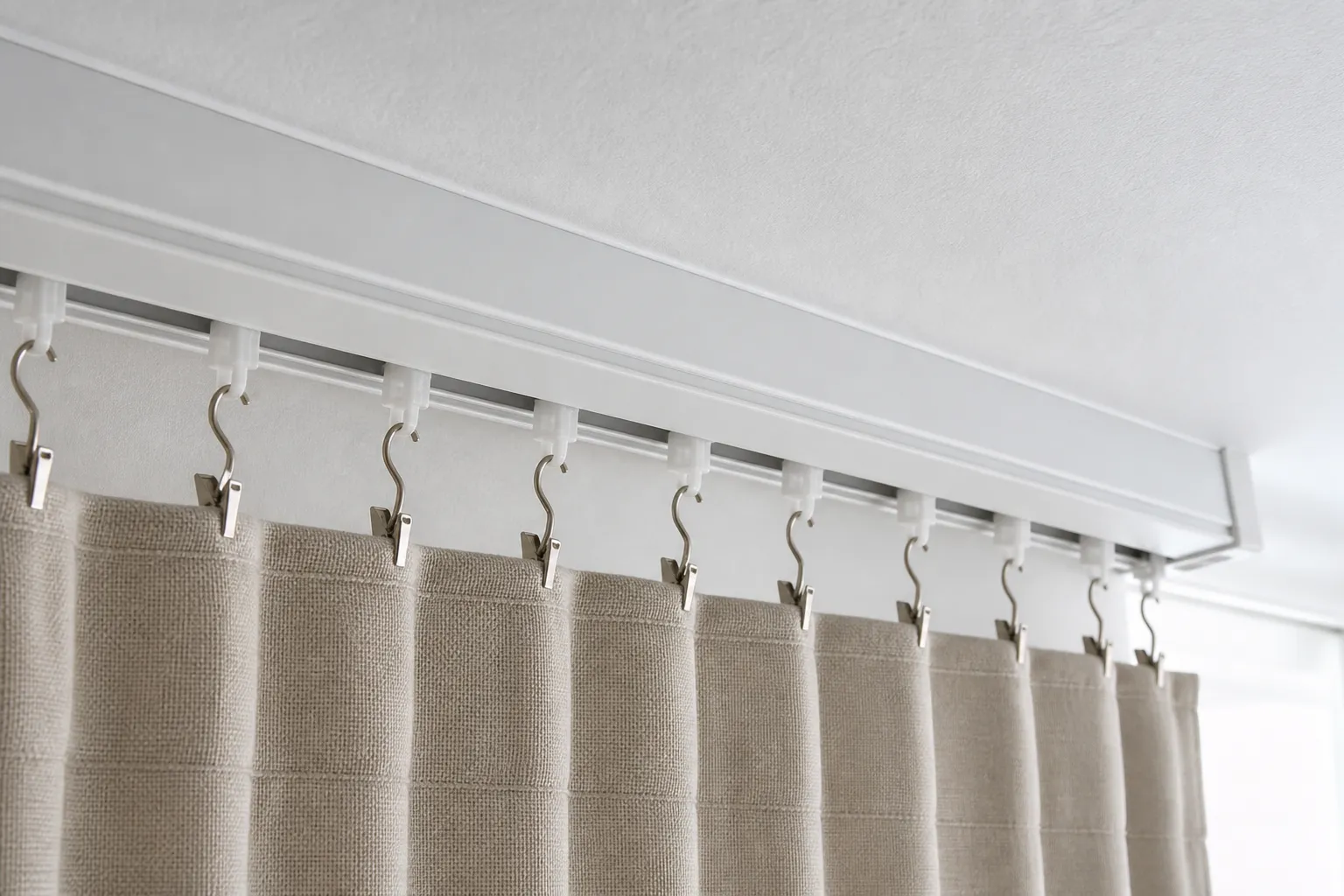
A hook joins the top of the curtain to whatever moves along the rail. On a track, that is a glider or carrier. On a rod, it is a ring. The hook has to hold the fabric at the correct height, keep the folds spaced, and slide without catching.
When the hook and the rail do not match, you see it straight away. The curtain sits too low and light leaks over the top. The heading leans out from the wall. Gliders bunch at one end because the hook is twisting in the eye. Most of these problems are fixed by changing the hook, not the curtain.
Pin hooks for pinch pleats
Pin hooks are thin metal hooks with a sharp straight leg. The leg is pushed up into the stiffened band at the back of a pleated heading, usually one hook behind each pleat and one at each end. The curved top then drops into the glider’s eye.
They suit pinch pleat, double pleat and other hand-sewn pleated headings on a standard aluminium track with loose gliders. They are what most made-to-measure night curtains in Singapore flats are hung with.
Pin depth decides the height. Push the pin in high and the heading sits lower, covering the track. Push it in lower and the heading rises above the gliders. On a ceiling track you usually want the heading to cover the rail so the top looks clean. On a wall track below a curtain box you may want the opposite. Ask where the pin will sit before the curtains are sewn, because the drop is measured from that point.
The limitation is that pin hooks leave small holes in the buckram, and moving them many times wears the band. Set the height once.
Plastic tape hooks for pencil pleats
Plastic tape hooks are the small white hooks that come in a bag with many ready-made curtains. They slot into the woven pockets on a gathered heading tape, the type used for pencil pleat and simple gathered headings. You pull the cords in the tape to gather the fabric, then hook it every few pockets.
Most heading tapes have two or three rows of pockets. The row you choose sets the height, much like pin depth.
They are cheap, light and easy to replace. They work on most standard glider tracks and on rods with small rings. They are less suited to a heavy lined blackout curtain, where the plastic can bend open over time and the gathers sag. For a heavy cloth, a metal hook in the same tape or a pleated heading with pin hooks holds better.
S-hooks and glider hooks
An S-hook is a metal hook bent into an S. One end goes through the glider eye or a ring, and the other holds a curtain loop or a ring sewn onto the fabric. You see them on older tracks, on shower curtains, and on some commercial rails.
Some track systems also use gliders with a built-in hook rather than an eye. In that case, the curtain needs a ring or tape pocket for the glider’s hook to catch. Before you buy loose hooks, look closely at what is on your track: an eye, a hook, or a carrier with a slot. That tells you which half you still need.
S-hooks are practical for light curtains and quick changes. On a long or heavy curtain they can swing and twist, and the heading will not sit as evenly as a pinned pleat.
Curtain rings on rods
On a visible pole, the curtain hangs from rings that slide along the rod. Each ring has a small eye at the bottom. A pin hook or tape hook goes from the heading into that eye. Clip rings skip the hook and grip the fabric directly.
This is the setup for a pinch pleat or pencil pleat curtain on a decorative rod. Eyelet curtains are different. The rod passes straight through the eyelets, so there is no hook at all. If you are still choosing between a pole and a rail, settle that first, because it decides the heading and therefore the hook.
Rings make a little noise when drawn and catch on the centre bracket of a wide rod. Passing brackets fix the second problem; the first is part of the look.
Curtain hook vs ring: which do you need?
Hooks and rings are often used together rather than one instead of the other. A ring is what slides along a rod. A hook is what joins the curtain to a ring or to a track glider. On a pole, a pleated curtain usually has a pin hook pushed into each pleat and dropped into the eye of a ring. So the choice is between three setups.
| Setup | Suits | Look | Weight | Watch for |
|---|---|---|---|---|
| Hooks on a track | Pinch, double or pencil pleat, blackout, ceiling track or curtain box | Track hidden, even folds | Takes heavy lined curtains | Hook height must be set so the heading covers the track |
| Hooks into rings on a rod | Pleated curtain on a visible pole | Tailored, with the pole on show | Medium to heavy, if the brackets are well fixed | Rings catch on centre brackets |
| Clip rings on a rod | Flat panels, light sheers, curtains you change often | Casual | Light curtains | Fabric sags between clips, and clips can slip or mark the cloth |
If the curtain is lined, full height or opened every day, hooks on a track or hooks into rings will hang more evenly than clips. Clip rings are a quick fix for a light panel with no heading tape, such as a café curtain or a rental where you do not want to sew.
Hook type or rod type curtain?
On Shopee, Lazada and other online shops, ready-made curtains are often listed as “hook type”, “rod type” or “2 in 1”. A hook type curtain has a heading tape with pockets for hooks, so it hangs on a glider track or from rings. A rod type curtain has a sewn sleeve or eyelets that the rod passes straight through. A 2 in 1 listing has both a rod pocket and hook tape, so check which one the photos actually show in use.
If your home has a track, in a curtain box or on the ceiling, buy hook type. Rod type only works if you put up a rod.
How to fit curtain hooks and clip rings
- Lay the curtain face down and mark where the hooks go: behind each pleat on a pleated heading, or at even spacing along the tape, with one hook at each outer edge.
- Set the height before you insert every hook. Use the pin depth or the pocket row so the heading covers the track, or hangs just below a rod.
- Count hooks against gliders. Each hook needs its own glider, and the outer hook usually goes into the fixed eye at the end of the track. Add or remove gliders through the end cap if the numbers do not match.
- Hang from the centre of the window outwards, then draw the curtain a few times to check nothing twists or bunches.
For clip rings, space the clips evenly with one at each edge, and clip just below the top hem so the fabric does not fold over.
Wave carriers for S-fold curtains
A wave or S-fold heading does not use loose hooks in the usual way. The track has carriers linked by a cord or tape so they stay an equal distance apart. The curtain has a heading tape with snaps or small hooks spaced to match, and it clips onto the carriers. That spacing is what makes the even ripple.
This is why you cannot take a wave curtain and hang it on any glider track with ordinary hooks. The folds will wander and the curtain may stack unevenly. Wave curtains need a wave track, and the carrier spacing on the track has to match the curtain. Our curtain track guide explains the track side of this.
For the look and fullness of each heading style, see curtain headings explained. This page only covers how each one hangs.
Which curtain hook type for each heading
| Heading | Usual hook | Track or rod |
|---|---|---|
| Pinch or double pleat | Metal pin hook | Glider track, or rod with rings |
| Pencil pleat or gathered tape | Plastic or metal tape hook | Glider track, or rod with rings |
| Curtain with sewn rings or loops | S-hook | Older track or glider hook system |
| Pleat or tape on a pole | Pin or tape hook into ring eye, or clip rings | Decorative rod |
| Wave or S-fold | Snap tape on linked carriers | Wave track with matched spacing |
| Eyelet | No hook | Rod through the eyelets |
If you are reusing an old track, take one glider off and bring it with you, or send a close photo. It saves a second trip.
Common questions
Are curtain hooks universal?
No. Pin hooks, tape hooks and wave carriers do different jobs. Many tracks accept both pin and tape hooks because they share an eye-type glider, but a wave curtain needs its own carriers, and an eyelet curtain needs a rod.
Can I use the plastic hooks from ready-made curtains on a heavy blackout?
They may hold at first, but plastic hooks can open and sag under a lined, full-height curtain. Metal hooks or a pleated heading with pin hooks is the safer choice for weight.
Why can I see the track above my curtains?
The hook is set too low on the heading. Move the pin hook higher in the buckram, or use a lower pocket row on the tape, so the heading rises to cover the track.
Should I replace old gliders when I change curtains?
If gliders are cracked, stiff, or missing, yes. Ask the fitter to check the existing track and gliders before the new curtains are hung.
What do you need curtain hooks for?
Curtain hooks join the heading of the curtain to the gliders on a track or the rings on a rod. They set how high the curtain hangs and keep the folds evenly spaced as it opens and closes. Eyelet and rod pocket curtains are the exceptions, because the rod passes through the fabric.
What are the different curtain hanging types?
The main ones are hooks on a track, hooks into rings on a rod, clip rings, eyelets on a rod, rod pockets and tab tops, and wave carriers on a wave track. Tracks suit ceiling and curtain box installs, which are common in Singapore flats. Rods suit a visible pole above the window.
How do you hang a curtain with clip rings?
Slide the rings onto the rod before it goes up, leaving one ring between each end bracket and the finial so the outer edge of the curtain stays put. Clip one ring at each edge of the panel, then space the rest evenly along the top. Keep the clips just below the hem so the top edge stays straight.
What is the name of curtains with hooks?
Curtains that hang on hooks are usually sold as “hook type” curtains. The heading is either a stiffened pleated band for pin hooks, such as pinch pleat, or a gathered tape with pockets for tape hooks, such as pencil pleat. They hang from gliders on a track, or from rings on a rod.
How do you hang pinch pleat curtains?
Push a metal pin hook into the back of each pleat, plus one at each end, at the depth that gives the height you want. Check that the track has one glider for every hook. Then hang the curtain from the centre of the window outwards and draw it a few times to check the folds.
What are the different types of curtain rod brackets?
The common types are wall brackets for a single rod, double brackets that hold two rods for a sheer and a night curtain, and ceiling brackets that fix the rod to the ceiling. On a wide rod, a centre support bracket stops sagging, and passing brackets let the rings slide past without catching.
What are café curtain rods?
A café curtain rod is a slim rod fixed across the middle of a window frame, holding a short curtain that covers only the lower half of the glass. It blocks the view in from a common corridor while daylight comes through the top, which suits HDB kitchens and small windows above a counter.
 S-Fold vs Pleated Curtains in Singapore: Ripple Fold, Pinch Pleat or Eyelet?
 How to Choose a Curtain Track in Singapore
 Curtain Rods vs Tracks in Singapore