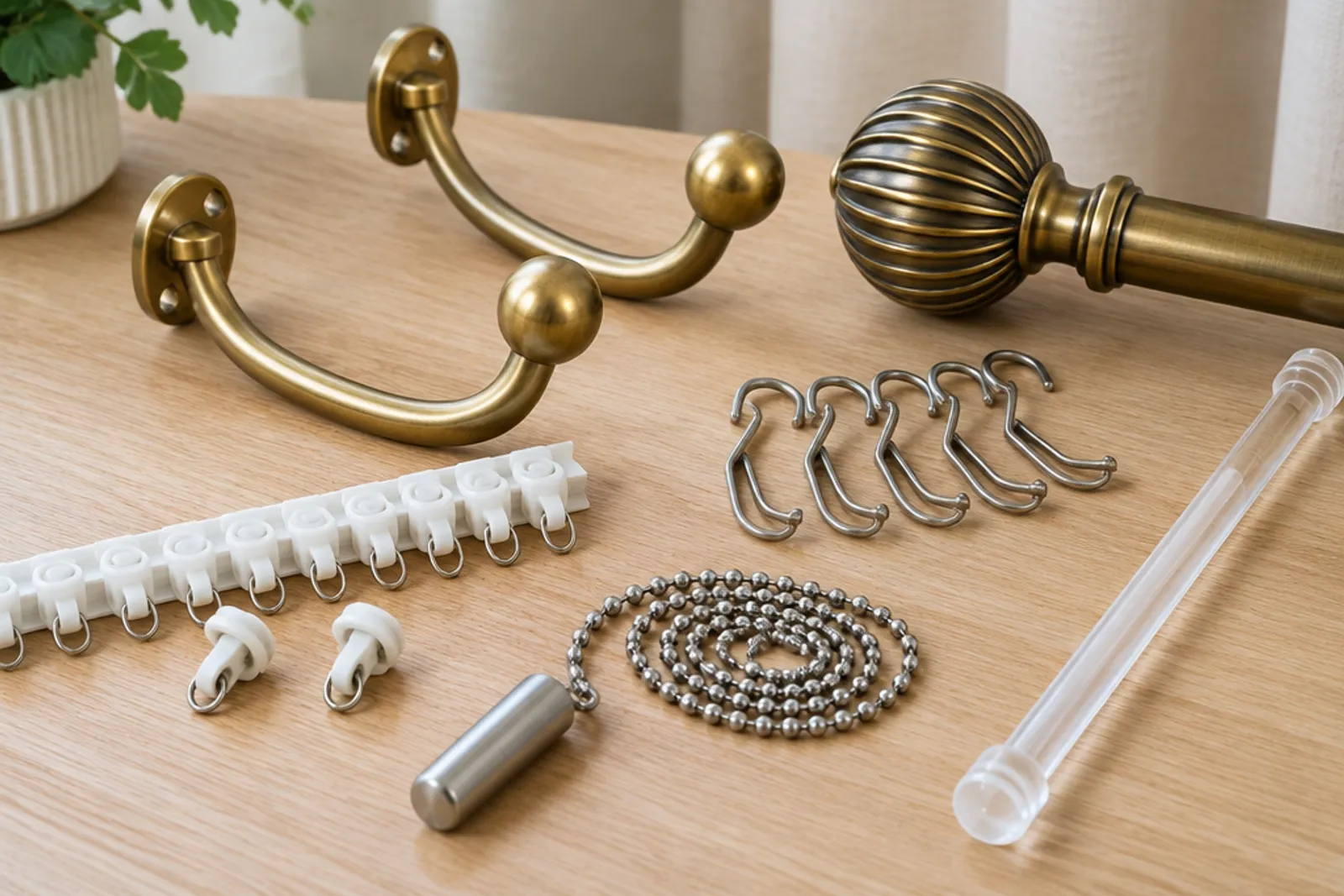
A curtain is more than its fabric. Above it sit brackets, a rod or track, gliders and hooks. Beside it there may be a tieback, a wand or a magnet where the two panels meet. Each of these small parts affects how the curtain opens, how it hangs and how long it lasts. In a Singapore flat, where windows stay open for breeze and humidity sits high all year, the material of each part also decides whether it rusts, stains the fabric or stiffens over time.
Below are ten accessories you are likely to come across when choosing or replacing curtains, what each one does, and what to look for in a local home.
1. Tiebacks and holdbacks
A tieback is a strip of fabric, cord or rope that gathers the curtain to the side of the window. A holdback is a fixed hook or knob on the wall that the curtain rests behind. Both keep the drawn-back curtain from drifting across the glass when the window is open and the wind picks up during a monsoon afternoon.
Fabric tiebacks made from the same material as the curtain look tidy and can be washed with it. Metal holdbacks suit heavier curtains and give a more formal look, but choose stainless steel or a coated finish so they do not leave rust marks on pale fabric. Fix holdbacks at around one third of the curtain height from the floor, and check that they do not sit where a window handle swings open.
2. Curtain hooks
Hooks connect the curtain heading to the gliders on a track or the rings on a rod. The type you need depends on the heading. Pinch pleats usually take metal pin hooks, pencil pleat tape takes plastic hooks, and S-fold curtains clip onto carriers rather than using hooks at all.
Hooks are cheap and easy to overlook, but a weak plastic hook on a heavy blackout curtain can bend or snap. Metal pin hooks in a damp room can also rust and stain the heading. If you are not sure which hooks your track needs, our guide to curtain hooks matches each hook to the heading and track.
3. Gliders and runners
Gliders (also called runners) are the small parts that move along inside a track and support the hooks. Their quality decides how smoothly a curtain opens. Worn or cheap gliders catch, jam or pop out of the track, which is often the reason an old curtain is hard to draw.
Look for gliders made of nylon or a similar low-friction plastic, sized for your track. Ball-bearing gliders roll more easily under heavy fabric, which helps on a wide living-room window with a lined curtain. When you change curtains on an existing track, it is often sensible to replace the gliders at the same time, since they wear down after years of daily use. Our guide to curtain tracks explains track types if you are deciding between a track and a rod.
4. Finials
Finials are the decorative ends fitted to a curtain rod. They stop the rings from sliding off and finish the look. Shapes range from plain caps and balls to more ornate designs in metal, wood or acrylic.
Finials only apply to rods, not to ceiling or wall tracks. Keep them in proportion to the rod and the room. A large ornate finial on a slim rod in a compact HDB bedroom can look out of place, while a simple cap suits a modern or minimalist room. Remember that finials extend past the end of the rod, so allow for them when the window sits close to a side wall, a wardrobe or an aircon trunking.
5. Brackets
Brackets fix the rod or track to the wall or ceiling. They take the full weight of the curtain, so their number and placement are more important than their appearance. A long rod needs a centre support bracket to stop it bowing, especially under a lined or blackout curtain.
In Singapore homes, brackets often go into concrete walls, a plaster ceiling or a carpentry curtain box. Each needs a suitable fixing. A plaster false ceiling without timber backing cannot take a heavy curtain on its own. Ceiling brackets let the track sit closer to the ceiling for a taller look, while wall brackets project the curtain far enough to clear the window handles. Our curtain installation service fixes brackets to suit the surface.
6. Curtain weights and chain weights
Weights sit in the hem to help the curtain hang straight. Individual weights are small discs or squares sewn into the corners and seams. Chain weights (also called lead tape or bead chain) run along the full length of the hem and keep sheers in particular from flapping.
Sheers near an open window in a high-rise flat catch a lot of breeze, so chain weights help them settle and fall in even folds. Ask what the weight is made of and how it is covered. Uncoated metal can mark fabric in humid conditions, and loose weights can damage a washing machine drum if the hem tears. Covered weights sewn into the hem are easier to live with.
7. Magnetic overlap
Small magnets sewn into the leading edges of a pair of curtains pull the two panels together when closed. This closes the gap in the middle, which is where light often leaks into a bedroom in the early morning.
Magnets suit blackout curtains in bedrooms facing east, where sunrise light through a centre gap can wake you early. They also stop the panels drifting apart when an aircon blows across them. An overlap arm on the track, where one curtain passes slightly over the other, does a similar job without magnets. Magnets need care in the wash, so check whether they can be removed or should stay in a laundry bag.
8. Draw wands
A draw wand is a slim rod clipped to the leading glider so you can pull the curtain without handling the fabric. It keeps hand marks and oil off pale or linen curtains, which show grime quickly.
Wands also suit tall windows where the top of the curtain is out of reach, and homes with young children, since a wand has no loop or cord. Many wands are clear acrylic so they blend into the curtain. They work best on tracks with smooth gliders, because a wand cannot overcome a track that jams. For a very wide or heavy curtain that is tiring to pull, consider motorisation instead, which removes the need to pull by hand.
9. Pelmets and curtain boxes
A pelmet is a panel or box that covers the top of the curtain and track. In Singapore, a curtain box is usually built by the carpenter during renovation, often as part of a false ceiling. It hides the track and brackets, reduces light spill above the curtain and gives the window a finished line.
A pelmet needs planning before the curtain is ordered. The internal depth must fit the track and the curtain layers, especially if you want a day and night pair. A box that is too shallow will leave the curtains rubbing against each other. Our guide to curtain pelmets covers the dimensions to discuss with your interior designer or contractor.
10. Tassels and decorative trims
Tassels, fringes and braided trims add a decorative edge to tiebacks or the curtain itself. They suit traditional and more formal rooms, and can bring texture to a plain fabric.
In a humid home, trims gather dust and can trap moisture, so they need more cleaning than the curtain around them. Some trims shrink at a different rate to the main fabric when washed, which can pucker the edge, so check whether the finished curtain can still be machine washed or needs professional cleaning. Avoid long hanging tassels in a child’s room, where they invite pulling. In a living room, a simple fabric tieback often gives a cleaner look with less upkeep.
Comparing curtain accessories
| Accessory | What it does | Material to look for in humid rooms | Child-safety note |
|---|---|---|---|
| Tieback or holdback | Keeps drawn curtains to the side | Fabric, stainless steel or coated metal | Avoid loose cord loops at low height |
| Hooks | Join heading to glider or ring | Plastic or stainless steel | No specific risk |
| Gliders | Move along the track | Nylon or low-friction plastic | No specific risk |
| Finials | Finish the rod ends | Coated metal, sealed wood, acrylic | Keep clear of climbing furniture |
| Brackets | Support the rod or track | Steel with a coated finish, aluminium | Fix securely for heavy curtains |
| Weights | Help the hem hang straight | Covered weights or chain tape | Covered weights stay inside the hem |
| Magnets | Close the centre gap | Sewn-in, covered magnets | Keep loose magnets away from small children |
| Draw wand | Pulls the curtain without touching fabric | Acrylic or aluminium | Safer than cords or loops |
| Pelmet or box | Hides the track, cuts light spill | Sealed carpentry or plaster with backing | No specific risk |
| Tassels and trims | Decoration | Synthetic trims that dry quickly | Avoid long tassels in children’s rooms |
Rust, mould and cleaning
Singapore’s mean annual relative humidity is around 82%, according to the Meteorological Service Singapore. That figure describes outdoor air, not your bedroom, but it explains why metal parts near an open window, a bathroom or a kitchen tend to show rust sooner than they might elsewhere. Rust on a hook or weight can transfer to fabric as a brown stain that is hard to remove.
When you choose accessories, ask what each metal part is made of and whether it is coated. Take hooks and weights out before washing if the care instructions say so, and dry the curtain fully before rehanging. Our guide to washing curtains explains how to handle linings and hardware.
Common questions
Which curtain accessories do I actually need?
Every curtain needs brackets, a rod or track, and the hooks or rings that suit its heading. Gliders come with a track. Tiebacks, weights, magnets, wands and pelmets are optional and depend on the room and how you use the curtain.
Are metal hooks or plastic hooks better in Singapore?
Plastic hooks do not rust, which suits light curtains in damp rooms. Heavy lined or blackout curtains usually need metal pin hooks, so choose stainless steel or coated hooks and keep them dry.
Can I add tiebacks to curtains I already have?
Yes. A fabric tieback can be made from matching or contrasting fabric, and a wall holdback can be fixed beside any window. Check the position against window handles and furniture before drilling.
Do curtain weights help sheers in a windy flat?
Yes. A chain weight along the hem helps a sheer hang in straight folds and reduces flapping when the window is open. It works best together with a track that lets the sheer draw smoothly.
What is the safest curtain accessory setup for a child’s room?
Use a draw wand or motorisation instead of cords, avoid long tassels and low loops, and fix brackets securely so the curtain cannot be pulled down. Keep any loose magnets or weights out of reach.
 12 Curtain Mistakes Singapore Homeowners Make (and How to Avoid Them)
 15 Living Room Curtain Ideas for Singapore Homes
 Types of Curtain Hooks and Which Your Track Needs