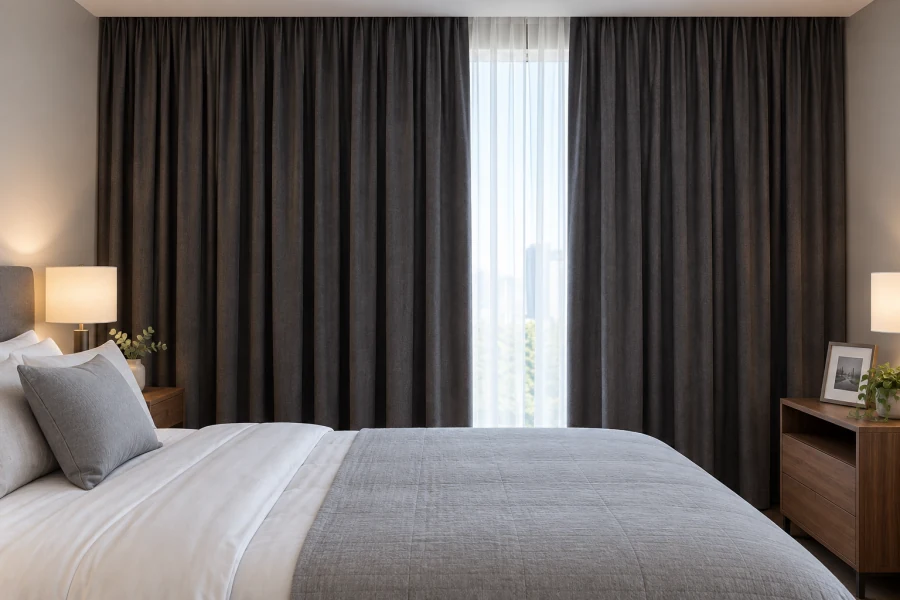
Dim-out curtains cut daylight and glare but leave the room visibly lit, while blackout curtains are made to stop almost all light passing through the fabric. Choose dim-out for living rooms and studies where you still want daylight, and blackout for bedrooms where you need to sleep past sunrise.
It is 7am on a Saturday in a flat facing east. The sun is already over the next block and coming straight through the bedroom curtains, which looked thick enough in the shop. You wanted a lie-in. Down the corridor, the living room curtains are drawn against the same sun, and the room is so dark that someone has switched on the lights at breakfast. One room needed more darkness and the other needed less. That is the blackout and dim-out choice in a single morning.
What dim-out and blackout mean
Dim-out fabric reduces light a lot but does not stop it. With the curtains closed on a bright day, the room goes noticeably dim and the glare goes away, but you can still see your way around, read the time on a wall clock and tell that it is daytime. The fabric usually glows slightly when sun hits it.
Blackout fabric is made to stop light passing through the cloth itself. Hold a good blackout sample up to a bright window and you should see little or nothing through it. In a room, the curtain itself stays dark. Whether the room goes truly dark depends on what happens around the edges, which we cover below.
There is no single industry line where dim-out ends and blackout begins. Suppliers describe their own fabrics, and some sell “dim-out” cloths that are quite dark and “blackout” cloths that are less so. Ask to see the actual sample against daylight rather than relying on the label.
Blackout lining or blackout fabric
There are two common ways to make a curtain block light, and this is where many people get confused.
Blackout fabric has the blocking built in. It is often a woven face with a coated or multi-layer back, or a dense triple-weave cloth. You get one layer that does the whole job. The choice of colours and textures is narrower, and some coated fabrics feel stiffer and hang with less movement.
Blackout lining is a separate layer sewn behind a face fabric of your choice. The face can be linen, a textured weave or a pattern you like, and the lining does the light blocking. This opens up far more fabric choice and the lining also protects the face fabric from sun. The trade-off is weight, a slightly bulkier stack when the curtain is open, and more cost because there are two layers.
A third option is a dim-out lining behind a face fabric. This gives a fuller, more finished curtain than a single unlined cloth, and cuts more light than the face alone, without going fully dark. It suits living rooms where you want softer light and some privacy at night.
A practical point for either route: pale face fabrics with blackout lining are usually fine, but very sheer or loosely woven faces can show the lining through them. Look at the made-up sample, not just the face swatch.
Light leak happens at the edges
You can buy the darkest fabric available and still wake up to a bright line of light. Most leaks come from around the curtain, not through it.
- Sides. If the curtain only just covers the window frame, light spills out past the edges. Making the curtain and track wider than the window, so the fabric overlaps the wall, cuts this down.
- Top. A rod or a track mounted on the wall a little above the window leaves a gap above the fabric. Light bounces up onto the ceiling. A ceiling-mounted track, or a pelmet or curtain box, closes this gap.
- Centre. Where two panels meet, light gets through unless the panels overlap. Overlap arms on the track, or a slightly wider panel, help here. Our guide to choosing a curtain track covers overlap and ceiling mounting.
- Bottom. A curtain that stops well above the floor lets light out underneath. Taking it close to the floor, or down to a deep sill on a shorter window, helps.
This is why a well-fitted blackout curtain usually does better than a blackout roller blind fitted inside the recess: the curtain can be made bigger than the opening and cover the gaps. It is also why we would not promise a “100% dark” room. The fabric can block light; the window, the wall and the ceiling still have a say.
Side-by-side comparison
| Dim-out | Blackout | |
|---|---|---|
| Light through the fabric | Reduced, room still visibly lit | Very little to none through the cloth |
| Daytime use with curtains closed | Comfortable, no lights needed | Usually needs lights on |
| Glare on a TV or screen | Usually reduced well | Removed, but room goes dark |
| Sleep in a sunny room | May not be dark enough | Better suited |
| Fabric feel and choice | Wider range, softer drape | Narrower if blackout fabric; wide if blackout lining |
| Weight on the track | Lighter | Heavier, especially lined |
| Privacy at night with lights on | Good with most fabrics | Good |
| Sun protection for the fabric | Some | Strong, the lining takes the sun |
Which rooms suit each
Bedrooms, especially east- or west-facing ones, usually suit blackout. If anyone sleeps in the day after a night shift, or you have a baby who naps, blackout with a ceiling track and generous side overlap justifies the extra cost. See our blackout curtains page for how we measure and fit them.
Living rooms often suit dim-out better. You want to cut the afternoon glare off the TV and keep the room comfortable, without turning it into a cinema at 3pm. A popular setup is a sheer on one track for daytime privacy and a dim-out curtain on a second track for evenings. Our page on day curtains and sheers explains the double-track arrangement.
Home offices and study rooms depend on the screen. If glare is the only problem, dim-out usually fixes it and keeps daylight in the room. If you take video calls with a bright window behind you, blackout gives you more control.
Media rooms are blackout rooms. Add a ceiling track and side returns if you want the room properly dark.
Children’s rooms often get blackout for naps, sometimes with a sheer on a second track so the room is not dark all day.
Dim-out, blackout or sheer
A sheer is the lightest of the three. It lets daylight through, softens glare and makes it harder to see in from outside during the day, but it gives little privacy at night with the lights on and no darkness for sleep. Dim-out sits in the middle, and blackout stops almost all light through the cloth.
Many Singapore homes use two of them together on a double track: a sheer behind for the day, and a dim-out or blackout curtain in front for the evening. In a living room that usually means sheer plus dim-out. In a bedroom it usually means sheer plus blackout. Our day and night curtains guide explains the setup and the curtain box depth it needs.
Common questions
What is a dim-out curtain?
A dim-out curtain is made from a dense fabric that cuts most daylight and glare but does not stop it completely. With the curtains closed on a bright day, the room goes noticeably dim and you can still see your way around without switching on lights. It suits living rooms, studies and dining areas.
What is the downside of blackout curtains?
Blackout curtains are heavier, so they need a sturdier track and stack wider when open. Coated blackout fabrics come in a narrower range and can hang stiffer, while blackout lining adds weight and cost. With the curtains closed, the room usually needs lights on, which suits bedrooms better than living rooms.
Which is better, blackout blinds or blackout curtains?
For a dark bedroom, a well-fitted blackout curtain usually does better, because it can be made wider and taller than the window and cover the gaps at the edges. A blackout blind inside the recess leaves light at the sides. Our blackout blinds vs curtains guide compares the two in detail.
Is it better to sleep with or without blackout curtains?
For many people, a darker room makes it easier to sleep past sunrise. Blackout curtains help most on east-facing windows, near street lights, and for anyone who sleeps during the day after a night shift. If you find it hard to wake in a fully dark room, leave a small gap or use a sheer instead.
Why is my room so hot even with blackout curtains?
Blackout curtains stop light, but heat still comes through the glass and warms the air and the curtain itself. Gaps at the top and sides let that warm air into the room, and a curtain closed after the sun has heated the glass can only do so much. Close it before the afternoon sun arrives. See our heat guide.
Will dim out curtains be dark enough for sleeping?
For some people, yes, especially in a room that does not get direct morning sun. If you are a light sleeper or the window faces east, dim-out will probably let in more light than you want. Look at the sample against your own window in the morning before deciding.
Is blackout lining as good as blackout fabric?
Both can block light through the cloth well. Lining gives you more face fabric choice and protects the face from sun. Blackout fabric is a single layer and can be lighter. The bigger difference in how dark the room gets usually comes from the width, track and fit.
Do blackout curtains keep the room cooler?
They can reduce the direct sun reaching the room, which helps comfort near a sunny window. How much difference that makes depends on the glass, the window’s exposure and the lining. We do not quote a temperature drop because it has not been measured for your room.
Can I add blackout lining to my existing curtains?
Often a separate lining can be made and hung on its own hooks behind the curtain, or sewn in, depending on the curtain and heading. Whether it is worth doing depends on the condition and size of the existing curtains.
Quiz
Blackout or dim-out: which do you need?
Five quick questions about the room and how you sleep. Open the full quiz
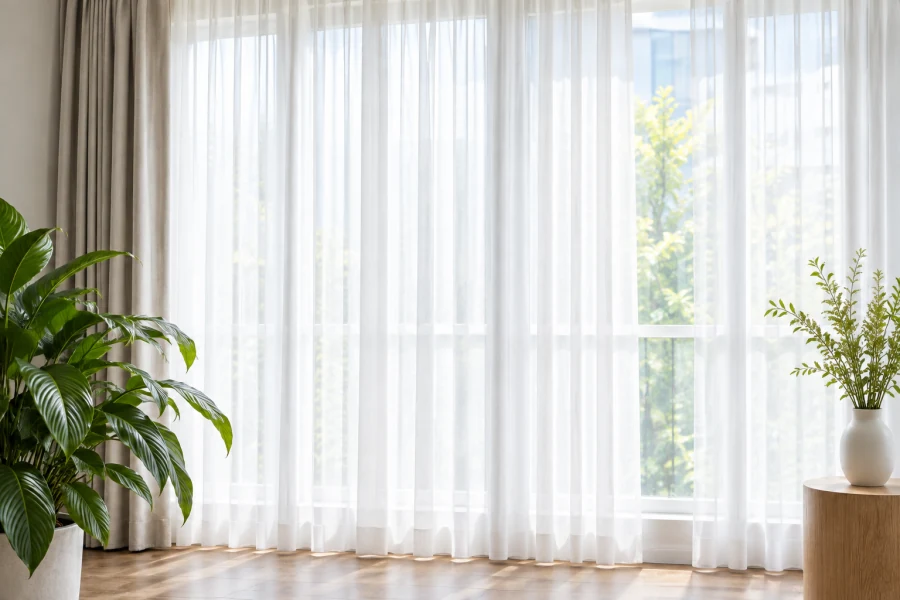 Day and Night Curtains: Layering Sheers with Blackout in Singapore
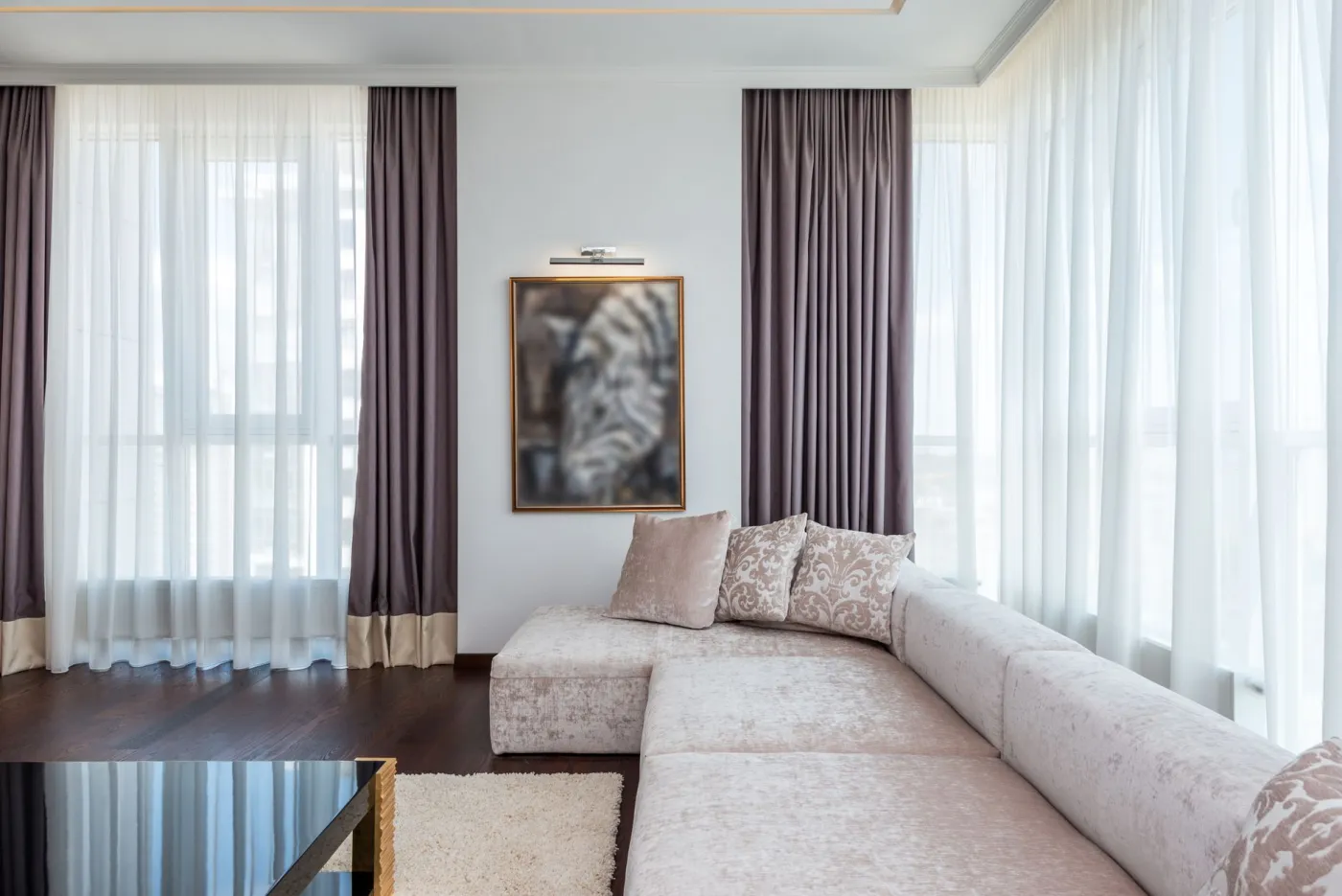 Curtain Pelmets and Curtain Boxes in Singapore Homes
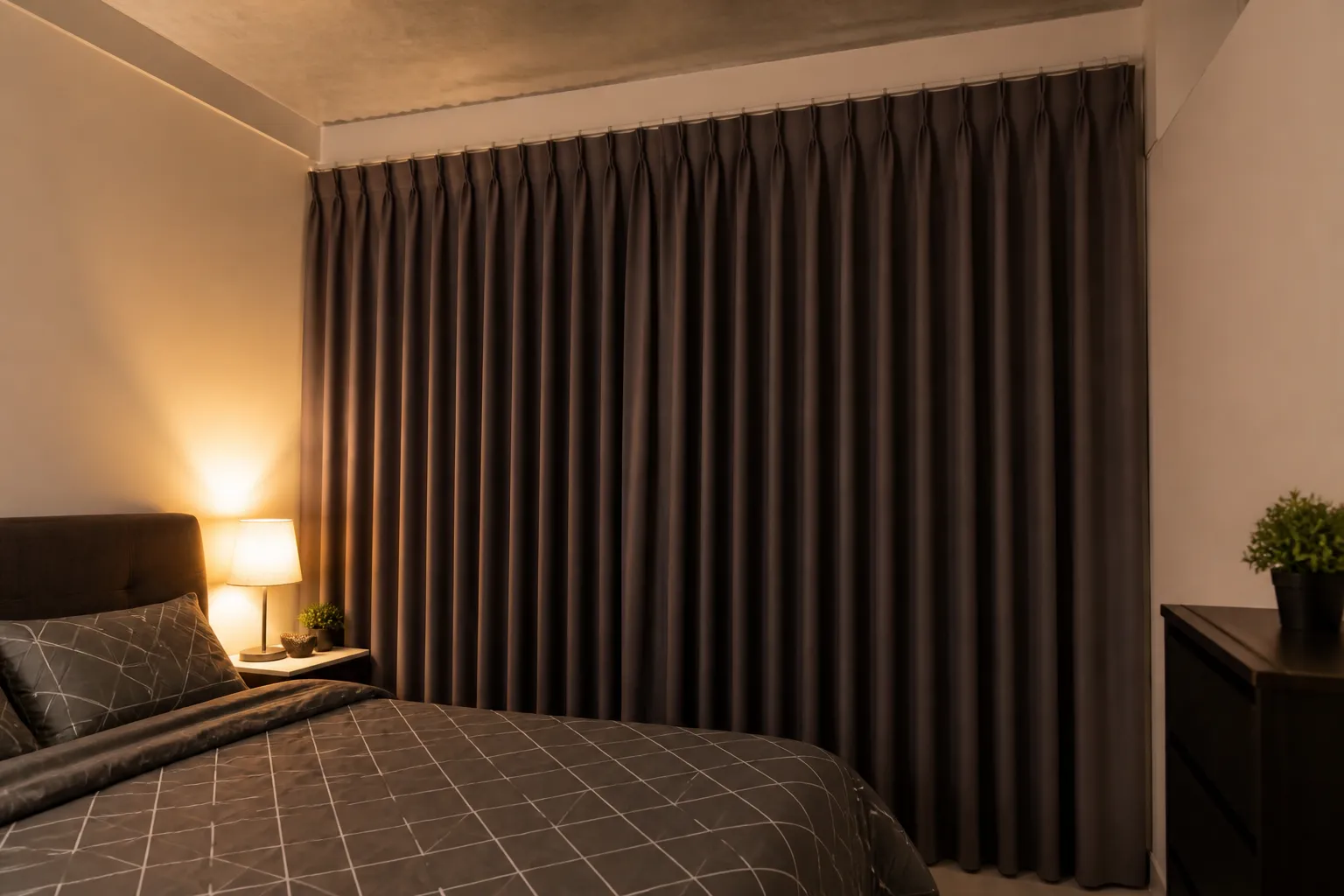 Acoustic and Soundproof Curtains in Singapore: Do They Help in an HDB?