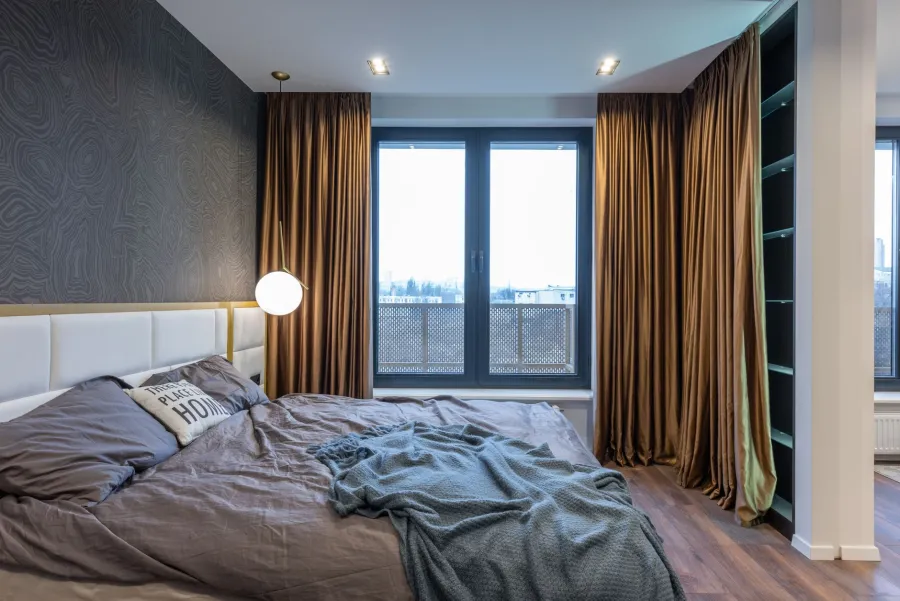
You have just collected the keys to a resale flat. The living room has a wide sliding door to the balcony, the kitchen has a small window above the sink, and the study has a casement right beside where the desk will go. Someone at the renovation showroom says “just do blinds everywhere, cleaner look”. Someone else says curtains make the place feel like a home. Both are right, for different windows.
We sell curtains, so take this with that in mind. We also think you should hear where blinds do the job better, because putting a curtain in the wrong window is a quick way to end up unhappy with it.
The real difference
A curtain is fabric that hangs from a track or rod and stacks to the side when open. A blind sits inside or just over the window opening and moves up and down (roller, Roman, Venetian) or tilts (slats). That one difference explains most of the trade-offs.
Curtains need space beside the window to stack, and they cover more than the glass. Blinds need almost no side space, but they cover the glass and little else.
Where blinds genuinely win
Kitchens and wet areas. A curtain near a stove picks up cooking oil and smells, and a curtain near a sink or in a bathroom stays damp. In Singapore, where humidity sits high all year, damp fabric is something you would rather not manage. A roller blind in a wipeable or moisture-tolerant material, or aluminium Venetian slats, is easier to live with here.
Tight reveals and small windows. Many HDB kitchens, service yards and toilets have a small window with a cabinet, tap or ledge right next to it. There is nowhere for curtain fabric to stack. A blind fitted inside the recess keeps the window clear and the counter usable.
Beside a desk or bed. If a desk, headboard or wardrobe sits tight against the window wall, a curtain gets pushed and crushed every day. A blind lifts out of the way above the furniture.
Fine light control. Venetian slats let you tilt light up towards the ceiling while keeping the view from the next block blocked. A curtain is more open or closed, and does not angle the light in the same way.
A clean, flat look. If you want the window to almost disappear into a minimal wall, a blind sits flatter than any curtain.
Where curtains win
Full-height glass and sliding doors. A wide balcony door or floor-to-ceiling condo window is hard to cover well with one blind. Very wide blinds become heavy and awkward to operate, and several narrow blinds side by side leave gaps. A curtain on a ceiling track runs the full width, stacks to the side, and lets you walk through the door.
Softness and a finished room. Fabric folds soften a room that is otherwise tiles, glass and hard furniture. This is why living rooms and bedrooms usually get curtains even in homes that use blinds elsewhere.
Sound. A heavy, full curtain absorbs some echo in a bare room. It will not soundproof a flat against traffic or a neighbour’s renovation, but it softens the room more than a flat blind. Our guide to acoustic curtains explains what to realistically expect.
Blackout coverage. A blind fitted inside the window recess leaves thin gaps down both sides where light gets through. A blackout curtain can be made wider and longer than the window, and on a ceiling track it covers the frame and the wall around it, which is where a lot of early-morning light leaks in.
Layering. A double track lets you run a sheer by day and a heavier curtain at night. You can get day/night blinds, but a sheer curtain gives more privacy from the next block while keeping the room bright. See day curtains and sheers for how that works.
Side-by-side comparison
| Curtains | Blinds | |
|---|---|---|
| Space needed beside window | Needs room to stack | Very little |
| Kitchens, toilets, service yards | Usually a poor fit | Usually the better choice |
| Full-height glass, sliding doors | Strong fit | Awkward when very wide |
| Light leak at edges | Lower when made wider than the window | Gaps at sides if fitted in the recess |
| Angled light control | Open or closed | Venetian slats can tilt |
| Softness and room acoustics | Softer, absorbs some echo | Flatter, harder surface |
| Day and night layering | Sheer plus night curtain on a double track | Possible with dual or combi blinds |
| Cleaning | Fabric care depends on the cloth; some can be washed, some need professional cleaning | Wipe or dust; roller fabrics vary |
| Furniture tight against window | Gets crushed | Lifts clear |
Using both
Many homes end up with a mix, and that is sensible. A typical split looks like this:
- Living room and balcony door: curtains, often a sheer plus a heavier layer on a double track.
- Bedrooms: curtains with blackout lining, made wider than the window.
- Kitchen, service yard and toilets: blinds.
- Study: either, depending on how close the desk sits to the window.
You can also put a blind inside the recess and a curtain over it. This suits a bedroom where you want the blind for daytime glare and the curtain for darkness and a softer look at night. It costs more and needs a deeper pelmet or ceiling clearance, so it is worth planning before the ceiling and false-ceiling work is done.
If you mix the two, keep the colours related. A white roller blind in the kitchen and a warm grey curtain in the living room can sit together fine, but the change should look planned rather than accidental.
A quick way to decide
Stand at each window and ask three questions:
- Is there space on either side for fabric to stack? If not, lean towards a blind.
- Is it near water, cooking or a desk? If yes, lean towards a blind.
- Is it wide or tall glass, a bedroom that needs to be dark, or a room you want to feel soft? If yes, lean towards a curtain.
Many windows answer clearly. The ones that do not are worth seeing in person, because the answer often comes down to a cabinet, a false ceiling or an aircon unit you only notice on site.
Common questions
Are blinds or curtains better for blocking light in a bedroom?
Both can use blackout material. The difference is coverage. A blind inside the recess usually leaves light at the sides. A curtain made wider and longer than the window, on a ceiling track, usually leaves less light around the edges.
Are blinds easier to clean than curtains?
Often, yes, for day-to-day dusting. Slats and roller blinds can be wiped down in place. Curtains need taking down to wash or send for cleaning, and how easy that is depends on the fabric’s care instructions. Curtains SG also offers curtain cleaning if you would rather not do it yourself.
Can I put curtains in the kitchen?
You can, but a curtain near the stove will absorb oil and cooking smells, and one near the sink will get wet. Most people find a blind easier in a kitchen. A short curtain on a window well away from the hob can work.
Do curtains or blinds look better in a small HDB flat?
It depends on the window. Blinds keep small windows tidy and free up wall space. Curtains hung high and wide can make a living room window look taller. Many small flats use blinds in the utility areas and curtains in the living room and bedrooms.
 Best Curtain Shops in Singapore (2026)
 Where to Buy Curtains in Singapore
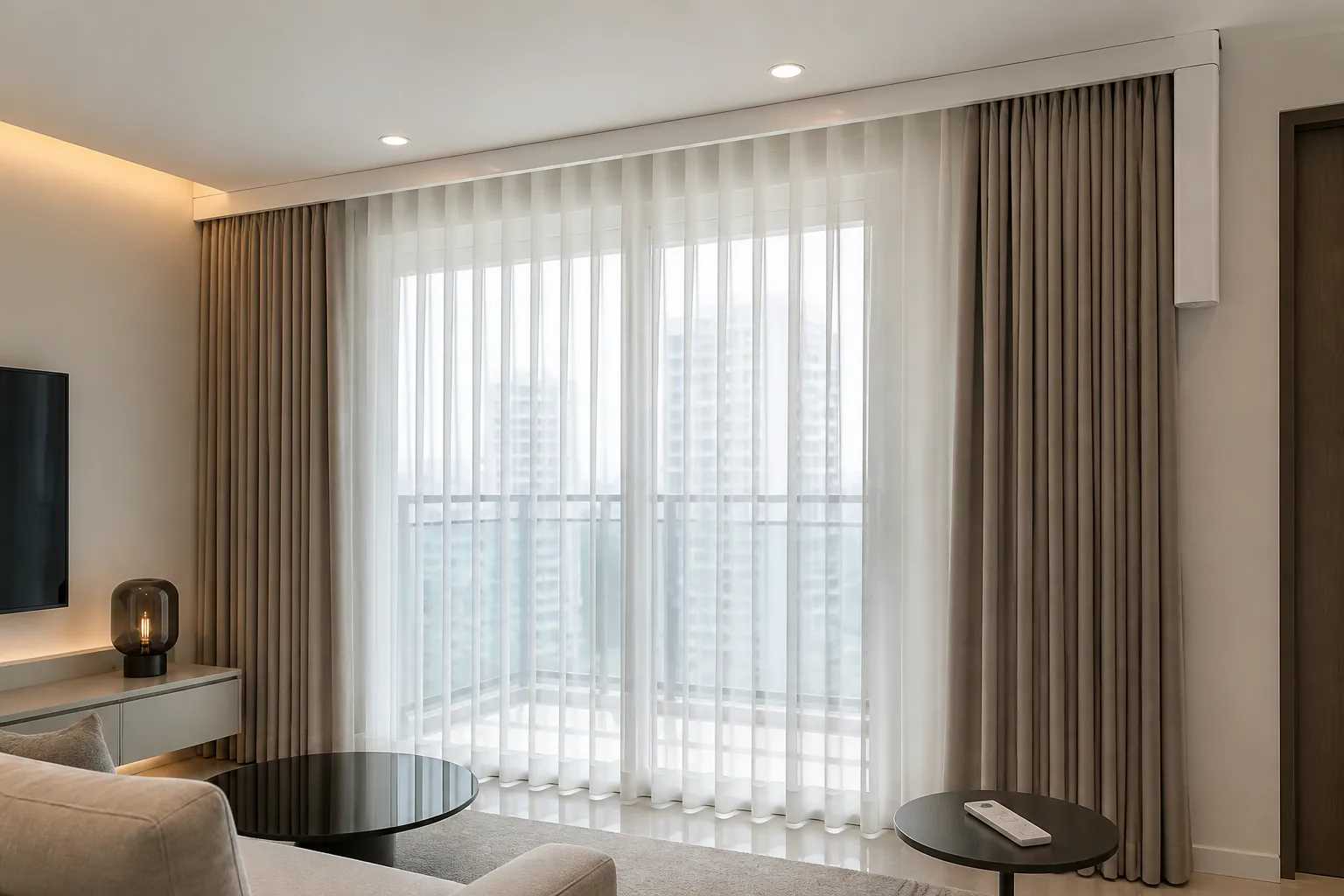 Smart Curtains in Singapore: Motor, Track and Power Guide