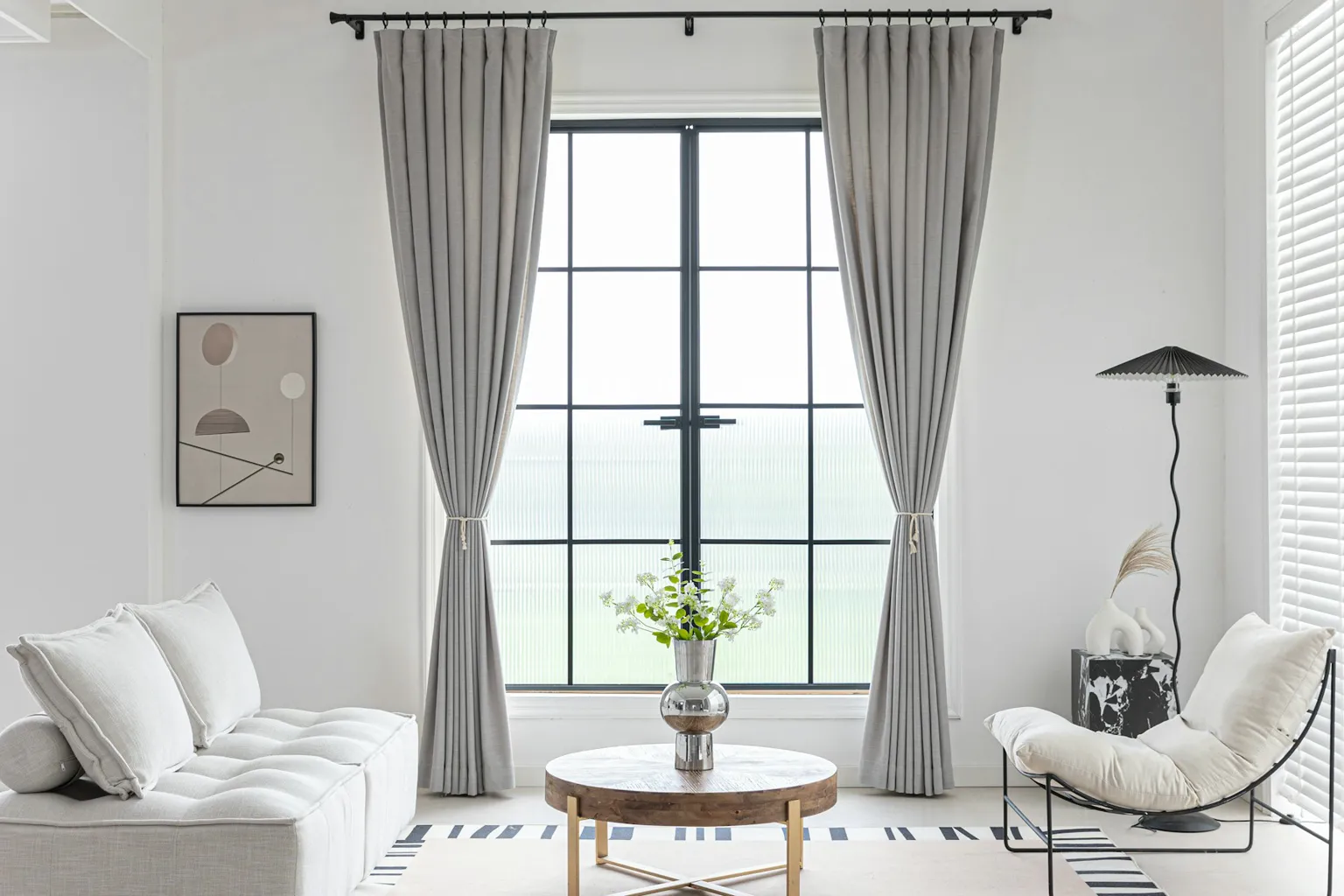
You have just collected the keys to a resale flat. The living room window faces west over a multi-storey carpark, the master bedroom looks across at the kitchen windows of the next block, and the study has a small window just above the desk. Three windows, three different problems, and the same question from whoever is helping you renovate: what curtains do you want? Before choosing colours, decide what each window has to do. The fabric, length and track usually follow from that.
Start with what the window needs to do
For each room, ask four questions.
- How much light do you want with the curtains closed? A bedroom used for sleep wants very little. A living room used in the afternoon usually wants softened daylight, not darkness.
- When do you need privacy? Daytime privacy and night-time privacy are different problems. A sheer stops neighbours seeing in during the day, but once your lights are on in the evening, people outside can see outlines and movement through it.
- Does direct sun hit this window, and at what time? Morning sun on an east-facing bedroom wakes you up. Afternoon sun on a west-facing living room puts glare on the TV.
- How is the room used? A study with a screen, a nursery with daytime naps and a dining area used mainly at night all ask for different things.
Write the answers down for each window. If two rooms come out the same, they can share a fabric. If they differ, they probably need different curtains, even if you want them to look alike from the corridor.
Fabric types for window curtains
Curtain fabrics fall into a few broad groups by how much light they let through.
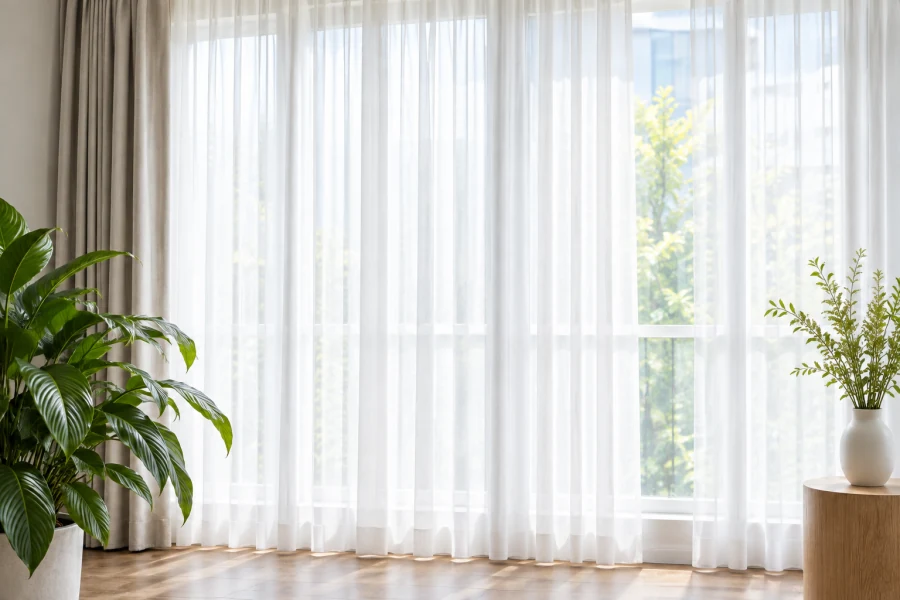
Sheer fabrics are thin and translucent. They soften daylight, cut the view in from outside during the day and let the room stay bright. They do little for sleep or night privacy on their own.
Dim-out fabrics are denser. Closed on a bright day, the room goes dim and the glare goes away, but you can still see your way around without lights. They suit living rooms, studies and dining areas. Our blackout vs dim-out guide compares the two in detail.
Blackout curtains stop most light passing through the cloth, either through a blackout fabric or a blackout lining sewn behind a face fabric you like. They suit bedrooms, nurseries and media rooms. How dark the room actually gets also depends on the track and how far the curtain extends past the window, which we cover below.
Within each group you also choose the fibre. Linen has a soft, natural look and creases easily. Polyester and polyester blends are common in Singapore homes because they keep their size well and are usually easier to care for. Our linen or polyester guide goes through how each behaves in humid rooms.
Ask to see a sample against your own window, at the time of day the room gets its strongest light. A swatch under shop lighting tells you much less.
Full-length or sill-length
Full-length curtains drop from the track to just above the floor. They look finished, cover more of the wall around the window and leave less gap at the bottom for light to spill out. In living rooms and bedrooms, this is the common choice in Singapore homes.
Sill-length curtains stop at or just below the window sill. They suit windows above a desk, a bed headboard, a built-in cabinet or a kitchen counter, where a long curtain would get in the way or drag on furniture. They also use less fabric.
A curtain that stops halfway between sill and floor usually looks like a measuring mistake. Pick one or the other. If you are unsure of the drop, our guide to measuring windows for curtains explains where to take each measurement.
Track position and side coverage
Where the track sits changes how the curtain looks and how much light gets past it.
A track mounted on the ceiling, or inside a curtain box, leaves no gap above the fabric. A track mounted on the wall just above the frame leaves a strip at the top where light bounces onto the ceiling. For a bedroom, ceiling mounting is usually the better choice. Our curtain track guide covers ceiling and wall fixing, and the curtain pelmet guide covers curtain boxes.
Make the track wider than the window. Extending it past the frame on each side does two things. When the curtains are closed, the fabric overlaps the wall and cuts light at the edges. When they are open, the fabric stacks beside the glass instead of covering part of it. Thicker and lined curtains stack wider, so they need more extension than a sheer.
If you are choosing between a decorative rod and a track, our curtain rods vs tracks guide explains which headings suit each.
Layering a sheer with a night curtain
Many Singapore homes use two layers on a double track. The sheer sits closer to the window and stays drawn during the day for privacy and softer light. The night curtain, usually dim-out or blackout, sits in front and closes in the evening.
This setup solves the daytime and night-time privacy problem in one window. It suits living rooms facing other blocks and bedrooms where you want daylight in the afternoon and darkness at night. The trade-offs are more fabric, a deeper curtain box or bracket and a wider stack when both layers are open. Our day and night curtains guide explains the double track, and the day curtains and sheers page explains how the sheer layer works.
West-facing rooms and afternoon sun
A west-facing room in Singapore takes direct sun through the afternoon, all year. Typical daytime highs here sit around 31 to 33°C with little change between months, according to the Meteorological Service Singapore, so this is a daily situation rather than a seasonal one.
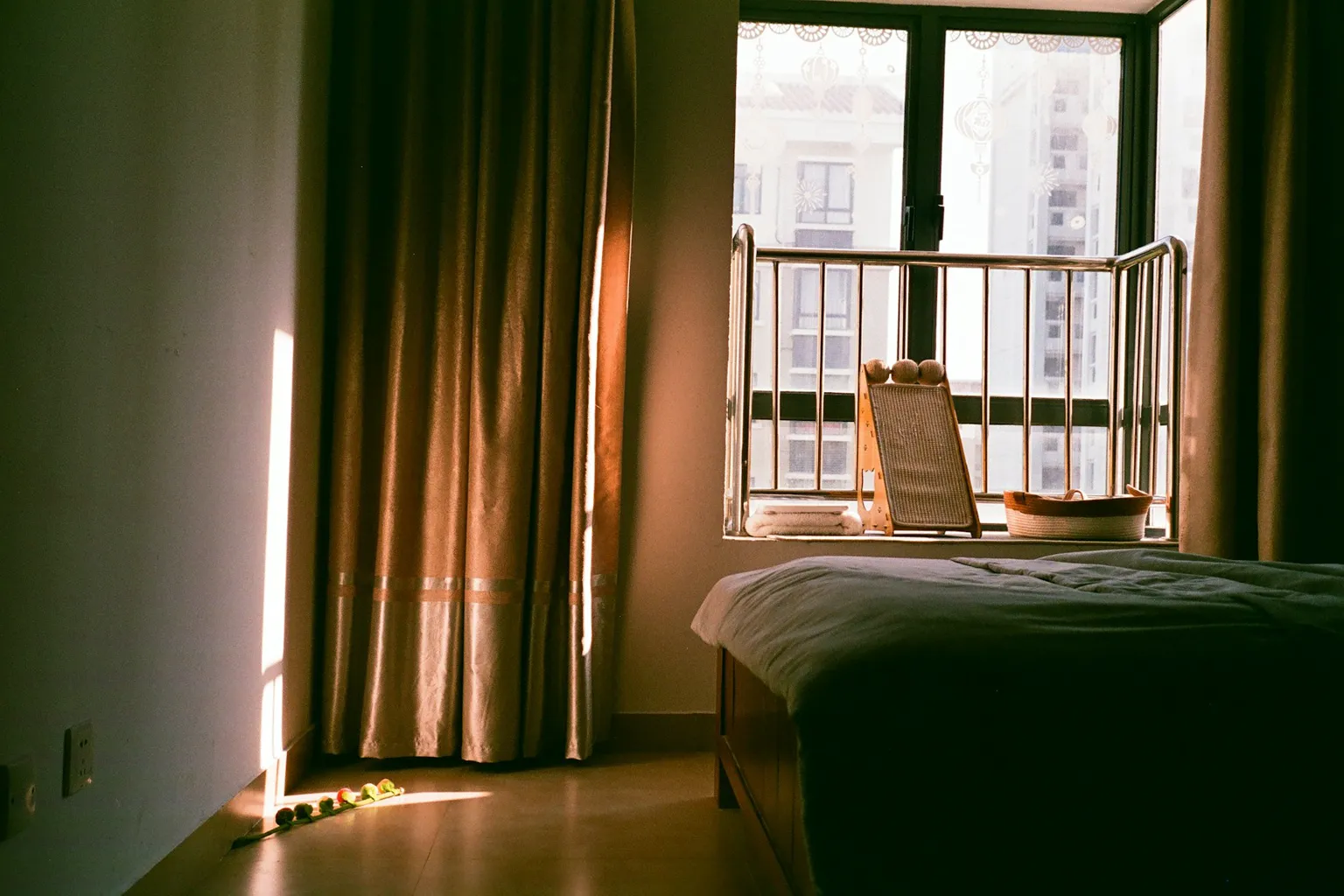
Curtains can help in a few clear ways. Closing a dim-out or blackout curtain cuts the glare on screens and stops direct sun falling on the sofa or floor. A lined curtain reduces some of the radiant heat you feel when sitting close to a sunlit window, and the lining protects the face fabric from fading.
What curtains cannot promise is a set drop in room temperature or a lower electricity bill. The result depends on the glass, the window size, how long the curtains stay closed and whether the air-con is running. We have not measured that for any particular room, so we do not quote figures. If heat is the main problem, a lined curtain with good side coverage is a sensible start, and the window film or glazing is a separate question for a contractor.
Room by room comparison
| Room | Main need | Typical fabric | Length | Notes |
|---|---|---|---|---|
| Living room | Softer light, glare off the TV, night privacy | Sheer plus dim-out on a double track | Full-length | Extend the track so open curtains clear the glass |
| Master bedroom | Darkness for sleep, privacy | Blackout, often with a sheer in front of the glass | Full-length | Ceiling track or curtain box, generous side overlap |
| Children’s room or nursery | Daytime naps, privacy | Blackout, with an optional sheer | Full-length if furniture allows | Choose a cord-free operation where possible |
| Study or home office | Glare control on screens | Dim-out | Sill-length if a desk sits under the window | Blackout if you take video calls with the window behind you |
| Dining area | Evening privacy, daytime light | Sheer, or sheer plus dim-out | Full-length | A lighter fabric suits a room used mainly at night |
| Kitchen, bathroom, service yard | Splash and moisture | Usually a blind instead | n/a | See curtains or blinds |
Care in Singapore humidity
Mean relative humidity in Singapore is around 82% across the year, according to the Meteorological Service Singapore. That outdoor figure does not tell you what happens inside a particular room, but it is a good reason to ask about care before you buy.
Check the care label or supplier instructions for the actual fabric. Some curtains can go into a washing machine on a gentle cycle, some need dry cleaning, and blackout-lined or coated fabrics often need more care than an unlined sheer. Find out how long a curtain takes to dry and where you would hang it, since a full-length lined curtain is heavy when wet.
Open curtains during the day when you can, and leave a little space between the fabric and a window that collects condensation from the air-con. Vacuum or shake out dust from time to time. For heavy, lined or large curtains, professional curtain cleaning saves you taking them down, washing and rehanging them yourself.
Common questions
What is the best fabric for window curtains in a Singapore bedroom?
For sleep, a blackout fabric or a face fabric with blackout lining. Polyester blends are a common choice because they keep their size in humid weather. If you want daylight in the afternoon, add a sheer on a second track.
Should window curtains touch the floor?
Full-length curtains usually stop just above the floor so they do not drag or collect dust. A small gap is normal. If you want a fuller look, ask about a slight break onto the floor, but it needs more frequent cleaning.
How wide should curtains be compared with the window?
Wider than the window, with the track extending past the frame on each side. The fabric itself also needs extra width so it hangs in folds when closed. Our curtain calculator is free and gives you a starting figure.
Do curtains help with heat in a west-facing room?
They reduce glare and some of the radiant heat near the window when closed. We do not promise a temperature drop or bill savings, because that depends on the glass, the room and how you use the air-con.
 18 Types of Curtains: A Singapore Guide to Fabrics, Headings and Layers
 Day and Night Curtains: Layering Sheers with Blackout in Singapore
 Do Blackout Curtains Keep Heat Out in Singapore?