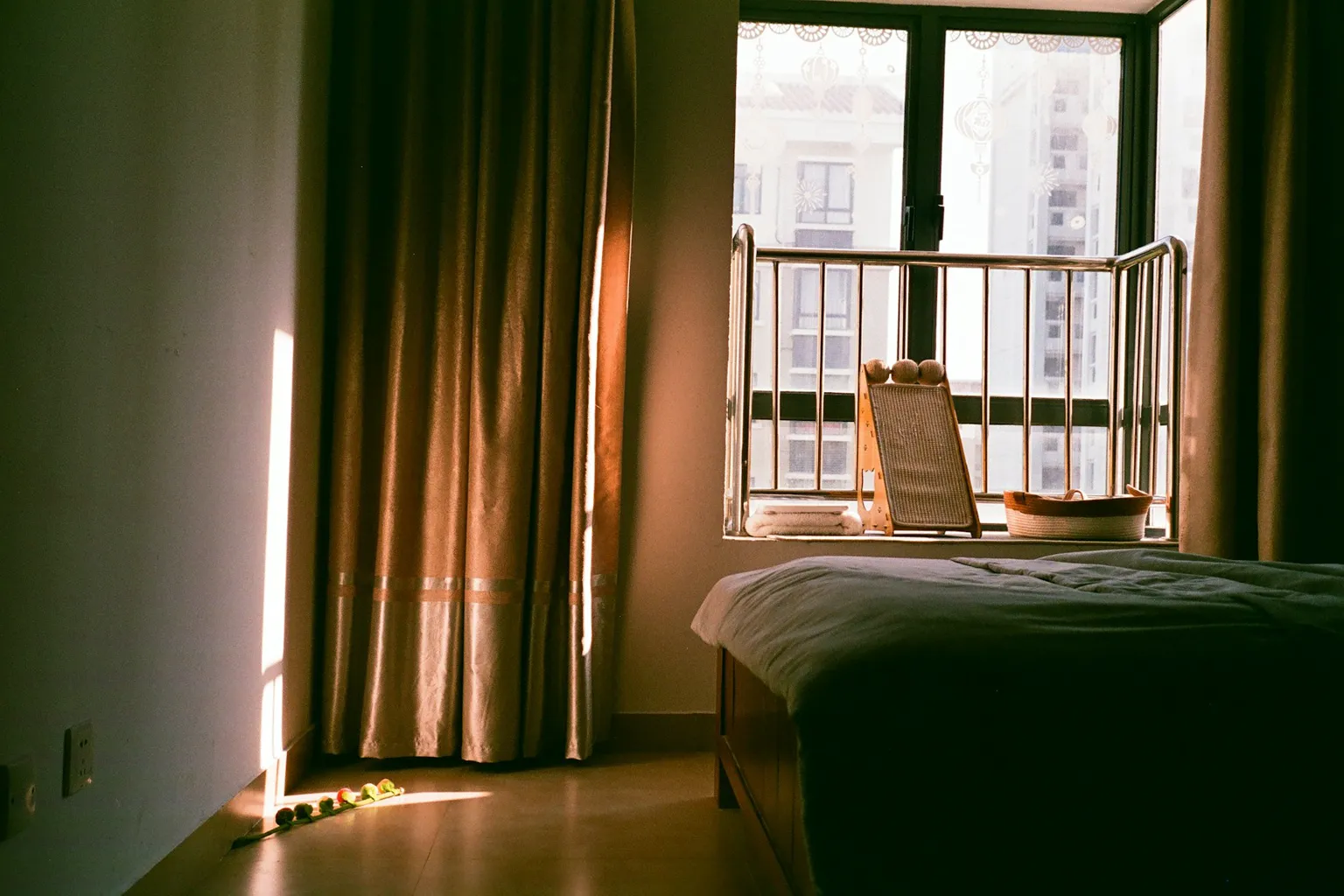
By four in the afternoon, the master bedroom in a west-facing HDB flat can feel like a different climate from the rest of the home. The sun has dropped low enough to come straight through the window, the floor near the glass is warm underfoot, and the aircon takes a long time to make the room pleasant before bedtime. A common question at this point is whether blackout curtains would fix it. They can help, sometimes noticeably, but they work within limits that are easy to understand once you see how the room heats up.
How afternoon sun heats a room
Singapore’s typical daytime maximum sits around 31 to 33°C for most of the year, according to the Meteorological Service Singapore, so there is no cool season to wait out. For a west-facing window, the hours that count are roughly from mid-afternoon until sunset, when the sun is low and shines almost directly into the room.
Two things happen at the window. Sunlight passes through the glass and falls on the floor, the bed and the walls. The floor, bed and walls absorb it and warm up, then release that heat into the air. At the same time, the glass and the window frame themselves warm up from the sun and the outdoor air, and they give off heat into the room for as long as they stay warm, often well after sunset.
A curtain can do a fair amount about the first problem. It can do less about the second.
What a blackout or lined curtain can do
When a blackout curtain is closed, direct sun no longer reaches the floor and furniture. Much of that light is stopped at the curtain instead, so less of it turns into heat deep inside the room. Glare goes away too, which helps if the room also has a TV or a desk.
The colour of the back of the curtain makes a difference. The US Department of Energy’s guidance on residential windows and window coverings notes that drapes with white or light-coloured backings reflect more of the sun’s heat back towards the window. Many blackout linings are white or off-white on the window side for this reason. A dark-backed curtain absorbs more and warms up itself.
Timing also counts. The same DOE guidance recommends closing coverings on west-facing windows during the day, before the sun reaches them. If you draw the curtain at 2pm instead of 5pm, the room has had less time to soak up heat, and there is less for the aircon to remove later.
What it cannot do
A curtain is a shade, so it slows heat gain without producing any cooling. With the curtain closed and no aircon or fan running, the room will still follow the outdoor temperature over the course of the day. It will usually just warm up more slowly and feel less harsh near the window.
The heat that reaches the glass before you close the curtain stays in the glass. A sun-baked window keeps radiating warmth into the gap behind the curtain, and some of that finds its way into the room.
Gaps at the edges let warm air move. The space between the glass and the curtain heats up in the afternoon. If the curtain stops short at the sides, has a gap at the top, or ends well above the floor, that warm air circulates into the room. The same gaps that let light leak around a blackout curtain also let heat around it.
We do not quote temperature drops or electricity savings for curtains. The result depends on the glass, the window’s exposure, the lining, the fit and how the room is used, and none of that has been measured for your room.
Fit and coverage
How the curtain is installed has as much effect on heat as the fabric choice. Things to check:
- Make the curtain and track wider than the window, so the fabric overlaps the wall on both sides.
- Mount the track on the ceiling, or use a pelmet or curtain box, so warm air and light cannot escape over the top. Our guide to curtain pelmets in Singapore explains how a box closes that gap.
- Take the curtain close to the floor, or down past a deep sill on a shorter window.
- Have the two panels overlap where they meet in the middle.
If you are still deciding how dark the fabric itself needs to be, our comparison of blackout vs dim-out curtains covers the difference in light through the cloth and at the edges. For a bedroom, blackout usually makes sense for sleep anyway, and the heat benefit comes along with it. Our blackout curtains page explains how we measure and fit them.
Pairing curtains with other options
A curtain is the last layer on the inside. Other layers stop heat earlier, before it passes through the glass.
| Option | Direct sun and glare | Heat from the window | Daylight with it in use | Notes |
|---|---|---|---|---|
| Blackout curtain, light backing | Blocks it when closed | Slows heat reaching the room; glass still warms | Room goes dark | Fit at the sides, top and bottom affects results |
| Dim-out or lined curtain | Reduces it a lot | Some reduction | Room stays usable | Comfortable for living rooms by day |
| Sheer curtain | Softens it | Little effect on its own | Bright | Good for daytime privacy, paired with a heavier curtain |
| Blinds inside or on the frame | Can block or angle it | Some reduction; edge gaps are common | Adjustable with slats | Compact, sits closer to the glass |
| Window film on the glass | Reduces glare | Can cut heat before it enters | Mostly bright | Check your HDB or condo rules before applying |
| External shading (awning, overhang, shutters) | Blocks sun before the glass | Stops the glass heating up as much | Depends on design | Often restricted in HDB and condos; check with the town council or MCST |
A common setup for a west-facing bedroom is a sheer on one track for daytime and a blackout curtain on a second track for the afternoon and night. Our guide to day and night curtains covers the double-track arrangement. If you prefer something slimmer, our blinds range includes options that sit closer to the glass, and some homes combine a blind with a curtain in front. For the trade-offs between the two, see curtains vs blinds in Singapore.
The DOE’s 2013 study on energy savings from window attachments looked at curtains, blinds, films and exterior shading across different climates. It found the effect varied a lot with the type of attachment, the window and how people operated it, which is one more reason to be cautious about any single figure.
Aircon habits that help
- Close the curtain on a west-facing window before the sun reaches it, not after the room is already warm.
- Keep the curtain closed while the aircon runs in the afternoon and evening, so the cooled air is not losing heat to the glass.
- Open the curtain again after sunset, once the glass has cooled, if you want the room aired out.
Common questions
Do room darkening curtains keep heat out as well as blackout curtains?
Room darkening or dim-out curtains also block a good share of direct sun, so they help with heat. A blackout curtain with a light-coloured backing usually stops more of the sun at the curtain. If the room is a bedroom, the darkness for sleep is often the deciding factor.
Should the back of the curtain be white?
A white or light backing facing the window reflects more of the sun’s heat, according to the DOE guidance above. Many blackout linings are light on the window side, so you can still choose a darker face colour for the room.
Are blackout curtains for the bedroom enough on their own for a west-facing room?
They are a good start, especially with a ceiling track and wide side overlap. If the room still feels warm, consider adding a blind or window film, and check whether any external shading is allowed for your block.
Will the curtain fabric fade or get damaged by the sun?
Fabric facing strong sun every afternoon does fade over time. A lining takes most of that exposure and protects the face fabric. When the lining itself wears out, it can usually be replaced.
Quiz
Blackout or dim-out: which do you need?
Five quick questions about the room and how you sleep. Open the full quiz
 Blackout vs Dim-Out Curtains: Which Do You Need?
 Window Curtains in Singapore: How to Choose for Each Room
 Day and Night Curtains: Layering Sheers with Blackout in Singapore