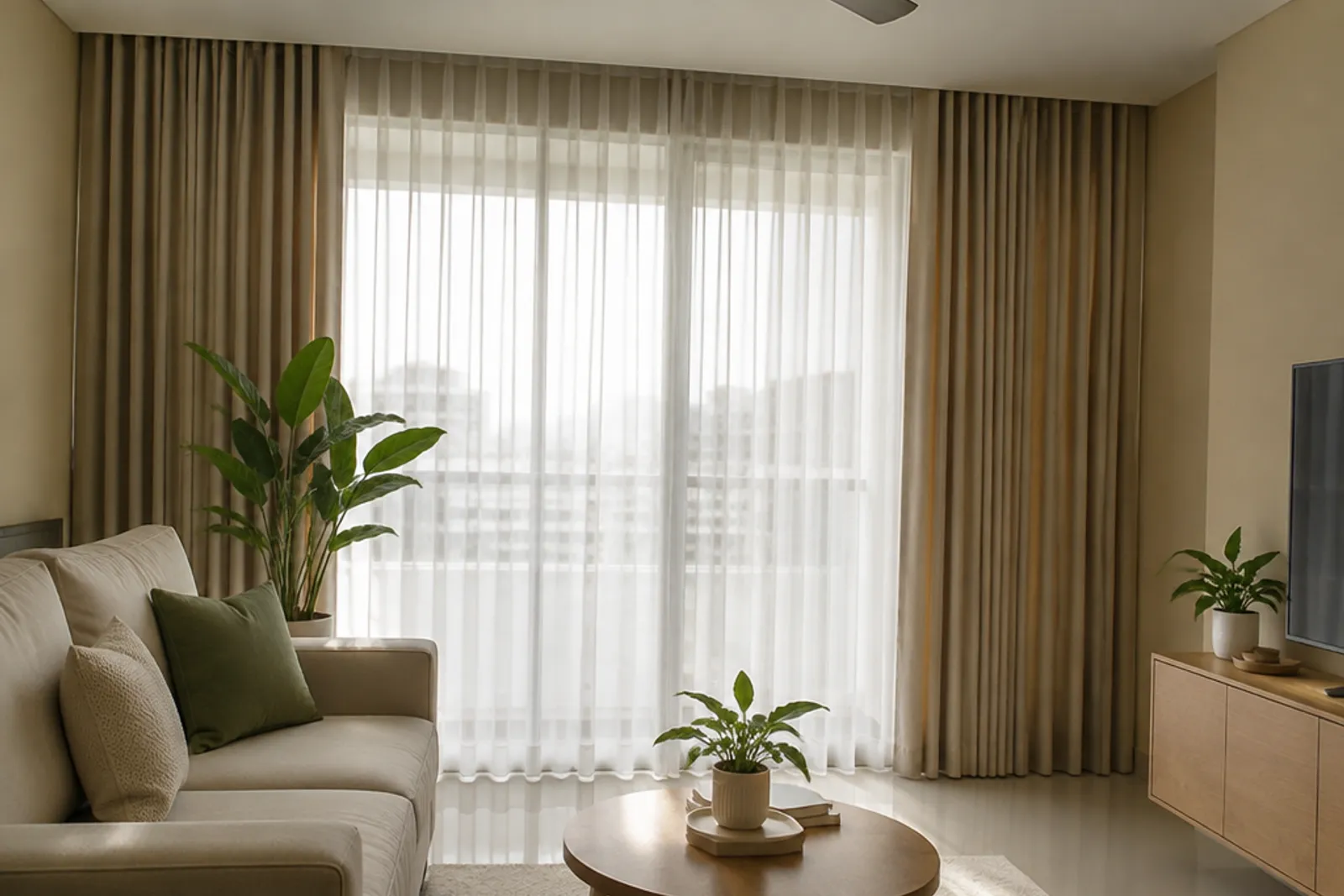
A living room in a Singapore flat usually has one big opening that sets the tone for the room, whether that is a wide HDB window, a sliding door to the balcony or a wall of condo glass. The curtains there are the largest piece of fabric in the home, and they get used every day for light, privacy and glare on the TV. Each idea below includes where it works in an HDB flat or condo, and where it falls short.
1. Ripple-fold sheers on a ceiling track
Ripple fold curtains hang in even, continuous waves from a ceiling track, with no visible pleats at the top. In a living room with a false ceiling or a flat concrete ceiling, mounting the track right at the ceiling line makes the windows look taller and hides the track.
A white or ivory sheer in ripple fold softens daylight from the corridor or the next block without making the room feel closed in. It also stacks neatly when drawn back, which suits HDB living rooms where the window sits close to a side wall. If you are comparing ripple fold with S-fold, pinch pleat and eyelet, our curtain headings guide explains how each one hangs and stacks.
2. Pinch pleat curtains for a more tailored look
Pinch pleats gather the fabric into stitched clusters at the top, giving a structured, formal finish. They suit living rooms with classic or transitional furniture, timber flooring and a heavier fabric.
The trade-off is stacking. Pinch pleat curtains take up a little more space at the sides when open than ripple fold, so check that you have wall space beside the window before choosing them. They work on both rods and tracks, and they keep their folds well in heavier fabrics such as velvet or a lined linen blend. A double or triple pinch gives a fuller look.
3. Sheer and dim-out on a double track
A sheer on the inner track handles daytime, filtering glare and giving privacy from passers-by. A dim-out or blackout curtain on the outer track closes over it in the evening, when the lights are on and the block across can see in.
You draw only the layer you need. On a west-facing living room, the heavier curtain can also go across in the late afternoon to cut glare on the TV. Our guide to day and night curtains explains how to choose the two fabrics so they look right together.
4. Floor-to-ceiling curtains on a short window
Many HDB living rooms have a window that starts at waist height. Running the curtain from ceiling to floor, rather than stopping at the sill, makes the wall look taller and the room more finished.
Widen the track as well, extending it past the window frame on both sides. When the curtains are open, they stack against the wall instead of covering the glass, so you keep the daylight. Leave a small gap of about a centimetre above the floor so the hem does not collect dust or pick up damp from mopping. Use our curtain calculator to work out fabric width for a wider track.
5. A curtain box to hide the track
A curtain box, or pelmet, is a recessed or boxed-in panel at the ceiling that hides the track and the top of the curtain. Many condo and BTO renovations include one in the false ceiling plan.
It gives a clean finish and stops light leaking over the top of a blackout curtain. It needs enough depth for the number of tracks you plan, so a sheer plus a dim-out layer needs a deeper box than a single curtain. Decide on your layers before the carpenter or ID finalises the ceiling. Our curtain pelmet guide covers sizing and placement.
6. Warm neutral colours for a bright HDB living room
Beige, oatmeal, sand and warm grey sit easily with the light timber floors, white walls and grey sofas found in many Singapore flats. They reflect daylight back into the room, and they show less fading from the sun than deep colours.
On a sheer, warm neutrals stop the daylight from looking cold or blue. On a dim-out layer, a mid-tone such as taupe or stone hides the dust and slight discolouration that builds up near a busy road. If you want a feature colour, use it on cushions or a rug and keep the curtains calm, since curtains are the largest fabric area in the room. Our curtain colours guide goes room by room.
7. A deeper colour to anchor a large window
A wall of condo glass can make a living room feel unfinished at night, when the glass turns into a black mirror. A deeper curtain colour in charcoal, navy, forest green or terracotta gives that wall weight and makes the room feel enclosed and comfortable after dark.
Pair the deep layer with a light sheer so the room stays bright during the day. Strong colours do fade faster in direct sun, so this works best on windows that do not face west, or with a lining that protects the face fabric.
8. Linen-look curtains for texture
Linen and linen-look fabrics have a slightly uneven weave that adds texture to a plain room. They suit relaxed living rooms with natural materials, rattan and timber.
Pure linen creases easily and can be prone to mould in a humid flat with little airflow. A linen-look polyester or a linen blend gives a similar texture with easier care. If you do choose pure linen, keep the windows open on dry days and clean the curtains regularly.
9. Japandi and minimalist curtains
Japandi and minimalist living rooms keep the palette small and the lines clean. Curtains for these rooms tend to use ripple fold or S-fold on a hidden ceiling track, in off-white, greige, oat or soft clay, with a fine texture rather than a pattern.
The goal is for the curtains to read as part of the wall when open. Avoid visible rods, finials and tiebacks. You can see examples on our Japandi curtains and minimalist curtains pages.
10. Korean and Scandinavian styles
Korean-style living rooms often use soft white or cream sheers that run the full height of the wall, sometimes with a muted pastel dim-out layer behind. The effect is light and airy, and it suits the white walls and pale furniture popular in new BTO flats.
Scandinavian rooms use similar light colours but bring in more texture, such as a nubby weave, and sometimes a soft grey or sage. Both styles keep hardware discreet and avoid heavy patterns. Browse our Korean curtains and Scandinavian curtains pages, or see all the curtain styles we supply.
11. Luxury curtains with weight and sheen
A luxury look comes from fabric weight, fullness and finish. Velvet, a heavy satin-backed weave or a fabric with a soft sheen hangs in deep folds and catches the light.
The look depends on generous fullness (more fabric than the window width strictly needs) and a hem that just touches the floor. These fabrics are heavier, so they need a sturdy track, and some need professional cleaning rather than a home wash. Our luxury curtains page shows fabrics suited to this style.
12. Curtains for a bay window
Bay windows in older HDB flats and many condos have angled sections and a ledge. You can bend a curtain track to follow the angles so one set of curtains covers every section of the bay, or fit separate Roman blinds or roller blinds to each pane and keep the ledge usable as a seat.
A bent track gives a softer, more finished look. Separate blinds give more control and keep fabric off the ledge, which helps if you use it for cushions or storage. Our guide to bay window curtains covers both approaches in detail.
13. Curtains on a balcony sliding door
A balcony door is used many times a day, so the curtain has to draw fully clear of the opening. Extend the track well past the door frame on the side where the curtain stacks, so it does not block the path.
Choose a fabric that copes with humidity and the occasional splash from monsoon rain blowing in. A sheer or a light polyester dries faster than a heavy blackout. If you want a blind as well, vertical blinds draw aside like a curtain and suit this opening.
14. Motorised curtains on a long track
On a wide living-room window or a full-height condo wall, hand-drawing two layers of curtain across several metres is tiring and pulls on the fabric. A motorised track opens and closes the curtains from a remote, wall switch or app, and can run on a schedule.
This works well with ripple fold, which keeps even spacing on a motorised track. Plan the power point at the end of the track before the false ceiling or curtain box is closed up. Our guide to smart curtains explains the options and what to plan.
15. Mixing curtains and blinds
Some living rooms work best with both. A blind inside the window recess handles daytime light, and a curtain in front adds softness and night cover. A common pairing is Korean combi blinds behind a dim-out curtain, or a sunscreen roller blind behind a sheer.
This suits west-facing living rooms in particular, where the blind can cut glare on the TV while the curtain stays open for a softer look. Check that the blind’s brackets and controls leave room for the curtain track. Our living room blinds guide compares the blind types for this room.
Comparing living room curtain ideas
| Idea | Best for | Things to plan | Care in humidity |
|---|---|---|---|
| Ripple-fold sheer on ceiling track | Modern HDB and condo rooms | Ceiling track position | Light, dries quickly |
| Sheer and dim-out double track | Rooms facing another block | Space for two tracks | Wash sheers more often |
| Floor-to-ceiling on short window | Waist-height HDB windows | Wider track, more fabric | Keep hem off the floor |
| Curtain box | Renovations with false ceiling | Box depth for all layers | Dust the box top |
| Linen-look fabric | Relaxed, natural interiors | Pure linen or blend | Pure linen needs airflow |
| Deep colour | Large condo glass | Sun exposure and lining | Fades faster in west sun |
| Bay window track | Older HDB, condo bays | Bent track or separate blinds | Keep fabric off the ledge |
| Motorised track | Wide or tall windows | Power point before ceiling work | Same as the fabric used |
| Curtains with blinds | West-facing rooms | Bracket and track clearance | Blinds wipe clean |
Practical checks for any living room idea
Whatever style you choose, three checks apply in a Singapore living room. First, look at the direction the window faces. West-facing rooms need a layer that handles afternoon glare. Second, think about who can see in after dark, and make sure one layer gives full privacy with the lights on. Third, plan for humidity and dust. Curtains near a busy road or an open balcony get dusty and damp faster, so a fabric you can wash or have cleaned easily saves effort later. Our curtain cleaning service takes curtains down, cleans them and rehangs them if you prefer not to do it yourself.
Common questions
What type of curtain is best for a Singapore living room?
A sheer curtain with a dim-out or blackout curtain on a double track suits most living rooms. The sheer gives daytime privacy and softer light, and the heavier layer covers the window at night or cuts afternoon glare.
Should living room curtains touch the floor?
Full-length curtains that stop about a centimetre above the floor look neat and stay cleaner. Curtains that pool on the floor look softer but collect dust and can pick up damp when you mop.
Are ripple fold curtains good for HDB flats?
Yes. Ripple fold curtains stack compactly when open, which suits HDB living rooms where the window is close to a side wall. They also work well on ceiling tracks and motorised tracks.
What curtain colour makes a living room look bigger?
Light colours that are close to the wall colour, such as white, ivory or soft beige, make the window wall blend in and the room feel larger. Hanging the curtains from the ceiling to the floor adds to the effect.
Can I use both curtains and blinds in the living room?
Yes. A blind in the window recess and a curtain in front is a common pairing. The blind handles daytime light and glare, and the curtain adds softness and full cover at night.
 10 Curtain Accessories to Know: Tiebacks, Hooks, Finials and Weights
 10 BTO Curtain Ideas by Room
 12 Curtain Mistakes Singapore Homeowners Make (and How to Avoid Them)