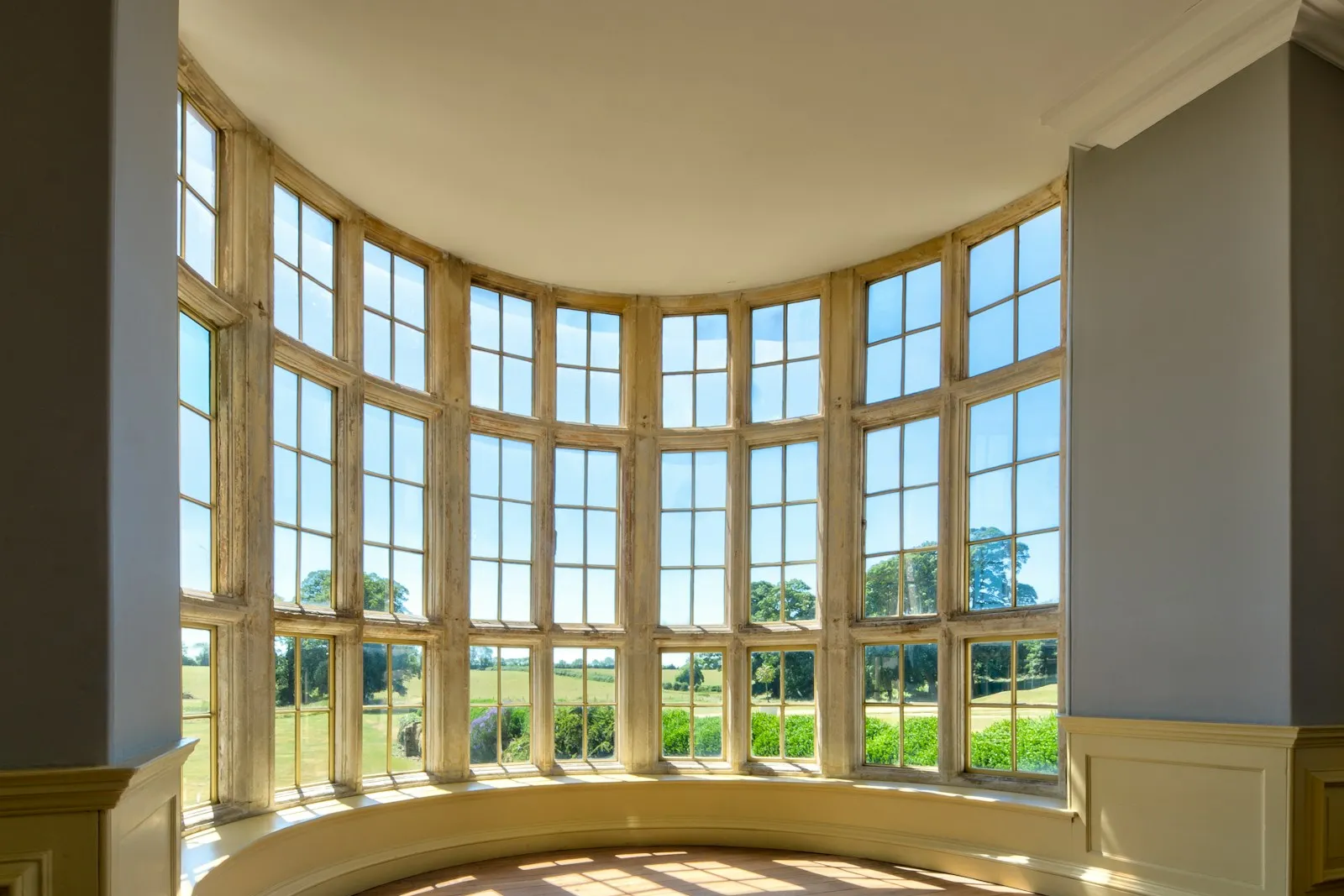
Many Singapore condos and older HDB flats have a bay window: a section of glass that projects out from the wall with a wide ledge at the bottom. It brings in extra light and a place to sit or keep plants. It also makes curtains harder to plan. The glass sits on more than one plane, the ledge gets in the way of a long curtain, and the afternoon sun can reach the room from two or three directions at once. Before choosing a fabric, decide where the curtain or blind will hang and how you want to use the ledge.
Angled bays and box bays
Bay windows in Singapore homes come in two common forms.
An angled bay has a centre pane facing straight out and two side panes set at an angle, often around 45 degrees, so the bay looks like half of a hexagon from above. In condos the bay is often in the master bedroom or living room.
A box bay projects out as a rectangle, with side panes at right angles to the main window. Some box bays are shallow, with a ledge only deep enough for a few pots. Others are deep enough to sit or even lie on, with a concrete ledge at roughly chair height. Some older HDB flats and many condos have this type, sometimes with a cabinet built under the ledge.
The difference affects the hardware. A box bay has clean right-angled corners, so separate straight tracks or blinds meet neatly. An angled bay has wider corners, and a track that follows the glass has to be bent to match those angles exactly. Measure each pane separately and note the angle of each corner. A home measuring visit helps here, because the walls and ceiling in a bay are rarely perfectly square.
Three ways to dress a bay window
There are three main approaches, and each changes how the room and the ledge are used.
- One curtain straight across the room, in front of the bay. The track runs wall to wall across the mouth of the bay, and the bay itself sits behind the curtain.
- Curtains that follow the bay, on a bent or curved track mounted to the ceiling of the bay or just above the glass.
- A separate blind on each pane, mounted inside the bay, sometimes with a curtain across the room as well.
Curtains across the room
This is the simplest option. A straight track runs across the opening of the bay, and the curtain hangs down to the floor in front of the ledge. When closed, it hides the bay, ledge and all. When open, it stacks at the sides of the opening.
It suits bedrooms where the ledge is mainly a shelf and darkness at night is the priority. A full-length blackout curtain across the room covers the glass and the gaps around it in one sweep, and there is no light leaking through the corners where separate panels would meet.
The trade-off is that you lose the bay when the curtain is closed. You cannot sit on the ledge with the curtain drawn, and plants on the ledge get no light. If you want a seat in the bay, this approach alone will not work well.
Curtains on a bent track inside the bay
Here the track follows the outline of the bay, usually fixed to the ceiling of the bay so the curtain hangs just inside the glass and down to the ledge. The curtain can then draw around the corners on one continuous track.
This keeps the ledge usable on the room side of the curtain, so you can sit there with the curtain closed behind you. The track is bent to the angles of your bay, so each corner has to be measured accurately. Our guide to curtain tracks in Singapore explains the track types and how ceiling and wall fixing compare.
There are limits. The curtain is short, usually only down to the ledge, which looks less formal than a floor-length drape. When opened fully, the fabric has to stack somewhere, and in a narrow bay it may cover part of a side pane. A tight-angled corner can also make the curtain drag as it passes round. Some homes avoid this with a separate straight track on each pane instead of one continuous track. That is simpler and stacks better, though you then open each section by hand.
A pelmet across the top of the bay can hide the track and the gaps at the ceiling line, and makes the bay look finished.
A separate blind on each pane
Fitting one blind per pane is often the neatest result in a bay. Each blind sits inside the frame of its own pane, so the ledge stays completely clear and you can raise or lower each side on its own.
That last point helps in Singapore. In a west-facing bay, the sun may hit one side pane in the early afternoon and the centre pane later. You can lower only the blind that faces the sun and leave the others up for light and the view.
Good choices for bay window blinds include:
- Roller blinds, with sunscreen fabric for daytime glare or blackout fabric for bedrooms. They roll up small and leave the glass almost fully clear.
- Korean combi blinds, which let you switch between see-through and covered stripes without raising the blind. They suit a bay facing another block closely.
- Venetian blinds in aluminium or PVC, which let you angle slats up for daylight while blocking the view in.
- Roman blinds, for a softer, fabric look on narrower panes.
The weak spot is the corners. Each blind leaves a small gap at its edges, and in an angled bay those gaps meet at the corners, so some light passes through. For a bedroom that needs to be properly dark, a blind per pane alone may not be enough. That is why many bays use blinds for the day plus a curtain across the room for the night.
Using the ledge as a seat
A deep bay ledge can work as a reading seat or a daybed, often with a cushion and a few pillows. If that is your plan, it decides most of the other choices.
The curtain or blind has to sit on the window side of the seat. Blinds inside each pane, or a short curtain on a bent track in the bay, both do this. A curtain across the room does not, because it hangs in front of the seat.
Check how you will reach the controls. Leaning across a cushion to pull a chain on the far pane gets tiresome. A wand or a motorised blind is easier to use from a seated position. Motorised blinds and smart curtains need a power point near the bay, which is easiest to add before renovation closes the ceiling or the ledge.
Think about heat as well. The ledge sits right against the glass, and the glass gets hot in the afternoon. Singapore’s daytime maximum is typically around 31 to 33°C across the year (Meteorological Service Singapore), so a west-facing seat may be uncomfortable without some cover on the glass. A sunscreen or blackout roller on the sunny panes, lowered in the afternoon, makes the seat more usable.
Sun, privacy and the view
Bay windows are designed to take in more of the view, which also means they show more of the room to the outside. In a condo facing another tower, or a low HDB floor facing a walkway, plan for evening privacy, when the room is lit and the outside is dark.
For daytime, a sheer or day curtain lets light in and softens the view in from outside. Our page on day curtains and sheers covers the fabrics. At night, sheers alone are not private, because a lit room shows through them. Pair them with a blackout or dim-out layer, or use combi or venetian blinds that can be closed.
For sun, the direction of each pane counts for more in a bay than on a flat window. A bay facing south-west may get morning shade on one side and strong late sun on the other. Separate blinds give you control pane by pane, which a single curtain across the room cannot.
Comparing options for a bay window
| Option | Ledge use | Night darkness | Sun control by pane | Look | Main drawback |
|---|---|---|---|---|---|
| Curtain across the room | Hidden when closed | Good with blackout lining | No | Full-length, formal | Bay unusable with curtain drawn |
| Curtain on bent track in the bay | Usable on the room side | Fair, some gaps at the ledge | Partly | Short, fitted | Stacking and corner drag on tight angles |
| Separate straight tracks per pane | Usable on the room side | Fair | Yes | Short, fitted | Each section opened by hand |
| Blind on each pane | Fully clear | Light gaps at the corners | Yes | Neat, minimal | Not fully dark on its own |
| Blinds per pane plus curtain across the room | Usable in the day | Good | Yes | Layered | Two systems to buy and maintain |
Humidity, monsoon rain and mould
A bay window has more glass and more corners than a flat window, and the ledge can collect condensation where an air-conditioned room meets warm glass. Singapore’s mean annual relative humidity is around 82% (Meteorological Service Singapore), and fabric pressed against a damp ledge or a corner of the frame can develop mould spots over time.
A few habits help:
- Keep curtains a little clear of the glass and the ledge, so air can move behind them.
- Open blinds and curtains in the morning to let the bay dry out, especially during the monsoon months when windows stay closed more often.
- Check the window seals before the rainy season. A bay has more joints, and a small leak at the ledge will wet the bottom of the curtain first.
- Choose fabrics you can clean easily. Roller and venetian blinds wipe down, while a fabric curtain needs washing or professional cleaning. Our guide on how to wash curtains and our curtain cleaning service cover both.
Measuring a bay window
Measure each pane separately: width inside the frame, height from the top of the frame to the ledge, and the depth of the recess. Note the angle at each corner for an angled bay, and check whether the ceiling of the bay is level with the room ceiling or lower. Look for anything that will get in the way, such as window handles, a grille, an air-conditioner unit or a downlight.
If you are planning a curtain across the room, also measure the width of the bay opening and the height from the ceiling to the floor. Our curtain calculator can help you estimate fabric width for a straight track. For a bent track, the measurements are more involved, and we would rather measure on site than work from photos.
Common questions
Which curtain suits a bay window?
It depends on the ledge. If you want to sit on it, use blinds on each pane or a short curtain on a track that follows the bay. If the ledge is just a shelf and you want a dark bedroom, a full-length blackout curtain across the room in front of the bay is simpler and blocks more light.
Can a curtain track be bent to fit a bay window?
Yes. Aluminium curtain tracks can be bent to match the angles of a bay, so one curtain can draw around the corners. The bends need accurate measurements of each corner, and tight angles can make the curtain drag, so separate straight tracks on each pane are sometimes the better fit.
Should I use one blind or separate blinds for a bay window?
Use separate blinds, one for each pane. A single blind cannot follow the angles of a bay, and separate blinds let you lower only the side facing the sun. The trade-off is small light gaps at the corners where the blinds meet.
How do I keep a bay window dark at night?
Blinds alone leave gaps at the corners and edges. For a properly dark bedroom, add a blackout curtain across the room in front of the bay, or hang lined curtains on a track inside the bay with enough overlap at each corner.
Do condo curtains for a bay window need a pelmet?
They do not need one, but a pelmet hides the track and the gap at the top of the bay and gives a finished look. It is usually built as part of carpentry, so decide on it before renovation finishes.
 15 Living Room Curtain Ideas for Singapore Homes
 10 Curtain Accessories to Know: Tiebacks, Hooks, Finials and Weights
 Blinds for Offices in Singapore: Glare, Screens and Meeting Rooms