To measure for curtains, decide where the track or rod will hang, then measure its width (or the window frame plus an extension on each side) and the drop from that fixing point to where the curtain should end, taking each reading in three places. Add a few photos of the wall and ceiling, and a fitter can quote from those numbers.
You have a new BTO bedroom, a measuring tape and a WhatsApp chat asking for “rough sizes”. You measure the glass, send the number, and then the questions start. Ceiling or wall? To the sill or the floor? Is there a curtain box? Measuring for curtains is less about the window itself and more about where the curtain will hang and where it should stop. A few extra numbers and photos now save a second round of messages later.
What to measure before a home visit
Your own measurements are enough for an early quote and for comparing fabrics. For made-to-measure curtains, the fitter will still take final measurements on site before anything is cut. Think of your numbers as a good first draft.
You need a steel measuring tape, a notepad or phone, and a step stool. Measure in millimetres or centimetres, and stay with one unit. A cloth tape stretches and is not reliable over a long window.
Step-by-step
- Decide where the curtain will hang. Ceiling, curtain box, or wall above the frame. If there is already a track or rod you plan to keep, measure that instead of the glass.
- Measure the width. For a new track or rod, measure the window frame from outside edge to outside edge, then decide how far past the frame the hardware should extend on each side. Allowing extra width at each side lets the curtains stack off the glass when open. For an existing track, measure its full length end to end.
- Measure at three heights. Take the width at the top, middle and bottom of the frame. Older walls are not always square. Write down all three.
- Measure the drop. Measure from the ceiling, the underside of the curtain box, or the track itself down to where you want the curtain to end. Take it at the left, middle and right. Floors and ceilings in older flats are not always level.
- Note the finish point. Sill length, just below the sill, or floor length. For floor length, curtains are usually made to finish slightly above the floor so they do not drag or collect dust. Tell us how far above, or ask us to set it.
- Record what is around the window. Aircon units, switches, window handles, grilles, a wardrobe or a corner. Measure the distance from the frame to each one.
- Take photos. One straight-on photo of the whole wall, one of the ceiling or box above the window, and one of each side.
Recording table
Copy this table and fill in one per window.
| Item | What to write | Example entry |
|---|---|---|
| Room and window | Name it so the quote is clear | Master bedroom, main window |
| Mounting | Ceiling, curtain box, or wall | Curtain box |
| Existing hardware | None, track, or rod, and its length | Track, keep |
| Width at top / middle / bottom | Three readings | Your three numbers |
| Planned hardware width | Frame width plus extension each side | Your number |
| Drop at left / middle / right | From mounting point to finish point | Your three numbers |
| Finish point | Sill, below sill, or floor | Floor |
| Obstructions | Aircon, switch, handle, grille, distance from frame | Switch on left |
| Opening | Pair to the centre, or one panel to one side | Pair |
| Layers | Single, or sheer plus night curtain | Double |
| Photos | Front, top and both sides | 4 sent |
The example column shows the format only. Use your own measurements.
Width: window, track or rod
The curtain is made to cover the track or rod, not the glass. A pair of curtains also needs fabric for fullness, so the finished curtain is wider than the track when flat. How much extra depends on the heading. Pleated and wave headings each use a different amount of fabric.
You do not need to work that out yourself. Send the track or rod width and the heading you want, and we will calculate the fabric. If you would like a rough figure first, our curtain width calculator gives an estimate from your track length and heading.
For a pair that meets in the middle, the two panels usually overlap slightly so light does not show through the join. Mention if you want this. On a blackout curtain, the overlap and the side returns matter as much as the fabric.
Drop: sill, apron or floor
Sill length is tidy for kitchens or windows above a desk. Below the sill, sometimes called apron length, covers the bottom edge of the frame and cuts the light that slips under a short curtain. Floor length is the usual look in Singapore living rooms and bedrooms with ceiling tracks.
Measure the drop to the finish point you want, not to the floor by default. If skirting, a raised ledge or a platform bed sits under the window, note it.
How long should curtains be
The finish point changes how the room looks and how much cleaning the hem needs. There are four common lengths.
| Length | Where the hem finishes | Suits | Trade-off |
|---|---|---|---|
| Sill length | Just above the window sill | Kitchens, windows above a desk or bench | Light shows under the hem, and the window can look short |
| Below the sill | Past the sill, covering the bottom of the frame | Bedroom windows with a wall below | Needs clear wall under the window, with no furniture in the way |
| Floor length | Just clear of the floor | Living rooms and bedrooms with ceiling tracks | Needs an accurate drop, because a short hem shows |
| Puddle | Extra fabric resting on the floor | Formal rooms where the curtain is rarely drawn | Collects dust and gets wet when the floor is mopped |
Floor length is the usual choice in Singapore flats. The hem sits just off the floor, close enough that you do not see a strip of skirting below it, but high enough that it does not drag when drawn or catch on a robot vacuum. Measure at the left, middle and right, because the floor may not be level, and tell us the finish you want.
Puddled curtains look soft in a formal room, but they need lifting every time the floor is mopped, and a damp hem in a humid flat starts to smell. I would only suggest them where the curtain stays open most of the time.
Hanging the track at or near the ceiling, rather than just above the frame, makes the window look taller, and a full drop from there to the floor is a common look in HDB and condo flats. If the curtain is linen or another fabric that can shrink when washed, mention it, so the drop can allow for it.
How wide should curtains be
Two widths are involved. The first is the track or rod. The second is the fabric that hangs from it.
The track should be wider than the window frame. Extend it past the frame on each side so the curtains can stack off the glass when open. How far depends on the stack, which depends on the heading and the fabric. A thick lined curtain stacks wider than a sheer. If you want the glass fully clear when the curtains are open, extend further. If there is a wall, wardrobe or aircon unit close to the frame, measure how much space you have before deciding.
The fabric is then wider than the track. This is fullness, the ratio between flat fabric width and track width. A 2x fullness on a 3m track means roughly 6m of fabric across a pair, so each panel is about 3m wide when laid flat. Typical ranges vary by heading. S-fold is often around 2x and set by the carrier spacing. Pinch pleat is often around 2x to 2.5x. Eyelet is usually lower, often around 1.5x to 2x. Our guide to curtain headings explains how each one folds.
For a pair, add a little for the overlap where the panels meet in the middle, and for returns if the curtain wraps back to the wall at the ends. We work those out when the curtains are made. To get a rough fabric width from your track length and heading, try the curtain calculator.
Recess or face-fix on HDB and condo frames
Some windows sit in a recess, with wall on both sides. A curtain fixed inside the recess has to be narrower than the opening and leaves light at the edges. Most curtains in Singapore flats are fixed outside the frame, on the ceiling or the wall above, so they can cover the full window.
Full-height condo glass often has no wall above or beside it. The track goes on the ceiling, and the drop is ceiling to floor. In that case, measure the ceiling-to-floor height at several points along the glass.
If the curtain box is already built, measure its inside depth. A double track for a sheer and a night curtain needs room for both.
When to wait for the fitter
Some windows are easier to measure in person:
- Bay windows and corner windows, where the track bends.
- Windows near a false ceiling, where the fixing point is unclear.
- Household shelter bedrooms and newer rooms with ferrolite walls, where drilling rules apply. Our curtain track guide covers those limits.
- Any room where you are not sure whether to use a track or a rod.
Send what you have, mark these as unsure, and leave the final reading to the fitter.
How to measure for a curtain rod
Measuring for a rod follows the same steps as a track, with three differences. First, the drop starts at a different point: for a ring-top curtain, measure from the eye of the ring, and for eyelets, from the top of the rod. Second, the rod is longer than the space between the brackets, so allow for the finials at each end and check they clear any wall or wardrobe. Third, look at what is above the window, because rod brackets need solid wall to screw into.
Eyelet curtains usually use less fullness than pleated ones, often around 1.5x to 2x the rod width. Our curtain rods vs tracks guide explains when a rod suits better than a track.
Common questions
Do I measure the glass or the existing track?
If you are keeping the track, measure the track. If you are fitting new hardware, measure the frame and add the extension you want at each side.
How much extra width should I add for overlap?
Add the extension you want for stacking at each side when you set the hardware width. The fabric allowance for fullness and the centre overlap is worked out when the curtains are made, so you do not need to add it to your measurement.
Can I measure myself before a made-to-measure visit?
Yes. Your measurements help with an early quote and fabric choice. The fitter checks them on site before cutting.
How long should curtains be from the floor?
For floor-length curtains, the hem usually sits just clear of the floor so it does not drag or collect dust. Measure the drop in several places, because floors are not always level.
Should curtains be wider than the window?
Yes. The track or rod usually extends past the frame on each side so the curtains can stack off the glass, and the fabric itself is wider again because of fullness.
Why are my three width readings different?
Walls and frames are often slightly out of square. Record all three. We use them to decide where the curtain needs to cover.
How long should bedroom curtains be?
Most bedroom curtains in Singapore flats are floor length, hung from a ceiling track with the hem just clear of the floor. That covers the whole window and cuts light at the bottom edge. Where there is clear wall under the window, below-sill length also works. Sill length lets light in under the hem.
How much bigger should your curtains be than your window?
Bigger on two counts. The track or rod extends past the frame on each side so the curtains stack off the glass, and the fabric is wider than the track because of fullness: often around 2x for S-fold, 2x to 2.5x for pinch pleat and 1.5x to 2x for eyelet.
What width curtains for a 240cm window?
Start with the track, not the glass. The track should extend past the 240cm frame on each side so the curtains can stack off the glass. Then multiply the track length by the fullness. At 2x, every metre of track needs about 2m of fabric across the pair, so a 240cm window needs more than 4.8m of fabric in total.
Should I measure curtain width or length first?
Decide the mounting point first, because both measurements start there. Width first is the usual order, since it fixes where the track or rod sits. Then measure the drop from that point down to the finish you want, at the left, middle and right, and record every reading.
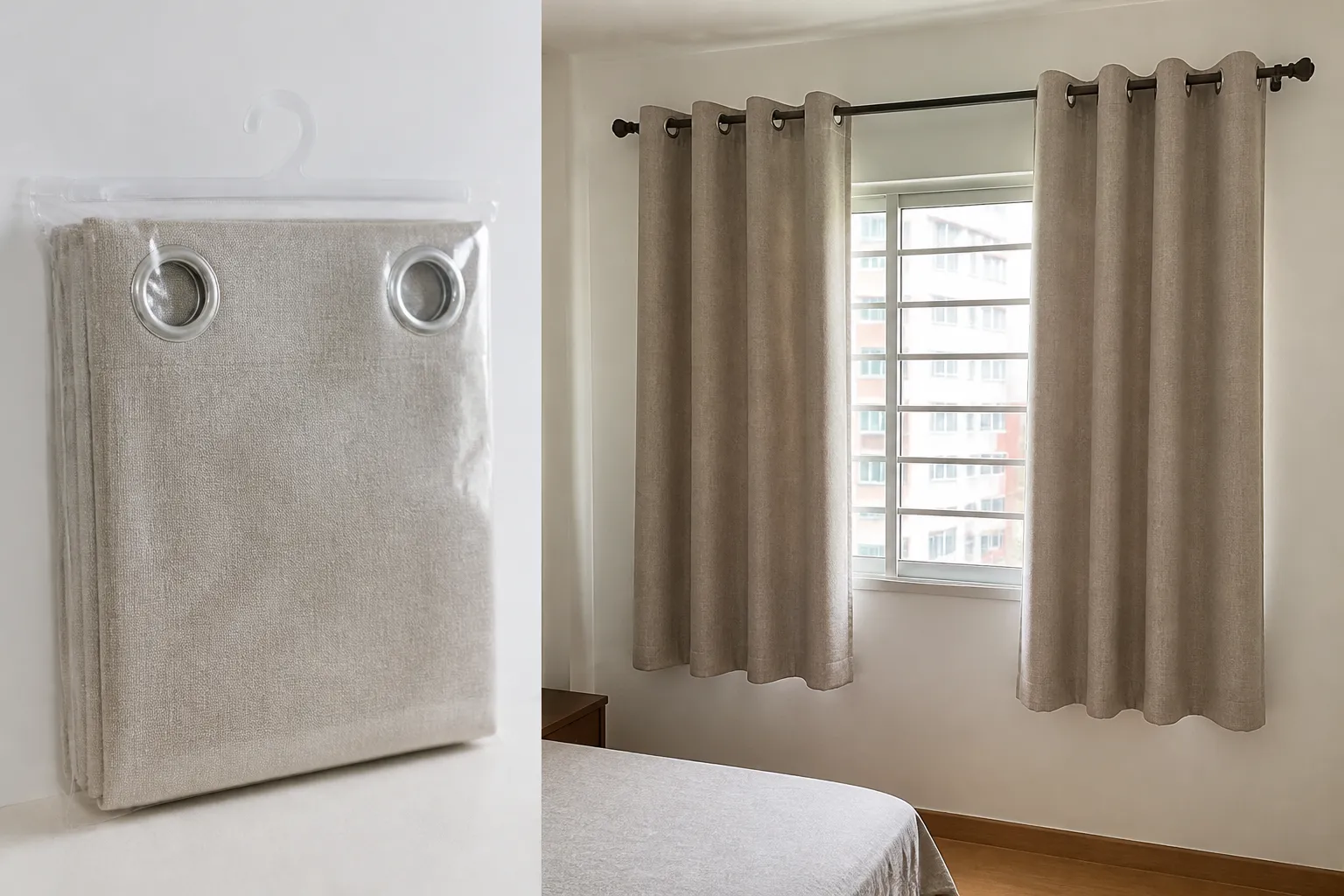 Ready-Made or Made-to-Measure Curtains in Singapore?
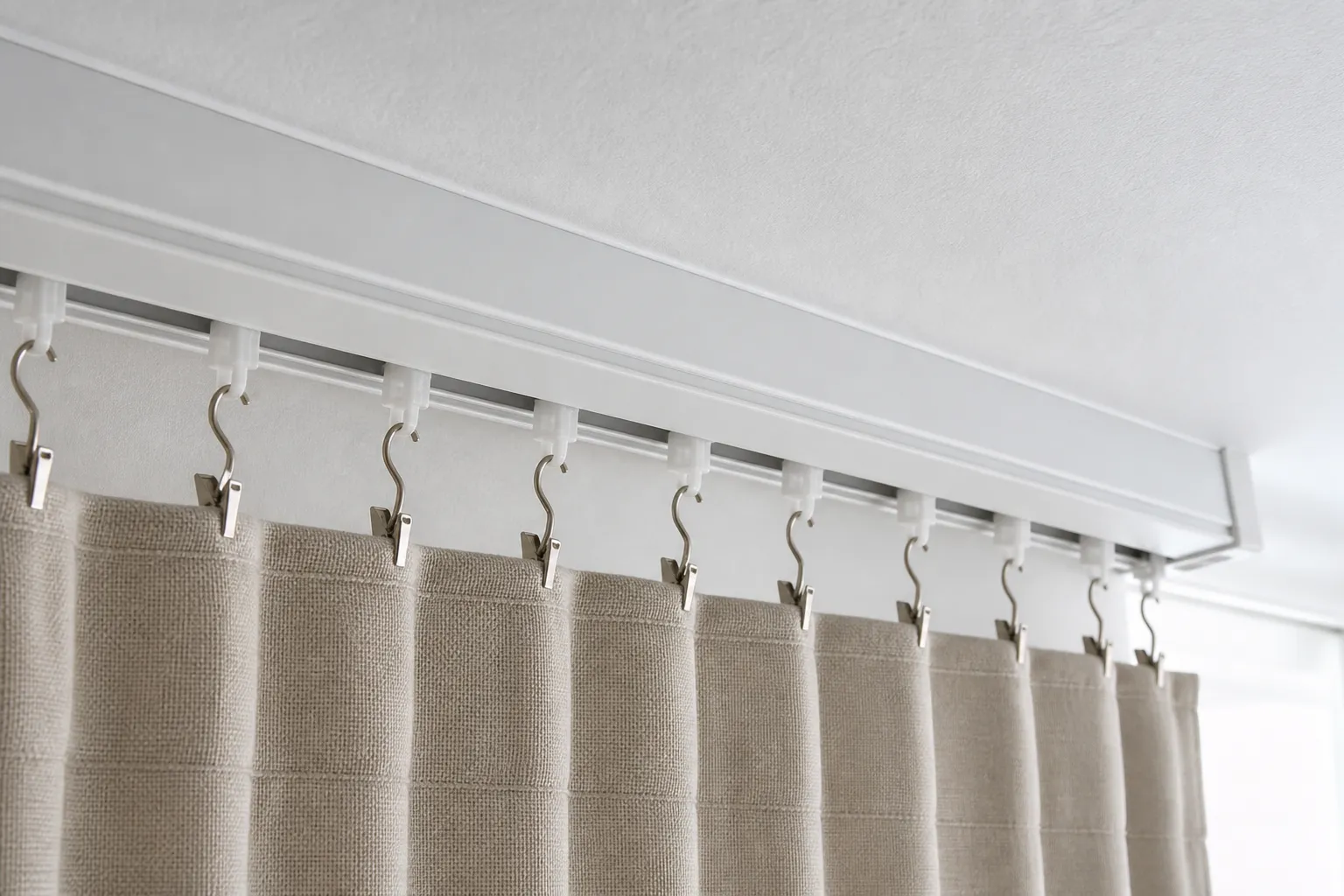 How to Choose a Curtain Track in Singapore
 S-Fold vs Pleated Curtains in Singapore: Ripple Fold, Pinch Pleat or Eyelet?