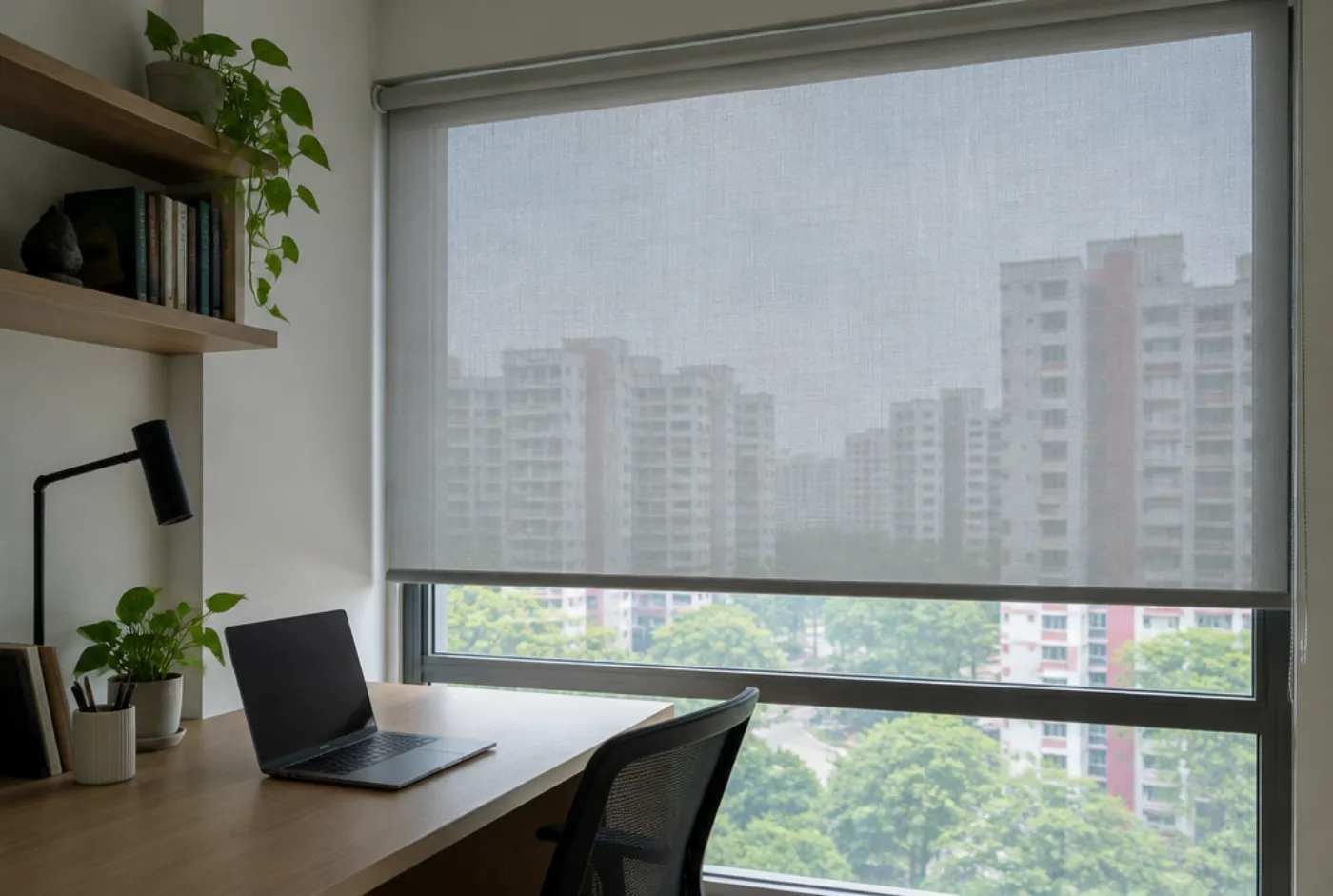
A sunscreen roller blind is sold with a percentage on the card: 1%, 3%, 5%, 10%. Beside it are whites, beiges and charcoals that look similar until you hold them to the glass. In Singapore these are blinds. Solar shades, or screen blinds, is the name on many overseas sites for the same open-weave roller.
The percentage is the openness factor. Mermet’s technical fabric guide describes it as the share of the cloth that is open holes, and as the share of visible light that passes straight through those holes without being diffused (section 9.4). The same section says openness does not, on its own, decide the view, the glare or the heat. Colour, the weave and the glass do that work with it.
Our sunscreen roller blinds are made to measure in this family of cloth. The rate already published for those rollers is $5 to $6.50 per sq ft installed, with a 20 sq ft minimum per blind. The card still has to be read before the colour is chosen.
What the percentage is counting
A 5% cloth has more open area than a 1% cloth. More of the sun can pass straight through, and the view through the holes is usually clearer. A 1% cloth is a tighter weave. Less light comes through the holes, and the outlook is dimmer.
That is the direction of the number. It is not a score for ultraviolet light, and it is not a privacy rating for night. Ultraviolet transmission is printed separately, when the maker has measured it, for that colour and that openness. Do not subtract the openness from 100 and treat the remainder as ultraviolet blocked. Coatings, dye and the pane all change what gets through. Draper’s notes on shade-fabric measurements list ultraviolet transmittance as its own figure: the share of ultraviolet energy that passes through the cloth. Ask for that figure for the swatch in your hand.
Why two cloths with the same percentage behave differently
Colour changes what the yarns do with the light that does not go straight through the holes.
Darker cloth absorbs more visible light. Less of it bounces around inside the weave and glows back into the room. Mermet’s guide says darker cloth therefore gives a clearer view out and stronger glare control, because diffused light and visible transmission are both lower (sections 9.5, 9.6 and 11.3). The trade-off is heat. Lighter cloth reflects more of the near-infrared, which is the part of sunlight you feel as heat (section 7.5). Darker cloth reflects less of it, so the blind and the air near it warm up more.
Lighter cloth does the reverse. It throws more heat back toward the glass, and it also reflects more visible light (section 7.3). In strong sun the blind can look bright from inside, and the blocks outside look softer.
Mermet’s fabric selection guide sorts the same choices by the job. For heat, they look for a light colour and a high solar reflectance, especially in the infrared. For glare, they look for a dark colour and a low openness, and they treat a visible transmittance under 8% as effective glare control on their own cloths. For a clear view out, they look for a dark colour and a more open weave, and the examples they show are around 5%.
Those are a maker’s rules for fabrics they test. They are a starting point for a swatch book, not a result for your window. The glass in front of the blind changes the sum. Mermet’s guide says the visible light through the whole window is roughly the glass visible transmittance multiplied by the fabric’s visible transmittance (section 9.1). Solar heat gain is a property of the glass, the frame and the blind together, not of the cloth alone (section 8.2). A percentage improvement printed for one double-glazed low-E unit will not match an older single pane or a different low-E coating.
What to read on the card
When two swatches are in front of you, compare these measured figures for the same colour and the same openness. Names vary slightly by maker. Draper’s list and Mermet’s sections 8 and 9 use these:
| On the card | What it measures |
|---|---|
| OF, or openness | Open area of the weave, and the visible light that passes straight through the holes |
| Tv, or VLT of the fabric | Visible light through the cloth, direct and diffused. Lower Tv means stronger glare control |
| Rv | Visible light the cloth reflects. A high Rv is one reason a pale blind glows |
| Rs, As, Ts | Solar energy reflected, absorbed and transmitted. The three add to 100% for the cloth |
| UV transmittance | Ultraviolet through that cloth. Compare this, not 100 minus the openness |
| SHGC improvement | How that cloth changed heat gain on a stated glass. Read which glass |
If the card only shows openness and a colour name, you do not yet have a heat or ultraviolet result. Ask for the measured row, or compare samples at the window and accept that you are judging by eye.
Three windows, as examples
These are hypothetical flats, so you can see how the complaint changes the cloth. They are not jobs we have measured.
A west-facing HDB living room, with a sofa and a television, takes the low afternoon sun. If the glass and the floor near it are hot, a lighter sunscreen and a lower openness reflect more near-infrared. The glass itself still warms, which the blackout heat guide explains for curtains and which applies to any cloth hung inside the pane. If the television washes out and you still want to see the blocks opposite, a darker cloth usually keeps a clearer view and glows less, and it absorbs more heat. Plenty of living rooms have both complaints. A darker sunscreen for the hours you are in the room, and a second layer for the peak of the afternoon, is a practical split. The living room blinds page and double roller blinds are the two places that split is already described.
A study with a laptop is often a glare problem before it is a heat problem. The screen mirrors the window while the room temperature is tolerable. Start with a darker, tighter weave and look for a low Tv. Mermet’s selection guide uses under 8% as their glare line. The sun and glare checker shows which months that window is brightest, and the study blinds page covers the desk.
A condo pane with a sea or city view is the opposite priority. A darker cloth around 5% openness is what fabric makers point to when the outlook matters. You accept more sun through the holes. If a sofa or a timber floor is bleaching along that glass, openness is the wrong number to trust. Visible light fades dyes, and ultraviolet is only part of the damage. The furniture fading guide and the heat, glare or fading page separate those problems.
Offices have a shorter version of this choice on the office blinds page. The logic is the same. The hours and the screens are not.
A light face outside and a dark face inside
Some weaves are built as two faces. Mermet’s guide describes a satin weave with a white street side, so the outside face reflects more sun, while the room side can be a darker colour for glare and view (sections 5.5 and 16.2). That is a category of cloth, not a line we list as a standard sunscreen. Ask at the visit whether a dual-sided fabric is available for the roller you want. If it is not, a light sunscreen plus a separate darker layer, or a curtain, is the way to split heat and glare.
Choosing at the window
Hold the sample inside the room, in the afternoon if that is when the problem happens. A charcoal that looks calm under shop lights can still leave the screen readable, or it can leave the glass warm. A white that matches the wall can glow enough that you raise it by 4pm, which undoes the heat control.
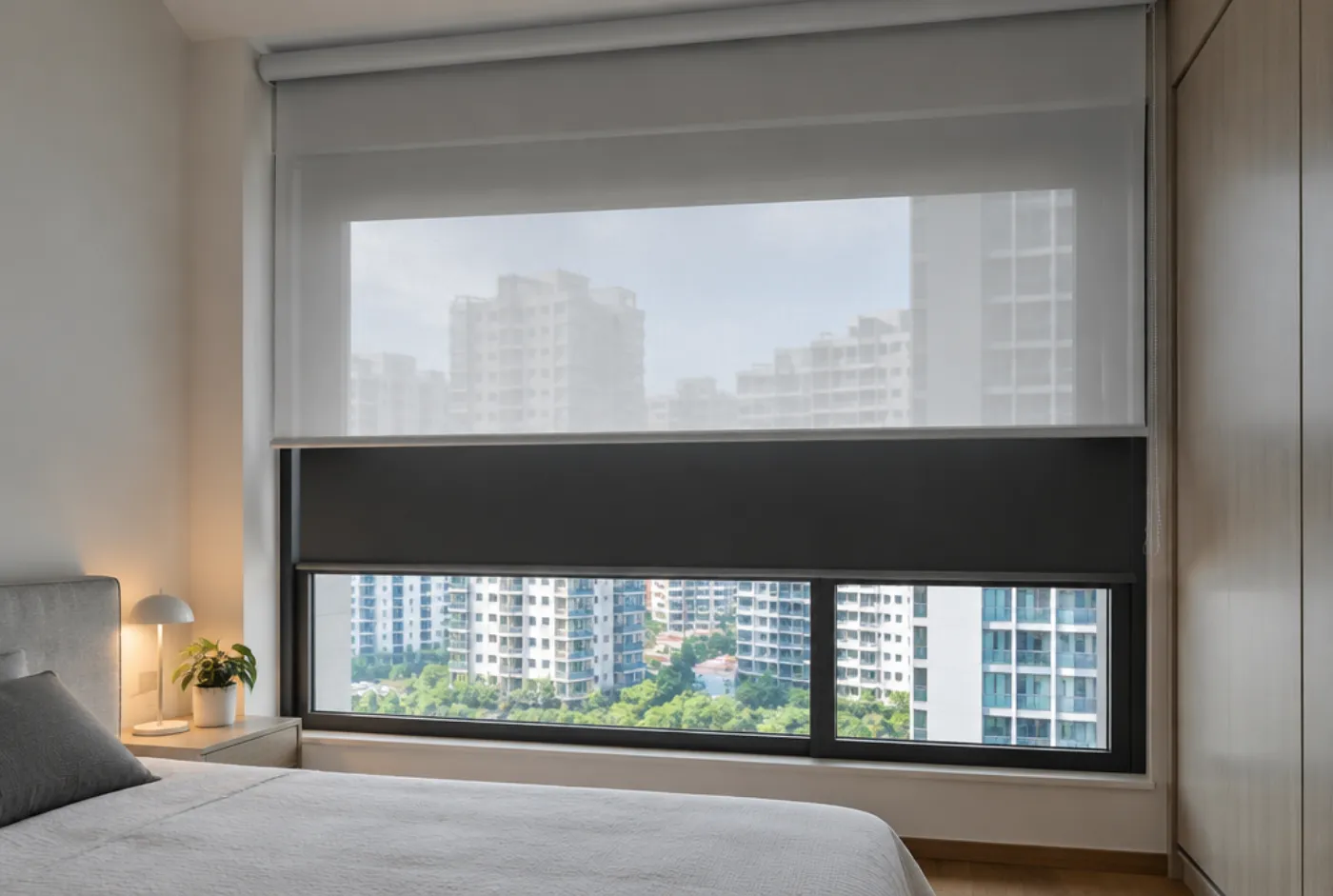
Night is a separate question. A tight weave can mute the view and still be seen through once the lamps are on. That is covered in can people see through sunscreen blinds at night.
Common questions
Is a lower openness always the better sunscreen?
It lets less light straight through the holes. For glare, pair it with a dark colour and check Tv. For heat, a light colour matters as much as the tightness. For a view you care about, a very tight weave can make the outlook dull. Match the percentage to the complaint, then read the measured row for that colour.
Does 3% openness mean the cloth blocks almost all ultraviolet?
No. Openness counts holes. Ultraviolet transmittance is a separate measurement for that fabric and colour. Use the measured figure. The glass and the hours the blind is raised still decide what reaches the sofa.
Will the same cloth suit every room in the flat?
Often it will not. A study screen and a living-room view can take different openness and different colours. Keeping the colours in one family is what stops the flat looking pieced together, which the types of blinds comparison already suggests for mixing products.
 Can People See Through Sunscreen Blinds at Night?
 Heat, Glare or Fading: Which Window Problem Do You Have?
 How to Stop the Sun Fading a Sofa or Floor