It is the week before Chinese New Year. The living-room sheers have gone grey along the hem where the standing fan pushes dust at them, and the bedroom curtains smell of last night’s cooking. Relatives are coming on Saturday. You want to know whether the washing machine can handle them, or whether this is a job to hand over. Many curtains can be washed or steamed at home if you follow the label and dry them properly. Some are safer with a cleaner, and the label usually tells you which.
Start with the care label
Look along the side hems, the bottom hem and the lining. Lined curtains sometimes have two labels, one for the face fabric and one for the lining. If they disagree, follow the stricter one.
The symbols to look for are these.
- A tub of water means the curtain can be washed. A number or dots inside it give the maximum temperature.
- A tub with a hand in it means hand wash only.
- A tub with a cross through it means no water at all.
- A circle means dry clean. A crossed-out circle means do not dry clean.
- A square with a circle inside is the tumble dryer. Crossed out, keep it out of the dryer.
If there is no label, find out the fabric before you wash anything. Ask whoever sewed or sold the curtains. If nobody knows, test a damp cloth with a little detergent on a hidden corner of the hem, or treat the curtain as dry clean only.
Taking curtains down and hanging them back
Do this with a second person if the curtains are full height. A lined night curtain is heavier than it looks once you are on a step stool holding it at arm’s length.
- Draw the curtains closed so the gliders are spread along the track.
- Before you unhook anything, take a photo of the back of the heading. It shows which hole or pocket each hook sits in, and that sets the height when you rehang.
- Unhook from one end and fold the curtain over your arm as you go, so the hem stays off the floor.
- Take every hook out of the heading before washing. Metal pin hooks can rust or snag the fabric, and plastic hooks can crack in the drum.
- Wave or S-fold curtains unsnap from the carriers. Note which snap goes on the first carrier at each end.
- While the track is bare, wipe it and the gliders with a dry cloth or the brush tool of a vacuum.
To rehang, put the hooks back in the same positions as your photo, then work from one end to the other, one glider per hook. If you skip a glider, the folds will bunch. Our guide to types of curtain hooks shows how each heading attaches, if you have lost track.
Machine wash, hand wash or dry clean
The care label always wins. This table is a starting point for when you know the fabric.
| Fabric or construction | Usual starting point | What to watch |
|---|---|---|
| Polyester sheer or voile | Machine, gentle cycle, cold, in a laundry bag | Snags from hooks left in, creases if left in the drum |
| Unlined polyester day curtain | Machine, gentle cycle, cold | Overloading the drum |
| Cotton | Gentle cycle, cool water, if the label allows | Shrinkage and fading |
| Linen or linen blend | Follow the label closely, often hand wash or dry clean | Shrinkage that shortens the drop |
| Curtain with a sewn-in lining | Often dry clean | Face and lining shrinking by different amounts |
| Coated blackout fabric | Gentle and cold if allowed, otherwise spot clean or dry clean | Cracked or peeling coating |
| Velvet, silk or embroidered fabric | Dry clean | Water marks and crushed pile |
For the machine, wash one pair at a time so the curtains can move freely. A front loader is gentler than a top loader with a central agitator, which can twist and stretch a long curtain. Use a mild liquid detergent, no bleach unless the label shows it is allowed, and the lowest spin speed. Take the curtains out as soon as the cycle ends. Left wet in the drum, they crease hard and start to smell.
For a hand wash, a bathtub is easier than a pail. Soak in cool water with a little mild detergent, move the fabric around gently, then drain and rinse twice. Press the water out by folding and pushing down. Do not wring, because wringing stretches the weave and creases it in long lines.
Dry cleaning is the safer choice for fabrics that dislike water, for curtains with a sewn-in lining, and for anything with a coating or pile. Full-height curtains are bulky to carry to a shop, so ask whether the cleaner can collect them.
Lined and blackout curtains
A lined curtain is two fabrics sewn together. If one shrinks more than the other in the wash, the hem puckers and the curtain no longer hangs straight. This is why many lined curtains carry a dry clean label even when the face fabric alone could be washed.
Some blackout curtains have a separate lining hooked or sewn on behind the face fabric. Others have a coating on the back of the cloth itself. A coating can crack or peel with hot water, wringing, tumble drying or a hot iron on the coated side. Our page on blackout curtains and the guide to blackout and dim-out curtains explain the difference between the two constructions.
For small marks on a blackout curtain, spot clean first. Dab with a damp cloth and a little mild soap, blot dry and let the area dry before you decide whether the curtain needs a full wash.
If the lining is detachable, wash the lining and the face fabric separately, each to its own label.
Linen and other natural fabrics
Linen and cotton can shrink when washed, especially in warm water or a dryer. On a made-to-measure curtain finished just above the floor, a small amount of shrinkage leaves a visible strip of floor under the hem, or lifts a sill-length curtain off the sill.
Wash linen cool, dry it flat or hung straight, and keep it out of the dryer unless the label allows it. Iron it while slightly damp, on the reverse side. If you are ordering linen curtains, ask whether the fabric has been pre-washed and how it should be cleaned before you choose it. Our guide to linen or polyester curtains covers how linen behaves in Singapore humidity.
Drying curtains in a humid HDB flat
Singapore’s mean annual relative humidity is around 82%, according to the Meteorological Service Singapore. That is outdoor air, not the inside of your flat, but damp fabric dries slowly here and starts to smell if it stays wet.
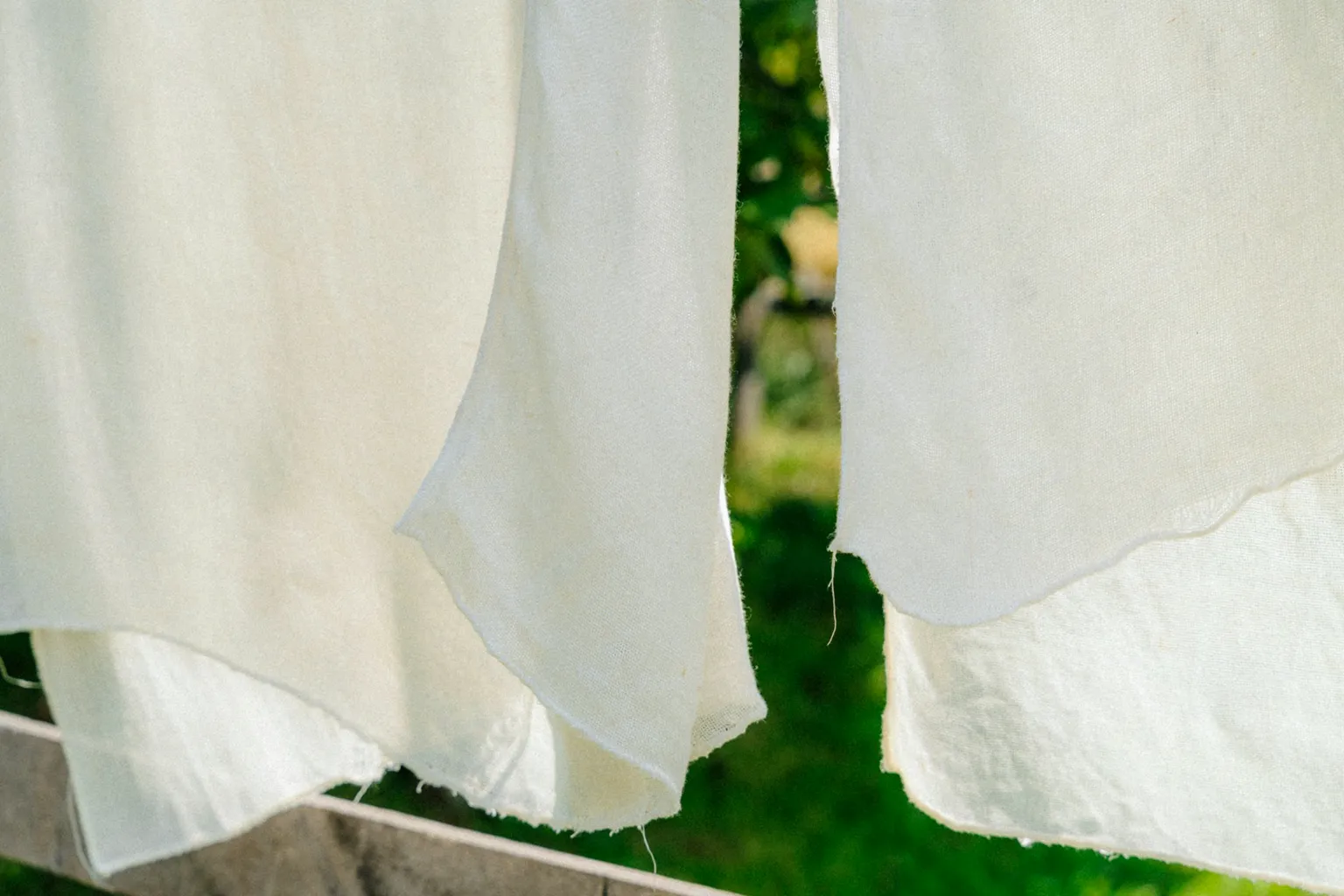
Wash in the morning so the curtains have the day to dry. Spread each panel over two poles or a wide rack in the service yard, so the fabric is not folded double. Put a fan on it. A dehumidifier, or a closed room with the air-con running, speeds things up on a wet day.
Check the thick parts before you rehang. The heading, the side hems and the bottom hem have the most layers and dry last. A lined curtain that feels dry on the face can still be damp between the layers.
Light polyester sheers are the exception. They can go back on the track while still slightly damp, with the window open and the fan on, and the creases drop out as they dry. Do not do this with lined, blackout or linen curtains.
If the curtains had mould spots, look at the window as well. A ledge that stays wet from condensation or rain will bring the spots back, whatever you wash them with.
Steaming curtains in place
Steaming is a way to freshen curtains without taking them down. It loosens dust, relaxes creases and reduces stale smells. It does not lift grease, set-in stains or mould that has stained the fibres.
- Vacuum the curtain first with the brush attachment, top to bottom, so you are not steaming dust into the fabric.
- Test the steamer on a hidden part of the hem and let it dry. Look for water marks or shine.
- Start at the top and work down in strips about the width of the steamer head.
- Keep the head slightly off the fabric. Pressing it on can leave water marks.
- Grip the hem lightly to keep the fabric taut, and keep your hand away from the steam.
- Leave the window open and the fan on until the curtain is dry.
Take care with coated blackout fabric, silk and velvet. Check the label for any heat or steam warning, and test before you do a whole panel.
How often to clean curtains
There is no fixed rule. A common routine is a light vacuum with the brush tool every few weeks, and a wash or steam when the curtains look grey at the hem or start to smell.
Some curtains need more attention. Sheers by a window that stays open collect dust faster than a night curtain behind them. Curtains near the kitchen pick up cooking oil and smells. Flats facing a main road or a construction site get dusty sooner. Bedrooms where the window is shut and the air-con runs often stay cleaner for longer.
When to have it done for you
Doing it yourself is fine for sheers and unlined polyester curtains. It gets harder with heavy full-height curtains you cannot easily lift down, lined or blackout curtains whose label says dry clean, velvet, silk or linen made to an exact drop, mould spots that a normal wash has not shifted, and curtains with no label.
Our curtain cleaning service covers on-site steam cleaning, dry cleaning, washing, and taking the curtains down and rehanging them. Steaming on site suits a regular freshen-up when you would rather not be without curtains. Heavier stains or mould usually need the curtains taken down.
Common questions
Can I put curtains in the washing machine?
Many polyester sheers and unlined day curtains can go in on a gentle cold cycle, in a laundry bag, with the hooks taken out. Check the label first. Lined, coated blackout, velvet and silk curtains are usually safer dry cleaned.
How do I wash blackout curtains without damaging them?
Find out whether the blackout is a separate lining or a coating on the fabric, then follow the label. Use cold water and a gentle cycle only if the label allows it. Do not wring, tumble dry or iron the coated side. Spot cleaning is often enough for small marks.
Should I iron or steam curtains after washing?
Steaming them once they are back on the track is usually easier, because the weight of the curtain helps the creases drop. Iron linen or cotton on the reverse while slightly damp, if the label allows.
How do I get mould spots off curtains?
Brush off what you can outdoors or in the service yard, then wash to the label. Use bleach only if the label shows it is allowed. Spots that remain after a wash may not come out fully, and a cleaner can tell you what can be done for the fabric.
 Types of Curtain Hooks and Which Your Track Needs
 Linen or Polyester Curtains in Singapore Humidity?
 Kitchen Curtains in Singapore: What Works Near the Stove and Sink