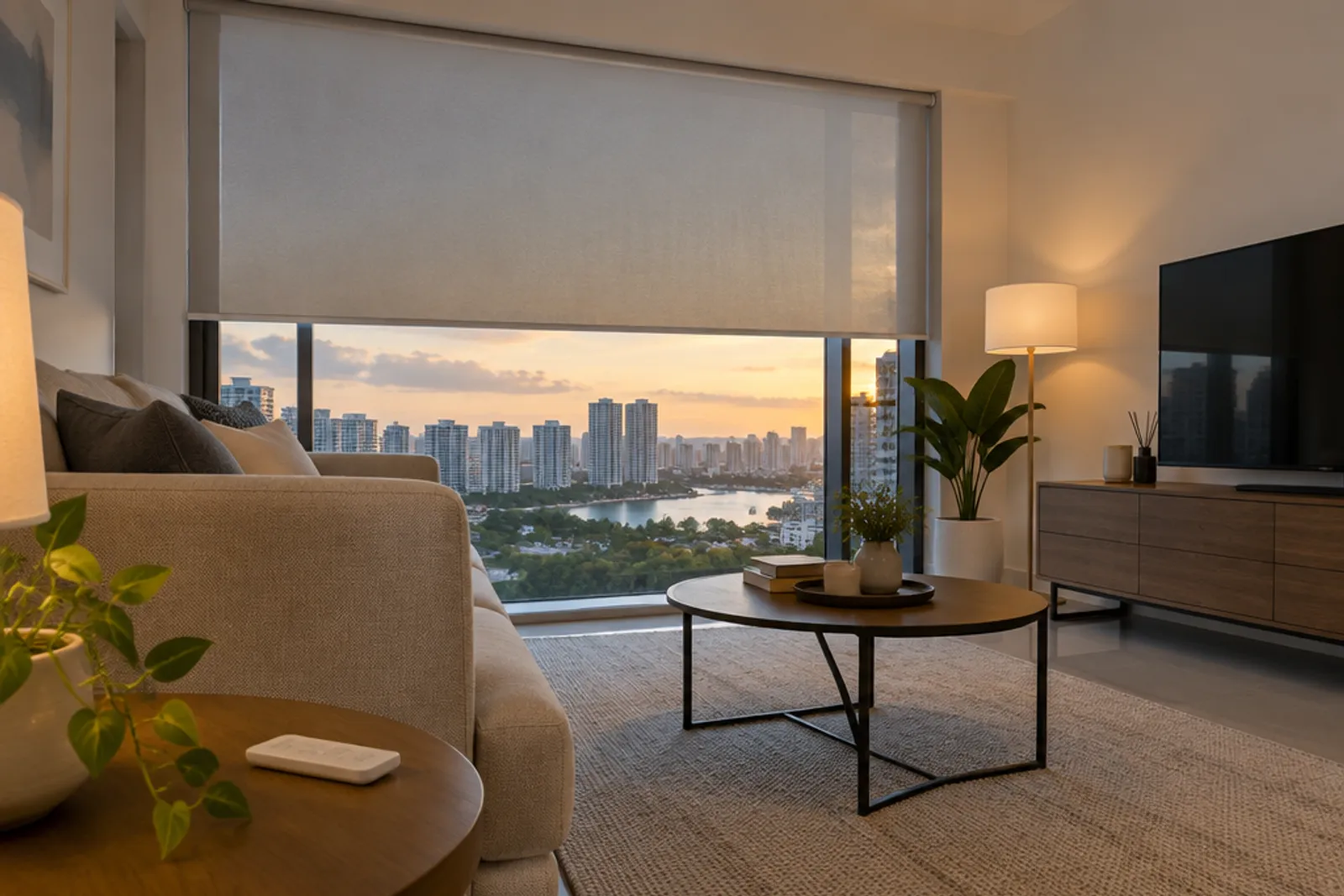
Motorised blinds and curtains are easy to add to a finished flat, but they are much easier to plan before the renovation starts. The motor itself is small. What causes trouble later is the power supply and the space around the window. Once the false ceiling is closed, the walls are painted and the curtain box is built, running a cable to a window or deepening a pelmet means hacking and repainting. A few decisions made at the planning stage avoid that.
This guide is about those decisions, with a focus on blinds. If you are still deciding whether a motor suits you at all, our guide to smart curtains in Singapore covers the case for and against.
Decide which windows get a motor
Start by walking through the flat and listing the windows where a motor would help day to day. Not every window needs one, and adding motors only where they make a difference keeps the plan simpler.
Windows that usually benefit:
- Wide living-room windows and full-height glass, where a long blind or a heavy pair of curtains is tiring to pull.
- West-facing windows, where you may want blinds to lower at the same time each afternoon to cut glare and sun on the glass.
- High or hard-to-reach windows, such as those above a sofa, a bay window platform or a staircase in a maisonette.
- Bedrooms, where lowering the blinds from bed or on a morning schedule is convenient.
- Homes with young children or pets, since motors remove the cords and chains that hang by the window.
Wired or battery motors
Motors for blinds and curtains come in two broad kinds. Wired motors run on mains power and need a power point or a concealed cable at the window. Battery motors carry a rechargeable battery, either built into the motor tube or in a separate pack, and are charged with a cable every so often.
| Wired motor | Battery or rechargeable motor | |
|---|---|---|
| Power | Mains power at the window | Rechargeable battery |
| Renovation work | Cable or power point needed before ceilings and walls are closed | None, can be added after renovation |
| Ongoing upkeep | No charging | Charge periodically; how often depends on use and the motor |
| Suits | Heavy curtains, wide blinds, windows used many times a day | Single blinds, rental flats, windows where wiring is no longer possible |
| During a power cut | Stops until power returns | Keeps working while charged |
| Look | Cable hidden in ceiling or wall | No cable, but a charging port to reach |
A wired motor is the better fit for heavy curtains on a long track and for blinds you raise and lower several times a day. A battery motor suits a finished flat, a rental, or a single window where cutting into a wall would be a nuisance. A home can use both kinds, chosen window by window.
Plan the power points during renovation
If you choose wired motors, the power has to reach each window before the false ceiling, the curtain box or the wall finish goes up. In HDB and condo flats, the usual approach is a concealed cable or a power point in the ceiling or inside the curtain box, close to where the motor will sit.
When you brief your renovation contractor or electrician, give them:
- Which windows get a motor, and which side of each window the motor will sit.
- Whether each window has a blind, a curtain, or both, since a window with a blind and a curtain may need power for two motors.
- Where you want wall switches, if you plan to use any alongside a remote or app.
- The height of the curtain box or the position of the blind bracket, so the power point is reachable but hidden.
Agree this with the electrician and your blind and curtain supplier together, so the motor and cable positions match. If you leave the motorisation decision until after renovation, battery motors are usually the simpler route.
In condo units, check the management rules before any electrical work in the ceiling. Some buildings also have rules on what can be fixed to the window frame or façade, which matters for outdoor blinds on a balcony.
Curtain box and pelmet depth
A motorised curtain track is bulkier than a plain manual track, because the motor sits at one end of the rail. If the track sits inside a curtain box or behind a pelmet, the box has to be deep enough to hold the track, the motor and the curtain stack without the fabric rubbing against the front.
A window with a blind behind a curtain needs more depth again. The blind sits at the back near the glass, the curtain track in front, and both need clearance to move. If you plan a day curtain and a night curtain on two motorised tracks, allow for that third layer.
There is no single depth that works for every home, because it depends on the track, the motor, the curtain heading and the number of layers. Confirm the motor and track before the carpenter builds the box, and ask for the box to be measured against those parts. Our guides to curtain pelmets and curtain boxes and choosing a curtain track explain the space each part needs.
Also leave a way in. A motor may need adjusting or replacing some years later, so a curtain box that is sealed shut with no access makes that job harder.
Which blinds motorise well
Blinds that roll or fold onto a tube at the top are the most straightforward to motorise, because the motor fits inside the tube or headrail.
- Roller blinds motorise well. The motor sits inside the roller tube and is hidden. A double roller, with sunscreen and blackout fabrics on one bracket, can have a motor on each roller.
- Korean combi blinds also motorise well, and a motor makes it easier to line up the stripes precisely to let light in or close the view.
- Roman blinds can be motorised. On a wide window, a motor takes the effort out of lifting heavy folded fabric.
- Venetian blinds can be motorised, but the motor has to tilt the slats as well as raise them, so the options are more limited. Check what the chosen system can do before ordering.
- Vertical blinds can be motorised to draw and rotate the vanes, which suits a wide balcony sliding door.
- Outdoor zip blinds on a balcony are often motorised, as they are large and run in side channels. Plan the power supply for these early, since the cable has to reach an outdoor position.
Honeycomb blinds can also be motorised in some systems. Ask about motor options for your chosen blind when you get a quote.
Heavy curtains and long tracks
A motorised curtain track pulls the fabric along the rail, so the weight and length of the curtain affect which motor suits it. A full-height blackout curtain with a lining across a wide living-room window is much heavier than a pair of sheers.
Tell the supplier what fabric you plan to use, the width of the window and the drop. A lined blackout curtain or a thick linen blend may need a stronger motor than a light sheer. Heavy fabric also stacks wider when open, which affects the space needed beside the window.
The curtain heading matters too. Ripple fold and S-fold headings run evenly on a motorised track, which is one reason they are common on motorised curtains.
Remote, app and voice control
Most motorised blinds and curtains can be operated in more than one way. A handheld remote is the simplest. A wall switch is convenient by the door of a room. Many motors can also connect to a hub or Wi-Fi bridge for an app on your phone, schedules, and voice control through a smart speaker.
Before ordering, check:
- Whether the motors you are considering work with the app or smart-home system you already use.
- Whether one remote can control several blinds, as a group or one at a time. A living room with three blinds side by side is easier to run as a group.
- Whether schedules are set in the motor, the hub or the app, and what happens to them if the Wi-Fi is down.
- Whether a hub or bridge is needed, and where it will sit within range of the windows.
Keep the controls simple for everyone in the household. An app-only setup can frustrate a family member who just wants to close the blind.
Humidity, monsoon and maintenance
Singapore’s mean annual relative humidity is around 82%, according to the Meteorological Service Singapore. Motors sit inside a tube or headrail, but the blinds and curtains around them still need ordinary care in this climate. Fabric near a window that gets condensation from air-conditioning, or rain blown in during the monsoon season, can develop mould spots if it stays damp.
A few habits help:
- Close windows during heavy rain so water does not reach the blind fabric or the motor end.
- Wipe or vacuum blind fabric regularly, and keep roller blinds fully lowered now and then so the fabric can air.
- For motorised curtains, the curtain can usually be unhooked from the track for washing while the motor stays in place. Our curtain cleaning service can take the curtains down, clean them on site or take them away, and rehang them.
- If you use battery motors, charge them before they run flat rather than waiting for the blind to stop halfway.
If a motor stops at the wrong height, it often needs its upper and lower limits reset. The method depends on the motor, so keep the instructions and remote that came with it.
Power cuts and manual backup
Wired motors stop during a power cut. Battery motors keep working while they are charged. If you are worried about being stuck with a closed blind in a bedroom, ask whether the motor or track has a manual override.
Many motorised curtain tracks let you pull the curtain by hand when the power is off, by drawing the fabric or the lead carrier. Blinds vary more. Some roller blind motors cannot be turned by hand at all. For a window you rely on for daylight or ventilation, a battery motor or a system with manual override gives you a backup.
Common questions
Can I add motorised blinds after renovation?
Yes. Battery or rechargeable motors need no wiring, so they can be fitted to a finished flat. Wired motors are possible later too, but running a cable to the window usually means opening the ceiling or wall, or running exposed trunking along it.
Which is better for a Singapore HDB flat, wired or battery motors?
Wired motors suit windows used many times a day and heavy curtains, and they are easiest to plan during renovation. Battery motors suit single blinds, rental flats and windows where wiring is no longer practical. A flat can also mix the two, with wired motors in the living room and battery motors in the bedrooms.
How deep should a curtain box be for a motorised curtain?
It depends on the track, the motor, the curtain heading and how many layers you have. A box for a single motorised curtain needs less depth than one holding a blind, a sheer and a blackout curtain. Confirm the parts first and have the box built to fit them.
Do motorised blinds still work during a power cut?
Battery motors keep working while they are charged. Wired motors stop until the power returns. Some curtain tracks can be pulled by hand when the power is off, but many blind motors cannot, so ask about manual override if this concerns you.
Can motorised blinds work with my phone or a smart speaker?
Many motors can, through a hub or Wi-Fi bridge. Check that the motor system works with the app or smart-home platform you already use, and keep a remote or wall switch as well for anyone in the household who does not use the app.
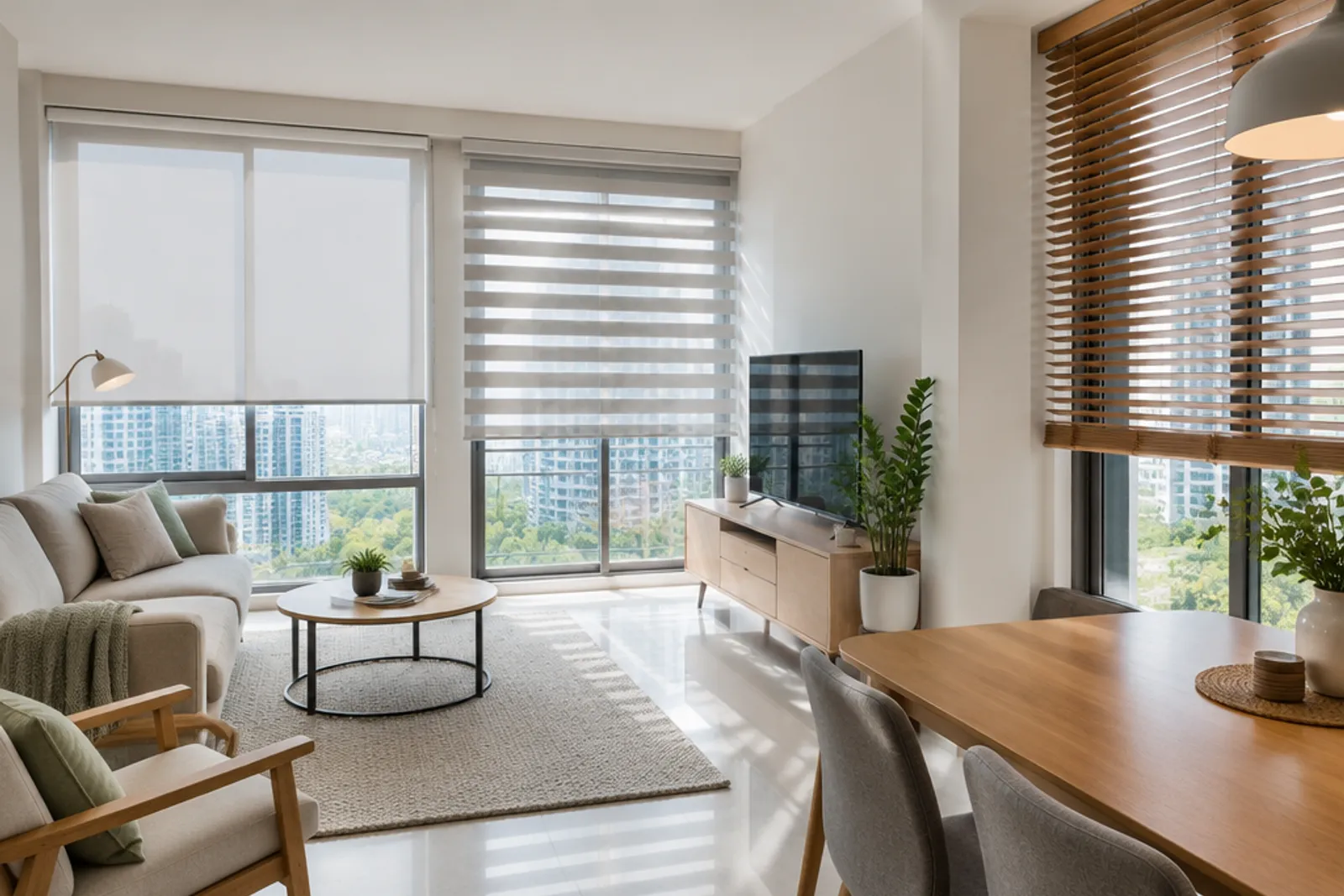 Types of Blinds in Singapore: 9 Options Compared
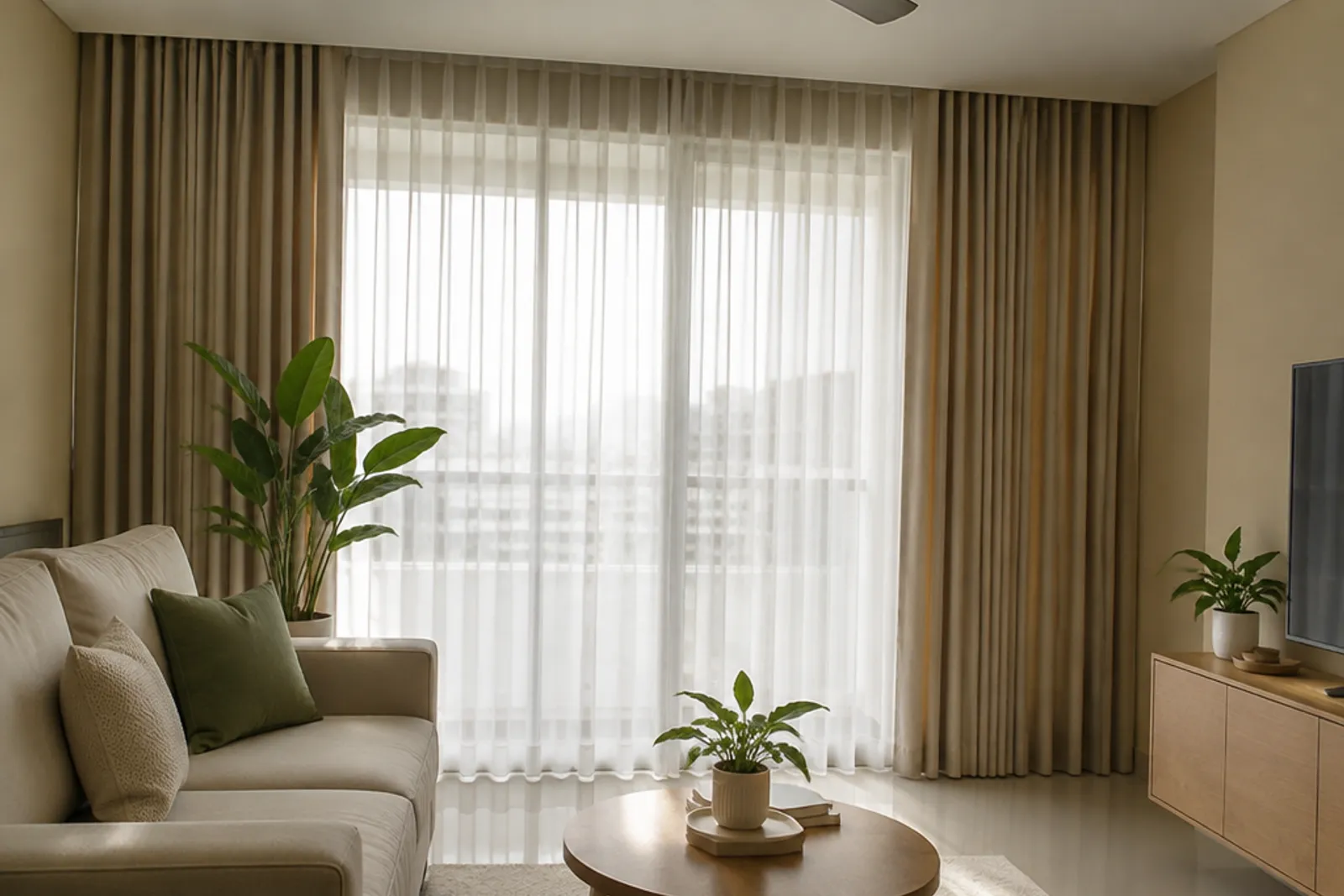 15 Living Room Curtain Ideas for Singapore Homes
 10 Curtain Accessories to Know: Tiebacks, Hooks, Finials and Weights