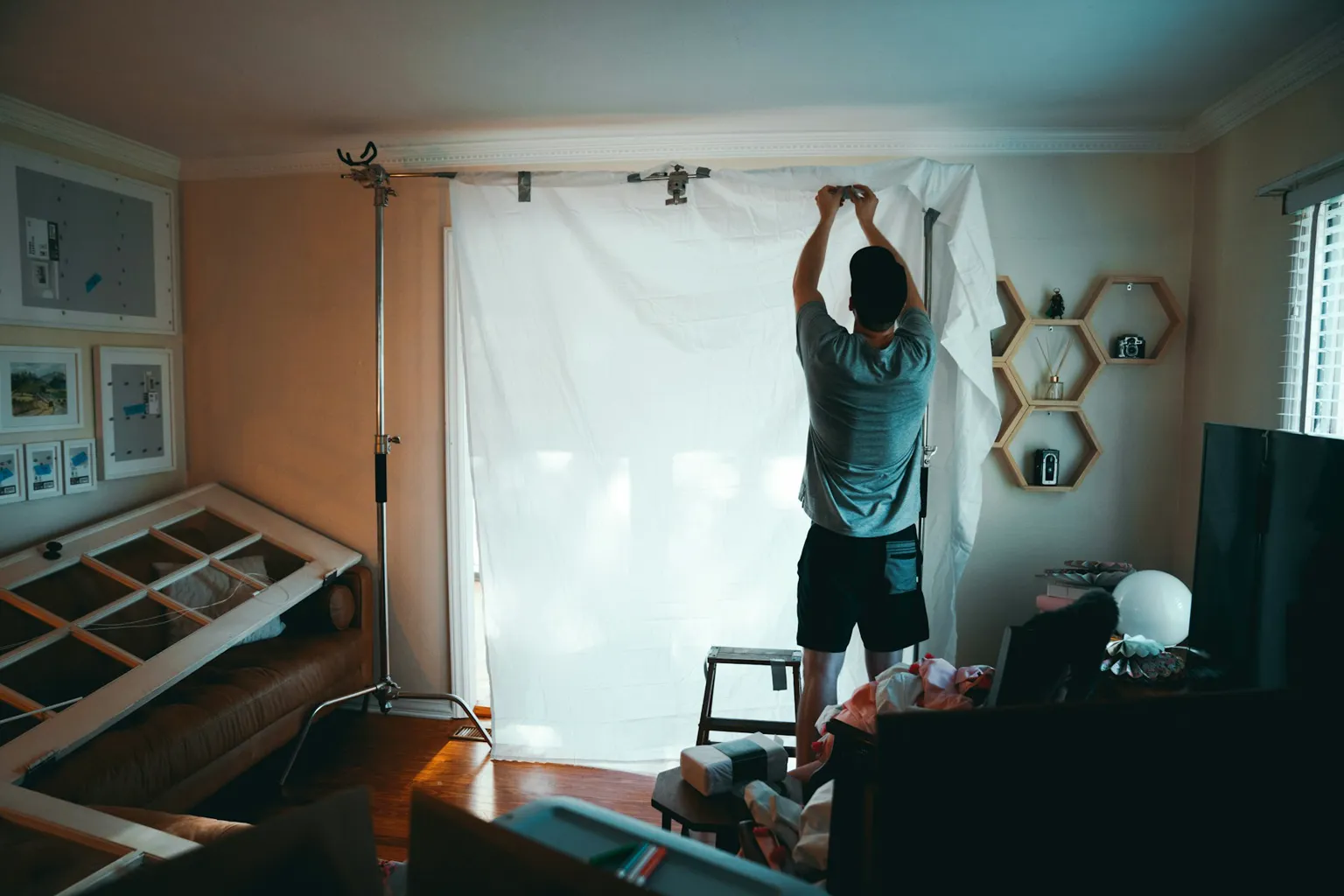
Your new curtains have arrived, the window in the living room is bare, and the wall above it is the solid concrete you find in most HDB flats. Hanging curtains yourself is a reasonable weekend job if you have a drill and some patience. Most of the effort goes into the decisions before you drill: how high the track sits, how far past the window it runs, and whether the wall or ceiling is the better fixing point. Some windows, such as a high ceiling or a wide span of heavy blackout, are better left to an installer.
Tools and parts to gather first
Lay everything out before you start, so you are not climbing down the ladder halfway through.
- A sturdy step ladder tall enough that you can work without stretching overhead
- A hammer drill with masonry bits, since HDB walls and ceilings are reinforced concrete
- A pipe and cable detector
- Wall plugs and screws that match each other and your drill bit
- A spirit level, or a laser level for long tracks
- A measuring tape and a pencil
- A screwdriver, or a drill with a screwdriver bit
- The track or rod, brackets, end stoppers and gliders or rings
- Curtain hooks that suit your track and curtain heading
- Safety glasses and a dust mask, plus a vacuum for the concrete dust
Check that the brackets supplied with your track are meant for the wall or ceiling you plan to fix into. Ceiling brackets and wall brackets look different, and a rod usually only comes with wall brackets.
Step 1: Decide the height
Start with the curtain you already have, or the length you plan to order. The track has to sit at a height where the curtain clears the floor by a small gap, so the hem does not drag or collect dust. If your curtains are made to measure, the maker worked from a finished length, and the track has to go where that length was measured from.
If you are choosing the height yourself, there are three common positions.
- Just above the window frame. This is the simplest, and suits a short curtain that stops at the sill.
- Partway between the frame and the ceiling. This makes the window look taller and lets the curtain cover the top of the frame, so less light leaks over.
- On the ceiling. In many HDB flats the gap between the top of the window and the ceiling is small, and a ceiling-mounted track is often the neatest option. It also blocks the most light at the top, which helps in a bedroom.
Measure the floor at several spots along the window. Older flats can have floors that are not perfectly level, and the curtain hem will show it. Work from the lowest point so the curtain clears the floor along its full width.
Step 2: Decide the width
A track that stops exactly at the window frame leaves the stacked curtain covering part of the glass when the curtain is open. Running the track past the frame on each side lets the curtain stack against the wall and leaves the window clear.
How far to extend depends on how bulky the curtain is when drawn back. A lined blackout curtain with a pinch pleat heading stacks wider than an unlined sheer. Check the space on each side too. In many HDB living rooms, a side wall, a column or an aircon trunking limits how far the track can go, and a track that stops short of an obstruction is better than one that runs into it.
If you have not ordered yet, our curtain calculator works out fabric width from the track length and the fullness you want. Our guide on measuring windows for made-to-measure curtains covers taking the measurements.
Step 3: Wall or ceiling
Both work. The choice depends on the room.
| Wall mount | Ceiling mount | |
|---|---|---|
| Suits | Rods, decorative finials, windows with a tall wall above | Tracks, low gaps above the window, curtain boxes |
| Light at the top | Some light passes over the track | Less light passes, since the track is against the ceiling |
| Hardware | Wall brackets that project the track forward | Ceiling brackets or clips screwed straight up |
| Watch for | Window frames and grilles the curtain must clear | False ceilings, downlights, aircon pipes and beams |
| Working position | Easier, drilling sideways at chest or head height | Harder, drilling overhead with dust falling toward you |
A wall bracket has to project far enough that the curtain clears the window handles, any internal grilles and the windowsill. A ceiling track has to sit far enough from the wall for the same reason. If you plan to add a second layer later, choose a double bracket now.
Some condos and renovated flats have a false ceiling made of board below the concrete slab. Board alone is not a good fixing for a curtain track. The track needs a timber batten behind the board or a fixing through to the slab above, which usually means opening up the ceiling. That is a job to hand to an installer.
Step 4: Mark the bracket positions
Mark the two end brackets first. Measure the same distance from the window frame on each side, and the same height from the ceiling or floor at each end. Use the level to confirm the marks line up, rather than trusting the ceiling or the window frame to be straight.
Then mark the brackets in between. Your track or rod comes with instructions on bracket spacing, and a heavier curtain needs brackets closer together. Place one bracket near each end, one near the middle on a long track, and space the rest evenly. On a rod, keep the end brackets in from the finials so the rod has room for the end rings and the curtain can still close fully.
If the track has to join two lengths, put a bracket close to the joint.
Step 5: Drill into concrete safely
Concrete walls in HDB flats and condos are strong, which suits a curtain track, but they also hide pipes and cables. Before you drill, run a pipe and cable detector over each mark. Be extra careful above and below light switches, sockets and the aircon point, where cables often run vertically through the wall, and near the kitchen and bathroom, where water pipes are likely. If the detector picks something up, move the bracket along the track a little.
Drill with the hammer setting on, using a masonry bit that matches the wall plug. Keep the drill straight, and drill to the depth of the plug plus a little extra so dust at the bottom does not stop it seating. Vacuum the dust out of the hole, tap the plug in until it sits flush, then screw the bracket on. A plug that spins in the hole means the hole is too wide. Fill it and drill a fresh hole slightly to one side.
HDB flats have two drilling rules to know about.
- In newer HDB bedrooms with ferrolite partition walls, HDB notes say not to drill within 200mm of the ceiling or beam, and to keep drilling depth around 22mm.
- In household shelters, SCDF and HDB allow drilling into the internal face to a depth of not more than 50mm, with non-metallic inserts and removable screws. Fixtures have to come down within 48 hours if you are told to clear the shelter.
Ferrolite walls sound and feel different from concrete when you knock on them. If you are not sure what a bedroom wall is made of, check your flat’s documents before you drill, or mount the track on the ceiling instead.
If you rent, get the landlord’s agreement first. If drilling is off the table, our guide to hanging curtains without drilling covers the options and their limits.
Step 6: Fit the track or rod
For a track, clip or screw the track onto the brackets as the instructions describe, then slide in the gliders. Count the gliders against the number of hooks on your curtain before you fit the end stoppers. Leave one spare glider at each end if your track allows it, since you cannot add them once the stoppers are on.
For a rod, rest it on the brackets, thread on the rings, then fix the finials. Keep one ring outside each end bracket, so the outer edge of the curtain stays fixed and does not slide toward the middle.
Run your hand along the track to check that it is level and that every glider moves freely. If one sticks, find out why now, while the track is still easy to reach. Our guide to choosing a curtain track explains the differences between track types if you are still deciding.
Step 7: Hook the curtains on
Match the hook to the heading and the track before you start. Pinch pleat curtains usually take pin hooks, S-fold or ripple fold curtains use snap tape that clips onto the gliders, and eyelet curtains thread straight onto a rod with no hooks at all. Our guide to types of curtain hooks covers each one.
Put the hooks into the curtain heading while the curtain lies flat on a bed or a clean floor. Space them evenly and check that each hook sits at the same height in the heading, or the top edge will look wavy.
Then hang the curtain, starting from the outer edge. Fix the outer end to the end stopper or the last glider first, then work toward the middle, one hook to each glider. Supporting the weight of the curtain over your shoulder while you work saves strain on the hooks you have already placed. If there are two panels, hang the second the same way from the other end, and check that they meet or overlap neatly in the middle.
Hanging sheers on a double track
A double track or double bracket lets you hang a sheer and a night curtain together, so you can keep daylight and privacy during the day and draw the heavier curtain at night. Our guide to day and night curtains covers the layering itself.
The sheer goes on the inner track, nearer the window. The night curtain goes on the outer track, nearer the room. This way the night curtain covers the sheer when closed, and the sheer is not trapped between the heavier fabric and the glass.
Sheers are light and easy to handle, but they show every uneven hook. Take extra care with the spacing in the heading, and check that both layers clear each other. If the sheer catches on the night curtain when you draw it, the brackets need a little more space between the two tracks.
Adjust and finish
A newly hung curtain rarely looks right on the first day.
- Check the hem height. If one panel is longer, many pin hooks can be moved up or down in the heading to adjust it slightly.
- Dress the folds. Draw the curtain open, arrange the pleats evenly by hand, and tie the stacked curtain loosely with soft strips of fabric for a few days. After that the pleats fall evenly on their own.
- Steam out creases from packing. Our guide on washing and steaming curtains covers this.
- Draw the curtain open and closed a few times to check the gliders run smoothly and the brackets stay firm.
Check the screws again after a week of use.
When to have the curtains installed
Hanging a pair of light curtains on a standard window is a manageable job for a careful DIYer. Some situations are better handed to an installer.
- Heavy, full-height blackout curtains on a wide living-room window. These need correct bracket spacing and a firm fixing along the full track.
- High ceilings, such as a double-volume condo living room or a window above a staircase, where you would be working at height on a ladder.
- Curtain boxes. Fitting a track inside a box often means working in a tight space overhead, and the box may need its own fixing.
- False ceilings, motorised tracks, or bay and corner windows that need bent tracks.
- Bedrooms where you are not sure whether the wall is ferrolite.
Our curtain installation page explains how we measure and fit tracks and rods in Singapore homes.
Common questions
How high should I hang curtains above the window?
High enough that the curtain covers the top of the window frame, and at a height where the curtain clears the floor by a small gap. In many HDB flats, the space above the window is small enough that a ceiling-mounted track is the simplest choice.
Can I hang curtains on a ceiling instead of a wall?
Yes, if the ceiling is concrete. Use ceiling brackets or a track designed to be screwed upward, and check for pipes, cables and downlights first. A board false ceiling needs a batten or a fixing through to the slab.
How do I hang sheer curtains with blackout curtains?
Use a double track or a double rod. Hang the sheer on the inner track nearer the window and the blackout curtain on the outer track nearer the room.
Do I need to put hooks in before hanging the curtain?
Yes. Insert all the hooks while the curtain is lying flat, check the spacing and height, then hang the curtain from the outer edge toward the middle.
 How to Hang Curtains Without Drilling in Singapore
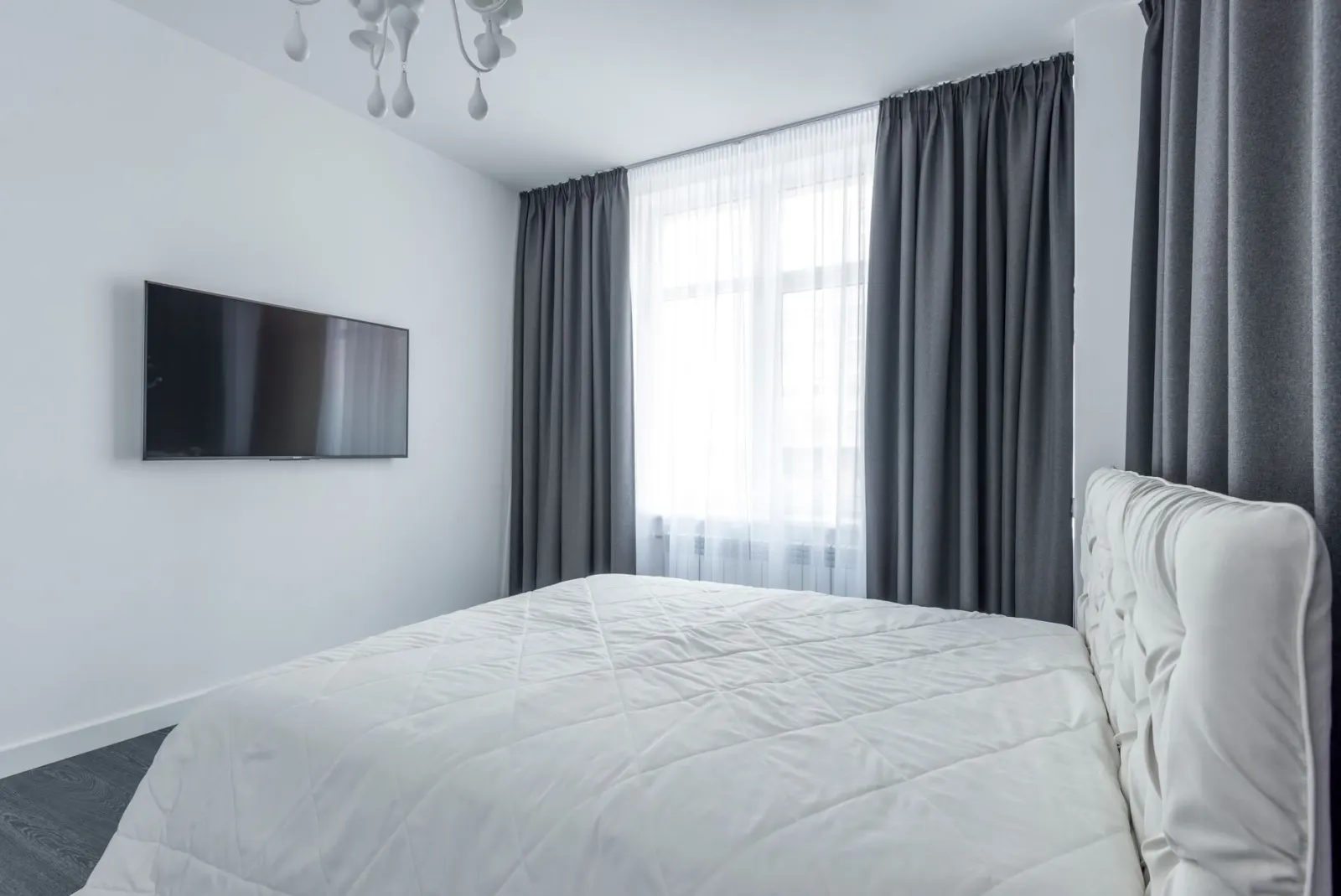 Types of Curtain Hooks and Which Your Track Needs
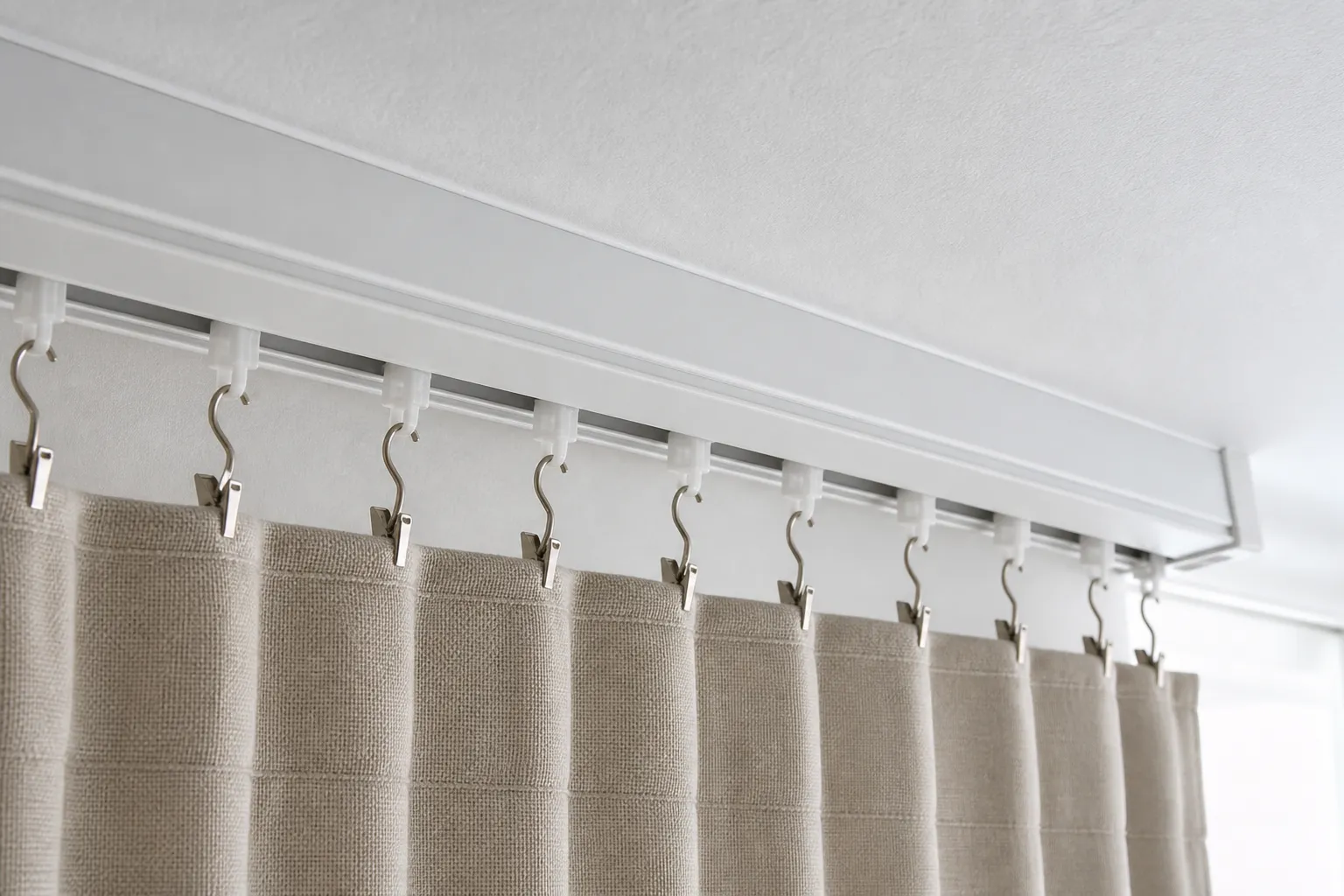 How to Choose a Curtain Track in Singapore