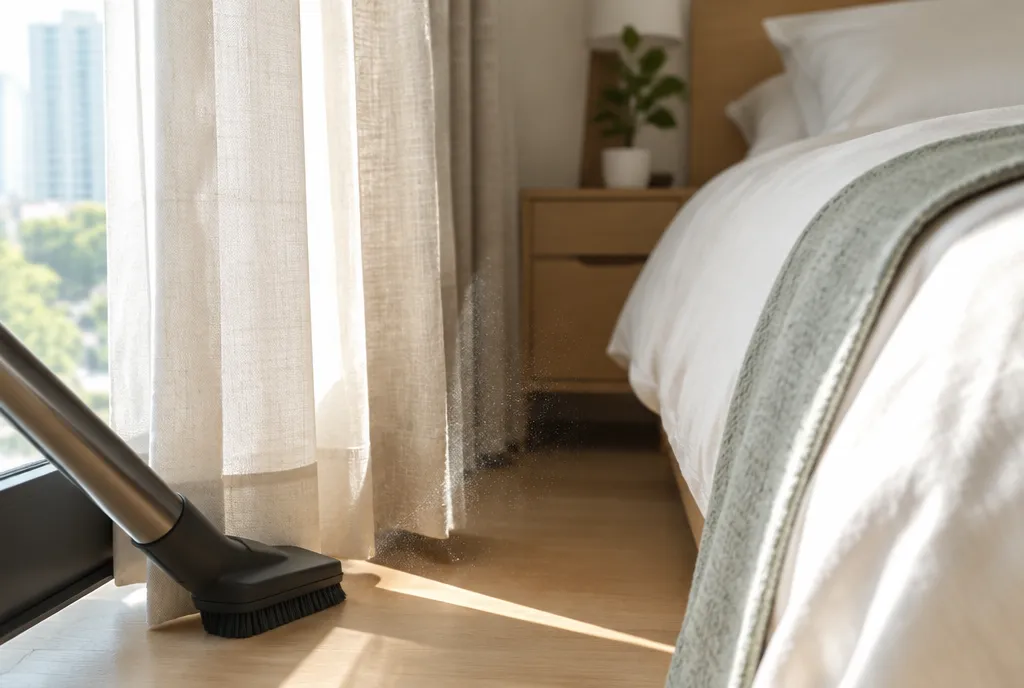
If you wake up with a blocked nose or itchy eyes that ease once you leave the bedroom, the room itself may be part of the cause. Curtains and blinds are among the largest fabric and dust-catching surfaces in a home, and in Singapore’s warm, humid climate they can hold dust mites and mould spores as well as ordinary dust.
That does not mean you need to remove them. It means choosing coverings that are easy to clean and keeping to a routine. This guide is general advice for the home. For allergy symptoms that persist, see a doctor.
Why curtains collect allergens
- Dust settles on fabric. Heavy, textured or pleated curtains have more surface and more folds for dust to sit in.
- Dust mites like warm, humid fabric. They feed on skin flakes and thrive in humid conditions. Curtains in a bedroom sit close to where people sleep.
- Damp fabric grows mould. Curtains near cold, wet glass after aircon can grow mould, and the spores can irritate airways. Our guide on curtain mould explains how this starts.
- Curtains are washed rarely. Bedding gets washed weekly. Curtains often go months or years without a clean.
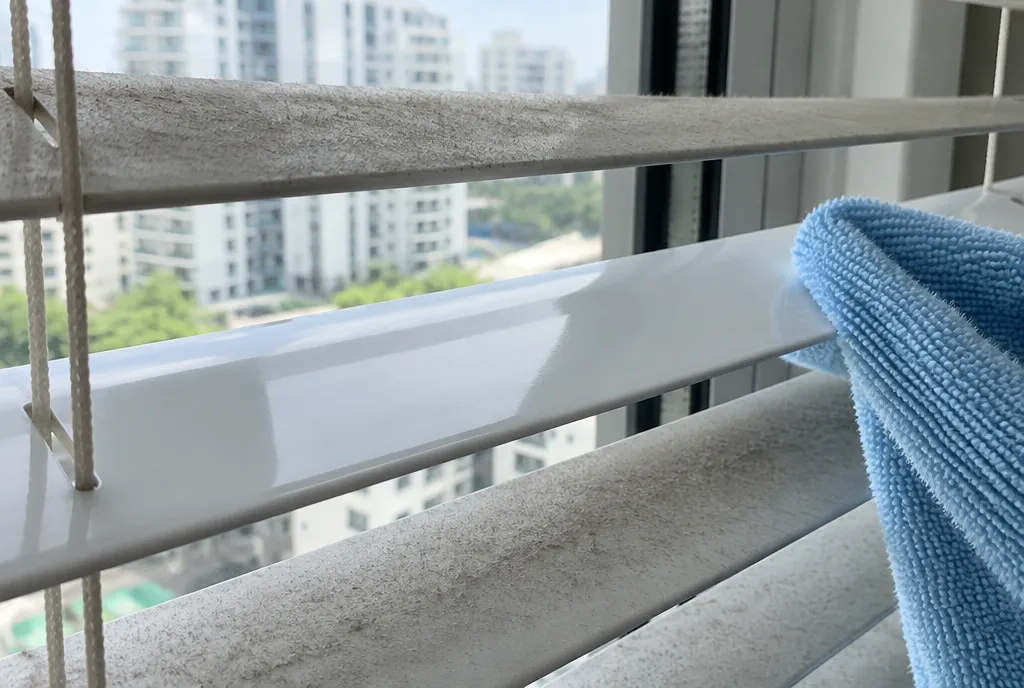
What is the black dust on blinds?
The grey or black film on blinds, especially near windows facing a road, is usually a mix of household dust, outdoor grime and soot from traffic, and sometimes cooking grease in rooms near the kitchen. If it is fuzzy or forms spots rather than an even film, it may be mould. Either way, clean it off, since it is easily disturbed into the air whenever the blind moves. Our guide on how to clean blinds covers each type.
Curtains or blinds for allergy sufferers?
Neither is perfect. Here is how they compare.
| Curtains | Blinds | |
|---|---|---|
| Surface for dust | Large, with folds | Smaller, flatter |
| Routine cleaning | Vacuum, then wash or professional clean | Wipe or vacuum in place |
| Deep cleaning | Take down and wash, or steam or dry clean | Wipe slats or spot clean fabric |
| Best types for allergies | Lightweight, washable polyester; simple headings | Aluminium or PVC Venetian, plain roller blinds |
| Harder types | Heavy velvet, chenille, deep pleats, dry-clean only | Fabric Roman blinds, Korean combi blinds with two layers |
For someone with dust allergies, blinds with smooth surfaces are usually easier to keep clean. Aluminium Venetian blinds and plain polyester roller blinds can be wiped down in place. If you prefer the look and softness of curtains, choose a washable fabric with a simple heading, such as an S-fold or ripple fold, which hangs in even waves without deep pleats. Our guide to curtain fabrics explains which fabrics wash well.
Are there anti-allergy curtains?
Some fabrics are sold with anti-dust or anti-mite finishes. These may help a little, but no finish replaces cleaning. In practice, the features that matter most are:
- a fabric that can be machine washed or easily steam cleaned
- a smooth weave rather than a heavy pile
- a detachable lining, so each layer can be washed and dried properly
- a hem that clears the floor, so it does not pick up dust from the floor
- a track that lets the curtain hang away from the glass, reducing condensation and mould

A cleaning routine for allergy sufferers
Little and often works better than a big clean once a year.
Weekly
- Vacuum curtains top to bottom with a brush attachment, on low suction.
- Wipe or dust blinds with a microfibre cloth or slat duster. Close the slats one way, wipe, then the other way.
- Open curtains and blinds fully each morning and air the room after aircon.
Every month or two
- Vacuum both sides of curtains, including the lining and the folds at each end.
- Wipe each blind slat with a damp cloth, or spot clean fabric blinds.
- Wipe the window sill and track, where dust gathers.
Every few months
- Wash curtains that can be washed, following the care label. Our guide on how to wash curtains covers each fabric.
- Dry them quickly and fully before rehanging, so they do not develop mildew.
- For heavy or dry-clean-only curtains, book a professional clean.
Tips while cleaning
- Wear a mask if dust sets off your symptoms, and open the windows.
- Use a vacuum with a good filter so dust is not blown back into the room.
- Clean from the top down, then vacuum the floor last.
When to call a professional
If your curtains are heavy, lined, very large or dry-clean only, cleaning them properly at home is difficult. Our curtain cleaning service offers on-site steam cleaning, dry cleaning and washing, and we can take curtains down and rehang them so you do not have to handle dusty fabric yourself. If you are replacing curtains, we supply made-to-measure curtains in washable fabrics with a hem that clears the floor, and blinds with smooth surfaces that wipe clean.
Common questions
Are curtains bad for allergies?
Curtains collect dust and can hold dust mites, which can bother people with allergies. Washable fabrics, regular vacuuming and a wash or professional clean every few months keep them manageable.
Are blinds better than curtains for dust allergies?
Smooth blinds such as aluminium Venetian or plain roller blinds are easier to wipe clean in place, so many allergy sufferers find them easier to live with. Fabric Roman and combi blinds hold more dust.
How often should I clean curtains if I have allergies?
Vacuum them weekly and wash them, or have them professionally cleaned, every few months. Bedroom curtains matter most because they are close to where you sleep.
Do blackout curtains hold more dust?
Not necessarily, but heavy blackout curtains are harder to wash at home and are often cleaned less, so dust builds up. Choose a blackout fabric that can be washed, or a detachable blackout lining.
 Blind Cord Safety: Making Blinds Safer for Young Children
 How to Stop Light Leaking Around Blackout Curtains
 Curtain Rod Sagging, Track Stuck and Broken Blinds: Common Faults and Fixes