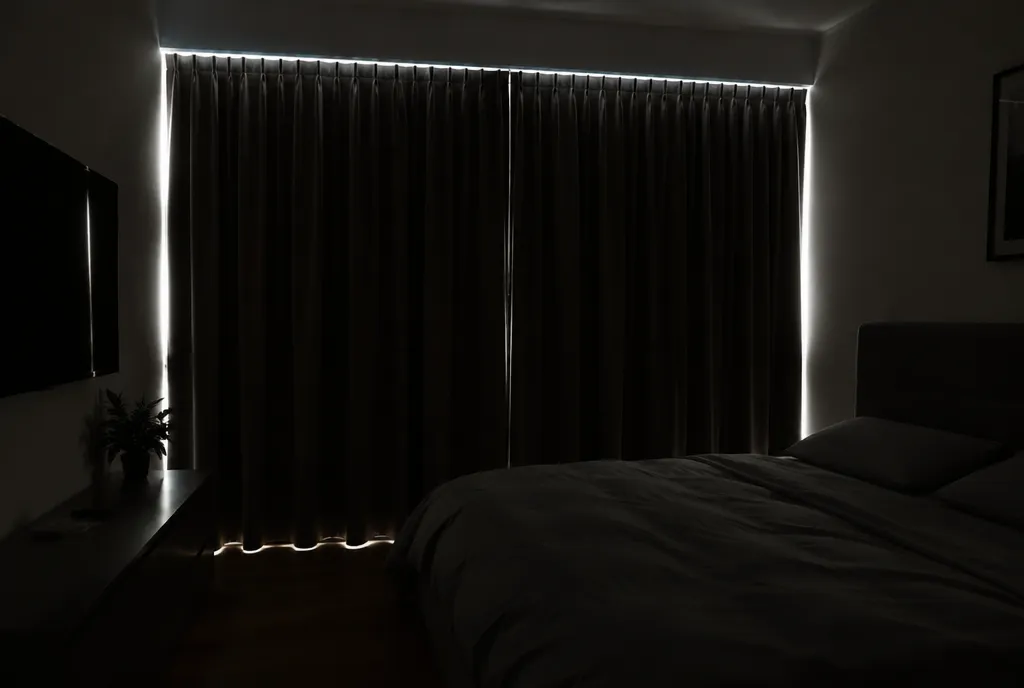
You bought blackout curtains so the bedroom would be dark, and the fabric does block light. But there is a bright line along the top, a glow down each side and a stripe in the middle where the panels meet. In the early morning, that is often enough to wake a light sleeper or a child.
Light leaks almost always come from how the curtains are hung rather than from the fabric. That means they can usually be fixed. Here is how, gap by gap.
First, check the fabric itself. Hold the curtain up to a bright window. If light shows through the cloth, it is dim-out rather than blackout, and no amount of fitting will make the room fully dark. Our guide on blackout vs dim-out curtains explains the difference, and the blackout or dim-out quiz helps you decide.
Light leaking at the top
Light spills over the top when the track or rod sits below the ceiling and the heading stands away from the wall.
- Move to a ceiling-mounted track. A track fixed to the ceiling leaves no gap above the curtain for light to pass. This is the most effective fix for the top.
- If the track must stay on the wall, mount it as close to the ceiling as possible and well above the window frame, so the light from the gap is above the glass.
- Add a pelmet or curtain box. A pelmet covers the top of the track and the heading, blocking light that rises over it. Our guide on curtain pelmets covers the options for HDB and condo homes.
- Check the heading. On rods with eyelets or rings, light passes between the rings. A track with a pleated or ripple fold heading sits tighter.
Light leaking at the sides
Side leaks happen when the curtain is no wider than the window, or when it stands out from the wall and light escapes sideways.
- Extend the track past the window. The track should run at least 15 to 20cm beyond each side of the frame, so the curtain covers the wall around the window as well as the glass.
- Add returns. A return wraps the outer edge of the curtain back to the wall, closing the side gap. Many tracks have end brackets or return fittings for this. On rods, a small hook or magnet on the wall can hold the edge back.
- Use enough fullness. A curtain stretched flat pulls away from the edges. Proper fullness lets it sit closed without strain.
- For windows in a recess, a curtain can cover the recess and the wall around it rather than fitting inside.
Light leaking in the middle
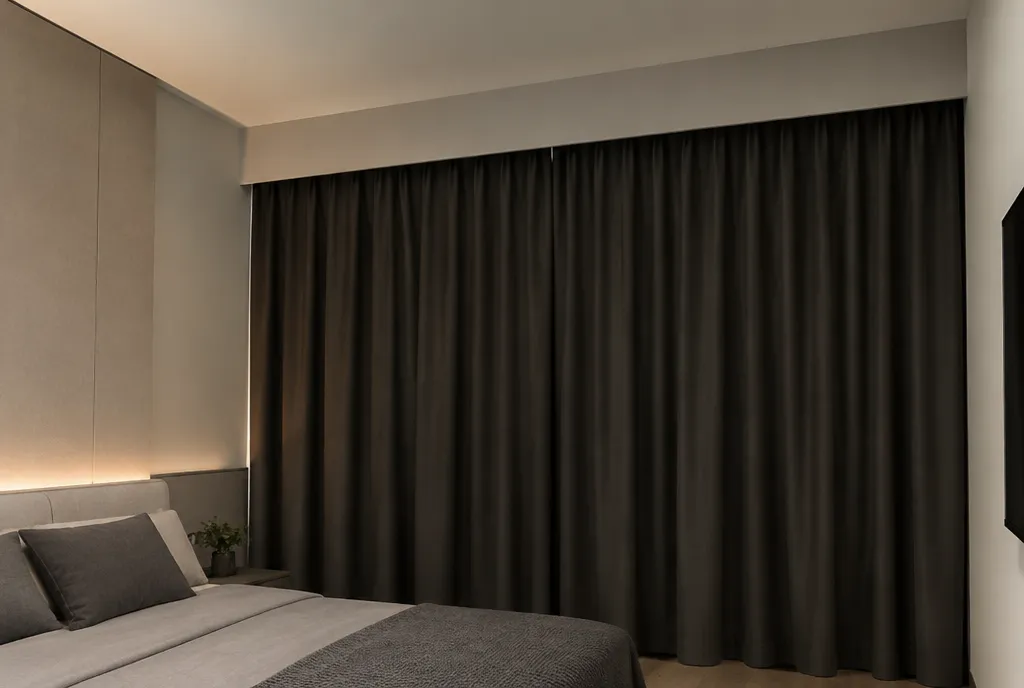
The gap where two panels meet is the most common complaint.
- Overlap the panels. On a track, an overlap arm or overlapping master carriers let one panel cross in front of the other at the centre. On a rod, adding a little more width to each panel lets them overlap.
- Add magnets. Small magnets sewn into the leading edges pull the panels together when closed.
- Consider a single panel drawing one way, if the window and furniture allow. There is then no centre gap.
- Close the curtains fully. It sounds obvious, but cord-drawn and motorised tracks often stop short if they are not adjusted.
Light leaking at the bottom
Light below the hem is usually a reflection off the floor or sill.
- Choose a floor-length curtain that finishes about 1cm above the floor, rather than a sill-length one.
- For sill-length curtains, make sure the hem falls well below the sill.
Add a blackout blind behind the curtain
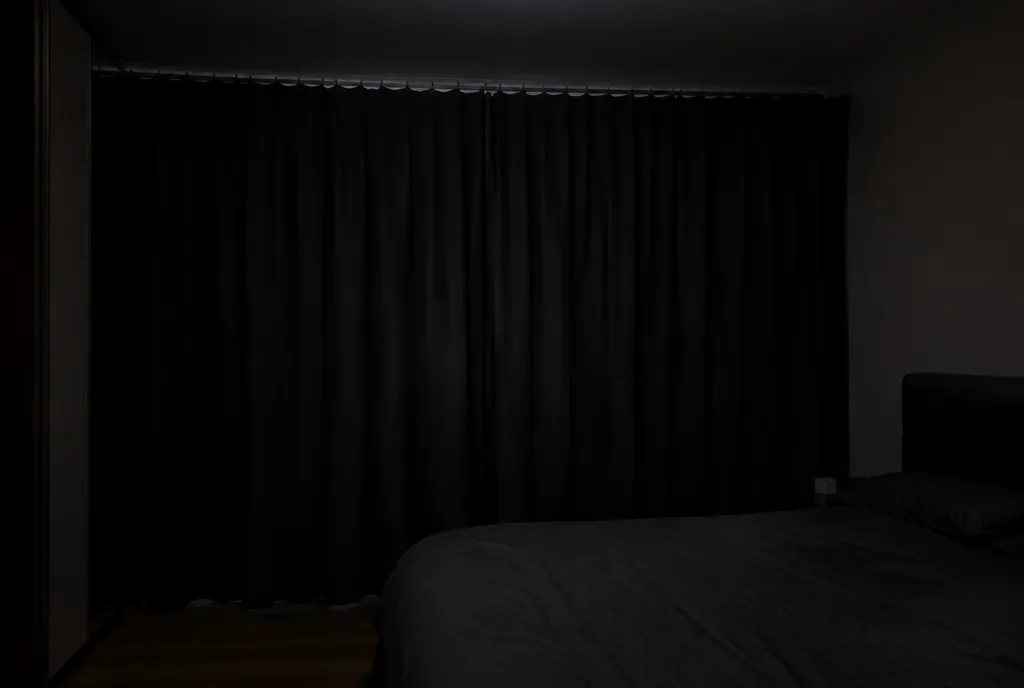
For a fully dark room, the most reliable setup is two layers: a blackout roller blind close to the glass, and blackout curtains in front. The blind stops most of the light at the window, and the curtain covers the edges of the blind. This suits bedrooms for shift workers, babies and anyone sensitive to early light. Our comparison of blackout blinds and blackout curtains explains how each performs alone.
When to call a professional
Most fixes involve moving or changing the track, adding returns or overlap, or adding a layer, which is easier to get right with the right fittings. Our installation service fits ceiling and wall tracks with the fittings each window needs. If your curtains are too narrow or short to overlap or reach the floor, new blackout curtains can be made to your track width and drop, and we can add a blackout roller blind behind them. We bring samples to a home measuring visit so you can see the fabric against your window.
Common questions
Why do my blackout curtains let light in?
Usually through gaps at the top, sides and middle, not through the fabric. A ceiling track, a wider track with returns, and overlapping panels close those gaps.
How do I stop light coming through the top of my curtains?
Mount the track on the ceiling or as high as possible, or add a pelmet over the track. On rods with rings, switching to a track with a tighter heading also helps.
How much should curtain panels overlap in the middle?
Enough to cover the gap fully when closed. An overlap arm or overlapping carriers on a track, or a little extra width on each panel, does this.
Is a blackout blind better than a blackout curtain?
A blind sits close to the glass but often leaks light at its edges. A curtain covers more of the wall but can leak at the top and middle. Together they give the darkest room.
 Blind Cord Safety: Making Blinds Safer for Young Children
 Curtain Rod Sagging, Track Stuck and Broken Blinds: Common Faults and Fixes
 Are Curtains Bad for Allergies? Dust Mites, Blinds and Cleaning Routines