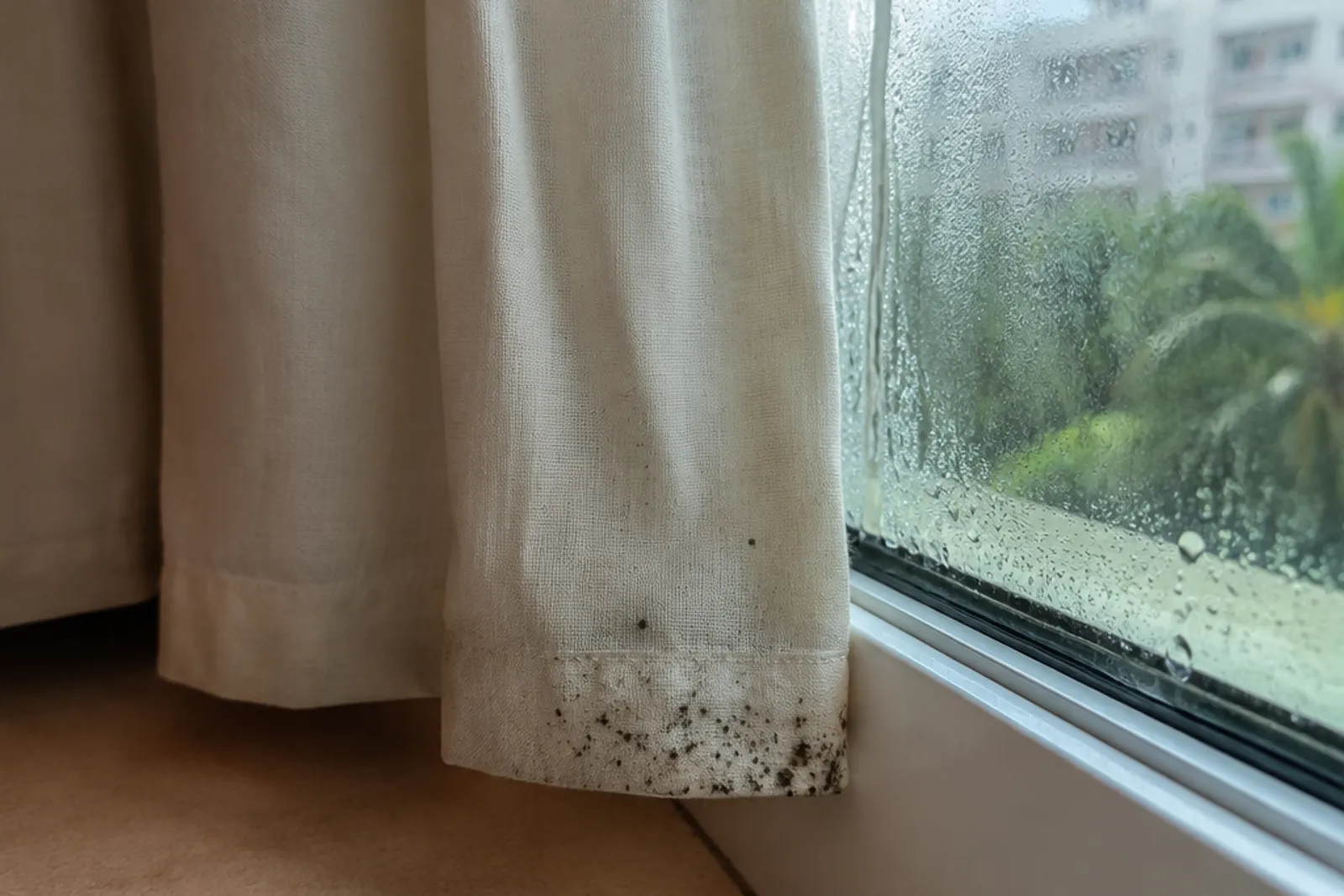
You draw back the bedroom curtains one morning and notice a cluster of small black dots along the bottom hem, or a grey patch on the lining where the fabric meets the window. Sometimes there is a musty smell before you see anything. Mould on curtains is a common problem in Singapore homes, and it usually has a clear cause. Once you know where the damp is coming from, you can clean what is there and stop it coming back.
Why mould grows on curtains in Singapore
Mould needs moisture, something to feed on and still air. A curtain can supply all three. Fabric absorbs moisture from the air, dust and skin oils that settle on it give mould spores something to feed on, and the folds behind a drawn curtain trap air that barely moves.
Singapore’s climate makes the moisture part easy. The Meteorological Service Singapore puts mean annual relative humidity at around 82%. That figure describes outdoor air, and conditions inside your flat depend on ventilation and aircon use, but it explains why fabric near an open window rarely dries out fully on its own. When a curtain stays damp for days at a time, spores that land on it have time to grow.
Mould usually appears in the same few places. Look along the bottom hem, on the back of the curtain or its lining where it faces the glass, and in the folds that stay bunched together when the curtain is drawn back. These are the parts that stay damp longest and get the least air.
Condensation from aircon on the glass and frame
Aircon is one of the common causes in bedrooms. If the aircon runs overnight, the window glass, the frame and the curtain itself cool down. In the morning, when the aircon goes off and the window is opened, warm humid air comes into contact with those cool surfaces, and moisture can settle on them. If the curtain is pressed against the glass or hangs close to it, the fabric takes up that moisture.
Condensation can also form on the outside face of cold glass and run down to the frame and sill. If water collects in the sill track and the curtain touches it, the hem stays wet.
A few changes help.
- Leave a small gap between the curtain and the glass. A track mounted further from the window, or a pelmet that brings the curtain forward, keeps the fabric off the glass. Our guide to curtain pelmets explains how this works.
- After switching off the aircon, open the curtains and the window for a while so the room and the fabric can dry.
- Wipe condensation off the glass and sill when you see it, especially on windows that face west and heat up quickly in the afternoon after a cool night.
- Check that the aircon unit is not dripping or blowing directly onto the curtain.
Hems that touch the sill or floor
A hem that rests on the floor or sits on a window sill is the most common place for black spots. In an HDB flat, floors are often mopped daily, and the bottom of a puddled curtain soaks up some of that water each time. On a sill, rain can blow in through an open window during the wetter monsoon months, and a curtain resting there absorbs it.
For floor-length curtains, a hem that clears the floor by a small margin stays dry during mopping and still looks finished. For a window that stops above a sill, the curtain should end just above the sill or extend clearly past it, rather than resting on it. If you are replacing curtains anyway, getting the drop right is one reason to consider made-to-measure curtains, since the length is cut to your floor or sill height.
Blackout curtains and their coating
Blackout curtains need extra care. Many blackout fabrics have a coated backing, often a layer of acrylic foam, on the side facing the window. That backing sits closest to the glass and its condensation, and it does not breathe as well as an open-weave fabric, so moisture can stay trapped against it.
Mould on a coated backing is harder to remove than mould on plain fabric. Scrubbing can damage the coating, bleach can break it down, and a hot wash or a tumble dryer can make it crack or peel. Once the coating is cracked, mould can settle into the cracks, and the curtain also lets light through where the coating has come away.
If you have blackout curtains on a window that gets condensation, a separate blackout lining that can be detached and washed on its own is easier to maintain than a single coated fabric. Our page on blackout curtains covers the options, and our guide to blackout vs dim-out curtains explains the difference between the two.
What causes mould and how to fix it
| Cause | What you notice | What to change |
|---|---|---|
| Condensation after aircon | Spots on the back of the curtain or lining, near the glass | Air the room after aircon, keep fabric off the glass, wipe the sill |
| Hem touching a wet floor | Black spots along the bottom edge | Shorten the hem so it clears the floor |
| Hem resting on the sill | Spots and a tide mark where the curtain meets the sill | End the curtain above the sill or past it, close windows in heavy rain |
| Folds left bunched for days | Grey patches inside the folds, musty smell | Open and close the curtains daily so the folds dry |
| Dirty fabric | Dull, grey film that spreads over time | Wash or clean the curtains on a regular schedule |
| Coated blackout backing | Spots or cracks in the backing | Clean gently, avoid heat and bleach, consider a detachable lining |
| Poor ventilation | Mould on several curtains in the same room | Open windows, run a fan or dehumidifier, keep furniture off the curtains |
How to remove mould from curtains safely
Start by checking the care label. It tells you whether the curtain can be machine washed, hand washed or needs dry cleaning, and what water temperature the fabric can take. If the label says dry clean only, or if the curtain has a coated backing, it is safer to have it cleaned professionally than to experiment at home.
For curtains that can be washed, these steps work for light spotting.
- Take the curtains down and brush off loose mould outdoors or on the balcony, so the spores do not spread inside the flat. Wear gloves and a mask while you do this.
- Test any cleaning solution on a hidden area first, such as the inside of a hem, and wait for it to dry before checking for fading or damage.
- Soak the affected area in a solution suited to the fabric. Diluted white vinegar or an oxygen-based stain remover is gentler on coloured fabrics than chlorine bleach.
- Wash according to the care label, using the warmest water the fabric allows.
- Dry the curtains completely before rehanging them (see the next section).
Chlorine bleach removes mould stains from white cotton or polyester that can tolerate it, but it fades coloured fabric and weakens some fibres. Use it only if the care label allows it, diluted as the bottle directs, in a ventilated space. Never mix bleach with vinegar, ammonia or other cleaning products, because the combination can release harmful gas. Use one product, rinse it out fully, and only then try another if you need to.
Deep black staining that has been there for months may not come out completely, even when the mould itself is dead. Our guide on how to wash curtains covers washing and steaming for different fabrics in more detail.
Washing and drying properly
A curtain that is put back up while still damp can grow mould again within days. In Singapore, a heavy curtain dried indoors in a closed room can stay damp in the folds for a long time.
Dry curtains in moving air. Hanging them in the sun on a dry day, or on a rack near an open window with a fan running, is better than drying them folded over a chair. Lined and blackout curtains take longer than sheers, so feel the seams and the hem, which dry last, before rehanging. Avoid the tumble dryer for blackout curtains and for any fabric whose label says not to.
How often you wash depends on the room. Curtains in a bedroom with aircon, a kitchen or a room near the bathroom benefit from a wash or a professional clean every few months, with a vacuum using a brush attachment in between to remove dust. Natural fabrics such as linen absorb more moisture than polyester, which our guide on linen curtains in Singapore humidity explains.
Ventilation and daily habits
Preventing curtain mould is mainly about letting the fabric dry every day.
- Open the curtains fully each morning so the folds spread out.
- Open the windows when the weather allows, especially after a night of aircon.
- Run a fan or a dehumidifier in rooms that stay closed, such as a spare bedroom or a study.
- Keep beds, sofas and wardrobes a little away from the curtains so air can move behind them.
- Close windows during heavy rain so the sill and hem stay dry.
If the room is damp for other reasons, such as a leaking window frame, water seeping in around a bay window or a damp wall, fix that first. Cleaning the curtains will not help for long while the source of the moisture remains.
When to replace mouldy curtains
Cleaning works well on light, recent spotting. Replacement makes more sense when:
- black staining remains after two careful cleans
- the musty smell returns within a few weeks of washing
- the blackout coating has cracked or is peeling, with mould in the cracks
- the fabric has thinned, torn or lost its shape from repeated treatment
- the curtain is too short and keeps sitting on a wet sill
If you replace them, choose a fabric and length that suit the room. A polyester fabric with a detachable lining is easier to keep dry than a heavy coated curtain, and a hem that clears the floor or sill removes the most common cause.
Professional curtain cleaning
Some curtains are hard to clean at home. Large or heavy curtains, blackout curtains, dry-clean-only fabrics and curtains on high windows can be difficult to take down, wash and dry properly in a flat. Our curtain cleaning service cleans curtains on site, or takes them away for cleaning and rehangs them afterwards. If mould keeps returning on the same window, we can also look at the track position, the drop and the fabric during the visit.
Common questions
What are the black spots on my curtains?
Small black or grey dots on a curtain are usually mould. They tend to appear along the hem, on the back of the curtain facing the glass, and in folds that stay bunched. A musty smell near the window is another sign.
Can mould on curtains be removed completely?
Light, recent mould can usually be removed with a wash suited to the fabric. Older, deep black stains may fade but not disappear, even after the mould is killed. If the stains or smell remain after two careful cleans, replacing the curtain is often the better option.
Is it safe to use bleach on mouldy curtains?
Only on white fabrics whose care label allows bleach, diluted as directed and in a ventilated space. Test it on a hidden area first. Never mix bleach with vinegar, ammonia or other cleaners, and avoid it on blackout curtains, since it can damage the coating.
Why do my blackout curtains get mouldy faster?
The coated backing on many blackout curtains sits next to the glass, where condensation forms, and it does not let moisture escape easily. Mould that settles on the coating is also harder to clean without damaging it. Keeping the curtain off the glass and airing the room after aircon both help.
How do I stop mould coming back on my curtains?
Keep the hem off wet floors and sills, open the curtains and windows after running the aircon, and dry the curtains fully after every wash. Run a fan or dehumidifier in rooms that stay closed. Washing or cleaning the curtains every few months also removes the dust that mould feeds on.
 How to Clean Blinds in Singapore: Venetian, Roller and Korean Combi
 12 Curtain Mistakes Singapore Homeowners Make (and How to Avoid Them)
 8 Kitchen Window Ideas for HDB and Condo Kitchens