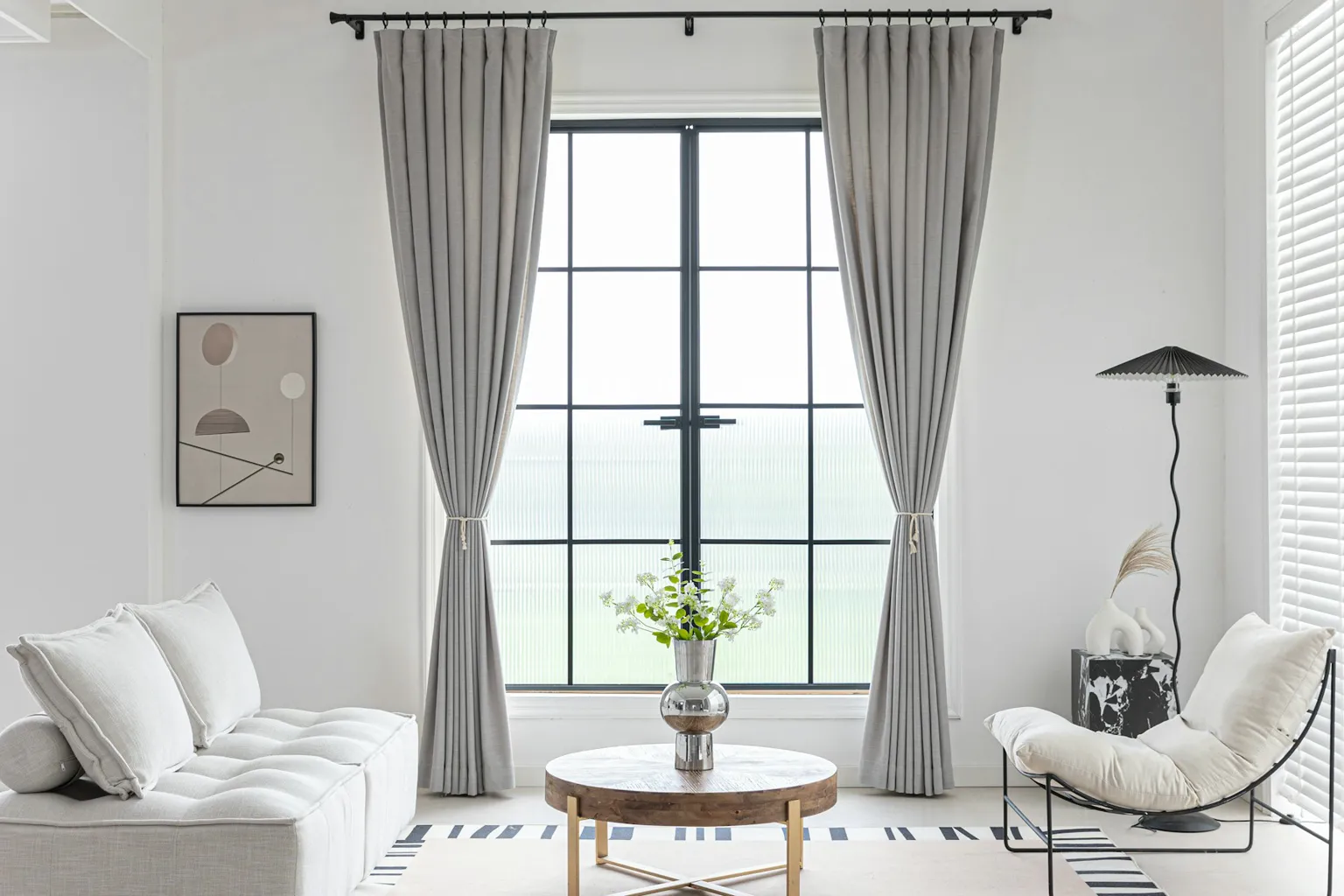
Most made-to-measure curtains in Singapore homes finish about 1cm above the floor. That length hangs straight, looks tidy and stays clear of dust and the mop. Short curtains that stop at the window sill still have a place, mainly in kitchens, above beds or desks, and on windows with a ledge or cabinet underneath. The right length depends on the window, what sits below it and how the room is cleaned.
This guide covers the five common curtain lengths, which rooms suit each one, and how to measure the drop so the curtains come out the length you expect. To work out your own drop, use the curtain length calculator.
The five curtain lengths
| Length | Where the hem stops | Suits |
|---|---|---|
| Sill length | About 1cm above the window sill | Kitchens, windows over a counter or ledge |
| Below sill | About 15cm under the sill | Bedrooms and studies with a bed or desk under the window |
| Floor length | About 1cm above the floor | Living rooms, bedrooms, most full windows |
| Touching the floor | Just touching | A soft, tailored look in rooms with little foot traffic |
| Floor-to-ceiling | From a ceiling track to just above the floor | Condo glass, sliding doors, making a room look taller |
Sill-length curtains (short curtains)
Short curtains stop just above the sill. They keep fabric away from a sink, stove, counter or window ledge, and they do not drag on furniture placed under the window. In Singapore flats they are most common in kitchens and service yards, though many owners now choose a kitchen blind instead because it wipes clean. Our guide to kitchen curtains covers what works near water and heat.
Short curtains look best on small windows. On a large living room window they can make the window look cut off.
Below-sill curtains
Below-sill curtains end about 15cm under the sill. They cover the edge of the window frame, which blocks more light and draught than a sill-length curtain, while still clearing a low bed, sofa back or desk. They suit bedrooms where a bed sits against the window wall.
Floor-length curtains
Floor-length curtains finish about 1cm above the floor. This is the default for living rooms and bedrooms in HDB flats and condos, because it covers the whole window, frames it properly and makes the ceiling look higher. Leaving that small gap means the curtain hangs straight even where the floor is slightly uneven, and the hem does not pick up dust or get wet when you mop.
Curtains that touch or pool on the floor
A curtain that just touches the floor, or “breaks” onto it, gives a softer, more tailored look. It suits a formal living room or a bedroom with little traffic. In humid Singapore flats the hem collects dust and can stay damp after mopping, so many owners choose 1cm above the floor instead. Pooling curtains, with extra fabric lying on the floor, are rare here for the same reason.
Floor-to-ceiling curtains
Floor-to-ceiling curtains hang from a track fixed to the ceiling, or inside a curtain box, and run down to just above the floor. They hide the top of the window frame, stop light leaking over the top and make the wall look taller. They are the usual choice for condo floor-to-ceiling glass, balcony sliding doors and any room where you want the window to look bigger than it is. See our guide to curtain pelmets and curtain boxes if your ID is building a box for the track.
Which length for each room
| Room | Usual length | Why |
|---|---|---|
| Living room | Floor length or floor-to-ceiling | Covers the full window and sliding door, looks finished |
| Master bedroom | Floor length, often blackout | Best darkness, covers light leaks at the frame |
| Kids’ room | Floor length, or below sill over a bed | Safer to keep cords and hems away from small children |
| Study | Below sill, or a blind | Keeps fabric off the desk |
| Kitchen | Sill length, or a blind | Keeps fabric away from the stove and sink |
| Bathroom and yard | A blind | Fabric stays damp |
Our room-by-room guides go further for each space, and the curtain or blind finder suggests a curtain or blind for a single window.
How to measure the curtain drop
The drop is the finished length from the top of the curtain to the hem.
- Measure from where the curtain will hang. That is the track or rod, or the ceiling if you are fitting a ceiling track. Measuring from the top of the window frame gives a curtain that is too short once the track goes higher.
- Measure to where the hem should stop. The floor, the sill or 15cm below the sill.
- Measure at three points. Take the drop at the left, middle and right, and use the shortest figure. Floors and ceilings in many flats are not perfectly level.
- Allow for the hooks and gliders. The curtain sits slightly below the track, so the maker takes a small amount off the measured drop.
- Measure after renovation. New flooring, skirting or a false ceiling changes the drop. Curtains measured before carpentry and flooring are finished often come out the wrong length.
Our full guide on how to measure windows for made-to-measure curtains covers width and fullness too. If you would rather not measure, we measure at your home and bring samples; the visit needs a $50 deposit, credited to your order.
Short or long: common mistakes
Hanging a short curtain on a large window. It makes the window look smaller. If something blocks a floor-length curtain, a blind in the recess usually looks better than a short curtain.
Mounting the track just above the frame. Raising the track towards the ceiling, with floor-length curtains, makes the room look taller and stops light spilling over the top.
Ordering the drop from the window size. Always measure from the track position, not the glass.
Curtains that drag. A hem that drags gets dirty and wears out. If curtains are a few centimetres too long, a curtain maker can usually take the hem up.
Ready-made curtains come in fixed drops, so they are often too long or too short for Singapore ceilings. Our comparison of ready-made and made-to-measure curtains explains when each makes sense.
Common questions
How long should curtains be?
Most curtains in Singapore homes finish about 1cm above the floor. Sill-length or below-sill curtains suit kitchens, studies and windows above furniture.
Should curtains touch the floor?
They can, for a softer look, but a curtain on the floor picks up dust and damp from mopping. Finishing 1cm above the floor is easier to keep clean.
Are short curtains out of style?
Short curtains still suit small windows, kitchens and windows above a counter or bed. On large living room windows, floor-length curtains or a blind usually look better.
What length are floor-to-ceiling curtains?
They run from a ceiling track or curtain box to about 1cm above the floor, so the drop equals the ceiling height minus a small allowance for the track and hooks. Measure at three points and use the shortest.
Can I make long curtains shorter?
Usually yes. A curtain maker can shorten the hem, though curtains with a deep decorative hem or a lining need more work. Shortening a lot can change how the pleats sit.
 Blinds Prices in Singapore (2026): Roller, Korean Combi, Venetian and Zip Blinds
 Cheap Curtains in Singapore: How to Get Affordable Curtains That Still Fit
 Curtain Prices in Singapore (2026): What Curtains Cost per Window and per Flat