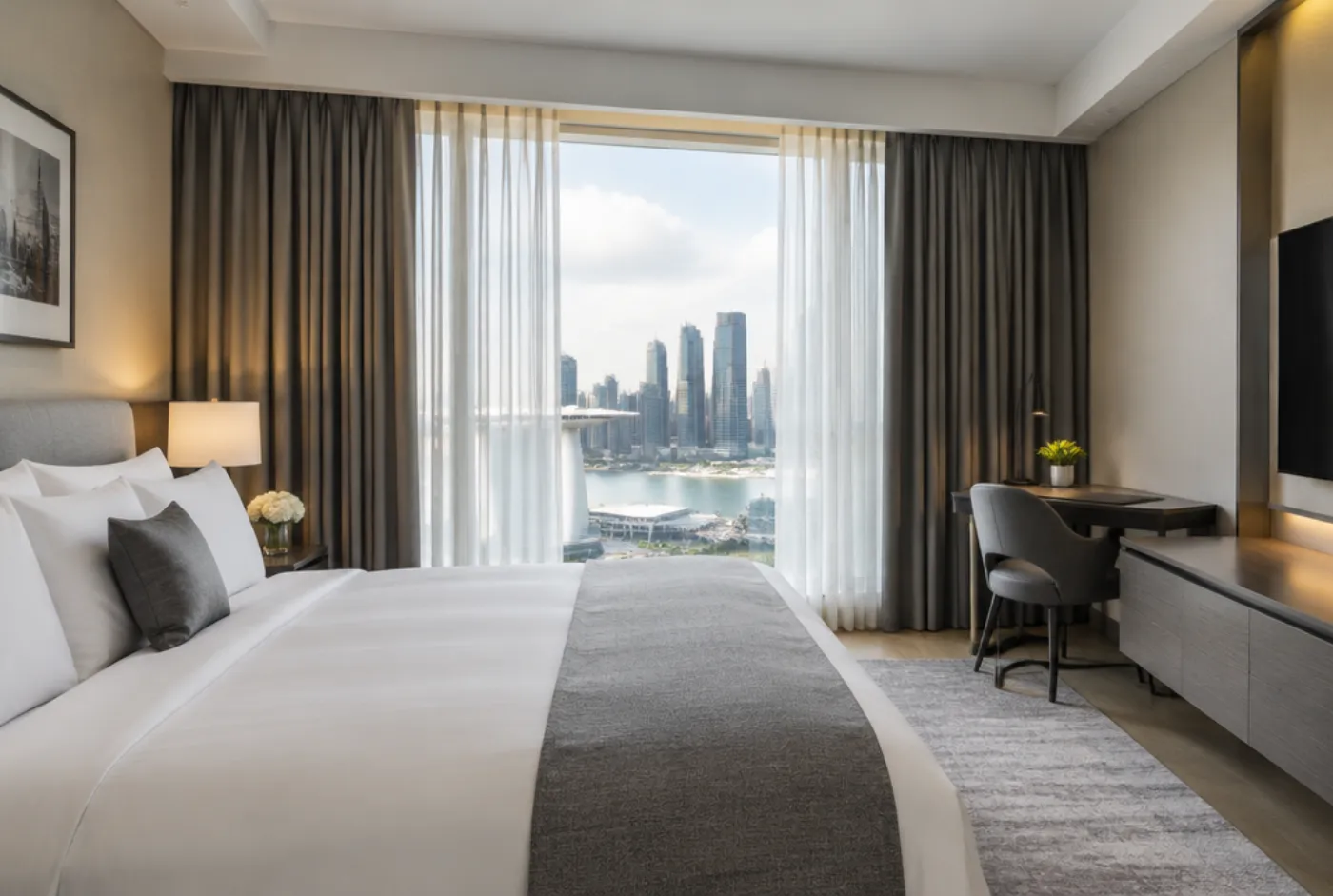
“Fire-retardant curtains” is not yet a product. A fit-out note that says FR, flame retardant or fire rated still needs a test name, a level, and whether the result has to survive washing. Start with who is asking. Then match the words they used.
This is about decorative and privacy curtains, window blinds and stage drapes. A fire shutter and a smoke curtain are different products. They are construction items under the Fire Code, not a pair of drapes. We do not sell those.
What we found in the Fire Code, and what we did not
We read the text of the Singapore Civil Defence Force Code of Practice for Fire Precautions in Buildings 2023, in the annotated full PDF SCDF hosts (the file named as current on 7 July 2026). In that text, “curtain” is used for curtain walls, for the leaves of fire shutters, and for smoke curtains. Smoke curtains are tied to standards such as BS 7346 and to SCDF’s Product Listing Scheme in the clauses we could search. We did not find the phrases BS 5867, NFPA 701, drapery, or a rule that ordinary window curtains in an office, shop or hotel must pass a named textile test.
A PDF text search can miss a figure or a scanned table. Treat this as a limit of that reading, not as legal advice that no requirement exists for your building. If a qualified person, a fire-safety engineer or the approved fire strategy for the project names a test, follow that. It can be stricter than the sentence we could find in the code.
Two other SCDF documents do mention drapes. Each has a narrow scope.
The fire safety requirements for amusement rides say the schedule applies to indoor and outdoor amusement rides. On loose components, the text says curtains, fabric banners or acoustic or black out materials “shall be tested to the standard NFPA 701”. That line is about amusement rides. It is not a rule we found for an office floor.
The Singapore Fire Safety Engineering Guidelines, 2nd edition (2025), Table 3.1, is about design-fire growth for performance-based fire engineering. For places of assembly it says that if there is no control on scenery and staging props, and the examples include “non fire-retardant drapes and curtains”, the stage is modelled with an ultrafast fire growth. That is an assumption for a fire-engineering model of a stage. It is not a product rule for a sunscreen blind in a meeting room. The PDF is on SCDF’s site.
Landlord house rules, hotel brand standards, insurer conditions and tender specifications often ask for a test anyway. Those are contract requirements. Put the clause in the quotation. Do not replace it with the words “fire retardant”.
Tests people name
BS 5867-2:2008, from BSI, specifies flammability requirements for fabrics and fabric assemblies used to make non-domestic curtains, drapes and window blinds, and for finished articles including combinations of curtains and linings. BSI says they are tested by the methods in BS EN ISO 6941 and BS EN ISO 15025. The scope is non-domestic. It is a British specification. We did not find it written into the Fire Code as a blanket rule for Singapore buildings. The same BSI page says fabrics are tested before any cleansing procedure, to assess them in the form in which they are most commonly used, and that a multi-layer curtain has to be tested in the combination in which it will be used.
The specification has levels. SATRA, a UK test laboratory, explains in its note on curtain flammability testing that BS 5867-2:2008 describes types A, B and C, with A the least severe and C the most demanding, and that each type refers to a cleansing procedure because a finish can wash out. SATRA also says the standard is unclear on whether specimens must always be tested after cleansing, and that the laboratory’s own view is to test before and after. The BSI page’s “before cleansing” line and SATRA’s caution are both reasons to read the report, not the sales word. If your tender says “Type B” or “Type C”, copy that type onto the order. Do not let a supplier swap in a different type because both can be sold as fire retardant. We are not saying Singapore hotels must use Type B. That would be a UK trade habit, not a clause we found here.
NFPA 701, 2023 edition, “establishes test methods to assess the propagation of flame of various textiles and films under specified fire test conditions.” NFPA’s description of the standard also says it is used for hanging textiles such as curtains and window shades. It is a US test method. Passing it is what the amusement-ride schedule names. A report should state the method and the result for the cloth in the roll. We are not restating the pass criteria. Those belong in the standard you were asked to meet.
A certificate is for the construction that was tested. A heavier cloth, a lining added later, or a spray-on treatment that is not the one in the report, is a different product. Ask for the report that names the fabric, the standard, the date, and any wash or soak the specimens went through.
Where this comes up in a Singapore fit-out
Offices. Some landlords ask for a certificate, and some only ask for a facade colour. The office blinds guide already says to check with building management before you choose cloth. Bring the answer to the sample meeting.
Hotels and serviced apartments. Guest-room drapes are laundered. A finish that fails after washing is the wrong certificate even if the new cloth passed. The hotel curtains page says to send the operator’s requirement at the start. We confirm what we can supply against it before quoting.
Clinics. Cubicle curtains are washed often, and many have a mesh header so sprinklers are not blocked. That is described on the cubicle curtains page. A window blind in a consultation room is a separate line. Send any operator or insurer specification you have been given. We will not invent a healthcare standard.
Stages and school halls. Scenery and drapes are the case the fire-engineering guideline uses as an example. Stage curtains tells you to send the specification you were given. A school hall and a classroom are not the same request. Classroom cords are a child-safety question as well as a fire question. See blind cord safety.
Homes. The HDB rule we could quote is about the pelmet and the false ceiling being non-combustible carpentry, not about the curtain fabric. That is on the pelmet guide. Keep loose cloth away from a hob. The kitchen curtains guide covers that. We are not saying a bedroom curtain in an HDB flat must be sold as fire retardant.
What to send us
The clause, the landlord guide, or the tender paragraph, with the test name still attached. Say whether the cloth is a window curtain, a blind, a cubicle curtain or a stage drape. Say if it will be washed.
We will tell you whether we can supply against that specification before you order. This site does not claim a standing range of fire-retardant fabrics. The hotel, clinic and stage pages describe those products and still ask for your specification first. If the test is one we cannot meet, we will say so.
How to put the test into a fit-out specification, so a tender cannot be answered with the single word “comply”, is in how to specify contract curtains. The wider fit-out programme is in curtains and blinds in a commercial fit-out.
Common questions
Does the Singapore Fire Code require fire-retardant curtains?
In the Fire Code PDF we searched, we did not find a clause that requires ordinary window curtains to pass BS 5867 or NFPA 701. Amusement-ride rules do name NFPA 701 for loose curtains on rides. A stage in a performance-based design may be modelled differently if drapes are not controlled. Your project can still have a stricter requirement from a qualified person, a landlord or a tender. Ask them, and send us the words they used.
Is BS 5867 the same as NFPA 701?
No. BS 5867-2 is a British specification for the flammability of non-domestic curtain, drape and blind fabrics, with types A, B and C. NFPA 701 is a US test method for flame propagation of textiles and films. A report to one is not a report to the other. Order the one named in your specification.
Do home curtains need to be fire retardant?
We did not find a Fire Code clause that says so for ordinary HDB or condo curtains. HDB’s written condition on non-combustible material, in the building-works guidelines, applies to the false ceiling and the pelmet, not to the curtain cloth. Keep fabric away from a cooktop.
Can a lining be added later and keep the certificate?
Not by assumption. BSI’s scope for BS 5867-2 includes combinations of curtains and linings, and it says multi-layer constructions should be tested in the combination in which they will be used. Ask for a report on the layered cloth you will actually hang.
 Curtains and Blinds in a Commercial Fit-Out
 How to Specify Contract Curtains and Blinds
 Blinds for Offices in Singapore: Glare, Screens and Meeting Rooms