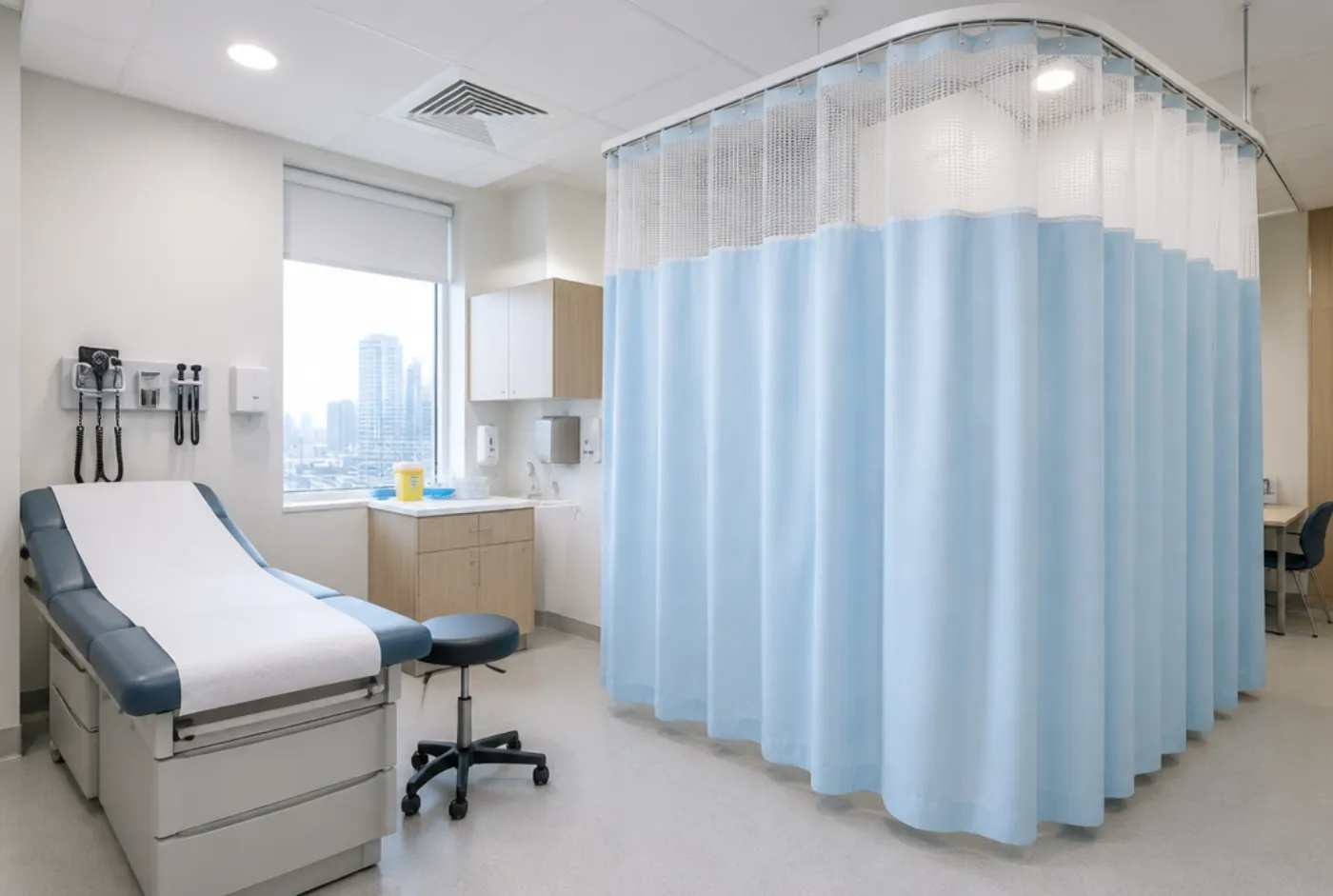
A clinic order is two products. One is the curtain around the couch, the dental chair or the changing space. The other is the blind on the window. They are cleaned differently, and a supplier who prices them as one line has not specified either.
This page is the list to put in front of any supplier. It is written for a GP, dental or aesthetic fit-out. It is not a claim that every clause below is mandatory for every one of those rooms. Two Ministry of Health documents set the questions. Ask the operator, and whoever is responsible for infection prevention on the project, which document that project is following.
The wider commercial range is on the commercial page. How to turn the answers into rows a tender can price is in how to specify contract curtains. If someone has written “fire retardant” on the drawing, read fire-retardant curtains before that word is copied onto the order.
Which document you are reading
The National Infection Prevention and Control Guidelines for Primary Care, 2022 are written for primary care. Section 7.14.6, Changing of Curtains, is the short operational rule.
The Infection Prevention and Control Specifications for New Healthcare Buildings, Revised 2024 are specifications for new healthcare buildings. Section 1.8, Finishes and curtains, is the design note. A shophouse clinic is not automatically a “new healthcare building” because it has a couch. A new build or a major healthcare renovation may be. Send the page your consultant marked, rather than assuming both apply, or that neither does.
Neither document, in the pages we read, states a fabric treatment, an antimicrobial coating, or a named disinfectant for curtain cloth. If a landlord, an operator or an insurer has a treatment in their own specification, ask them for the clause. Do not let a supplier invent one.
The change policy, before the cloth
Section 7.14.6 says there should be a schedule for the regular change of curtains used in the setting. Screen curtains should be changed immediately when visibly soiled. Alternatively, disposable curtains may be used.
Section 1.8 asks for a policy on changing privacy curtains, covering routine changing, curtains that become soiled, and the discharge of a patient with a known or suspected infectious disease that requires terminal cleaning. The example it gives is multi-drug resistant organisms.
Neither sentence states a number of weeks or months. Write the interval your infection-prevention lead sets. A brochure that says “change every three months” is not these documents. Put the policy in the specification so the fittings and the cloth can match it.
Ask the supplier three things in writing.
Whether a reusable curtain is specified to withstand healthcare laundering. Section 1.8 says that where reusable curtains apply, they should be able to withstand decontamination in healthcare laundering processes. Ask what wash or process that claim refers to, and who is expected to do the laundry. A cloth that cannot leave the track is the wrong cloth for a policy that says “change”.
Whether disposable curtains are what the operator has accepted. The primary care guideline names them as the alternative to a change schedule. Ask what is hung, how it is taken down, and how it is disposed of. Treat that as a question for the supplier you are comparing. Do not assume every workshop sells them.
Whether staff on duty can replace a soiled screen during a session. A fitting that needs a specialist to unhook will not meet a policy that says the curtain changes when it is soiled.
Fittings that come off
Section 1.8 says privacy curtains can be contaminated with microorganisms, which can then be transmitted to staff hands, and that curtains should have fittings that make them quick and convenient to replace.
Ask to see the hook, glider or tape on a sample, and ask how long a change takes with the tools the clinic actually has. “Quick-release” on a quotation is not a fitting until someone can take one panel off and put another on. Ask whether the track stays up and only the cloth leaves, and whether a mesh header is part of the cloth. A mesh header is a common cubicle detail so the ceiling is not fully blocked. If sprinklers sit above the track, ask the project’s fire consultant whether that header is required. We did not find that instruction in section 1.8.
On a new or renovated area, the same specifications say, at section 14.2.7, to thoroughly clean the new areas before installing furnishings, privacy curtains and clean supplies, and before permitting patient admission. Hang the curtains after that clean, not while the fit-out is still dusty.
Window blinds are a separate line
Section 1.8 says window blinds should be readily amenable to cleaning. It also recommends double-glazed room vision panels with integral blinds that are easy to clean. Those are the panels between rooms, not automatically the street window. If the drawings show a vision panel, ask whether the blind is inside the glass. A blind stuck to the face of the glass is a different product.
For the street or corridor window, ask whether the blind can be wiped in place with the cleaner the clinic already uses, and whether that cleaner is safe for the cloth. The specifications give sodium hypochlorite as an example for walls and floors that must withstand a hospital-approved disinfectant. They do not transfer that example to blinds. Do not write “bleach-proof” unless the supplier’s care note says so.
A roller in a smooth, wipeable cloth, or a venetian with slats that wipe, is the practical reading of “readily amenable to cleaning”. Ask for the care note with the sample. A fabric that has to be taken down and laundered like a privacy curtain will not be cleaned on a window-cleaning round.
What to send with the enquiry
Room names, a sketch of which curtains are screens and which are windows, the change policy or a note that you need help listing the questions, and any fire or landlord clause still attached. The specification guide is the row format. The fire guide is what to do with a test name.
WhatsApp +66 64 528 5763 or the contact page. We will tell you what we can supply against the note you send. If a line is a hospital cubicle track, a disposable curtain programme, or an antimicrobial cloth we have not been given a clause for, we will say so rather than treat it as a standard clinic blind.
Common questions
Do GP clinics have to follow the hospital building specifications?
The 2024 specifications are for new healthcare buildings. The 2022 guidelines are for primary care, and section 7.14.6 is the curtain-changing paragraph. A dental or aesthetic room should ask the operator which document the project is using. This page does not decide that.
How often must clinic curtains be changed?
Both documents ask for a schedule or a policy. Neither states a number of days or months. Screen curtains in the primary care guideline are changed immediately when visibly soiled, unless disposable curtains are used instead. The building specifications also cover a change after discharge of a patient who needs terminal cleaning. Write the interval your own lead sets.
Are disposable or antimicrobial curtains required?
The primary care guideline names disposable curtains as an alternative to a change schedule. It does not say they are mandatory. We did not find an antimicrobial or other fabric-treatment rule for curtains in the sections above. If your operator has one, send the clause and ask the supplier whether the cloth matches it.
What should a window blind in a clinic be able to do?
Section 1.8 says window blinds should be readily amenable to cleaning, and it recommends integral blinds in double-glazed vision panels where those panels are used. Ask for a blind that can be wiped on the clinic’s own cleaning round, and keep it as a separate line from the privacy curtain.
 How to Specify Contract Curtains and Blinds
 Fire-Retardant Curtains and Blinds for a Commercial Project
 Curtains and Blinds in a Commercial Fit-Out